.png)

What is an automatic watch? A complete guide for enthusiasts
- lewisvrichards3
- May 1
- 9 min read

TL;DR:
Automatic watches are powered by wrist movement using a rotor to wind the mainspring.
Winding efficiency varies between bidirectional and unidirectional rotor systems, affecting self-winding performance.
Proper maintenance and understanding movement features are essential for accurate timekeeping and preserving value.
Automatic watches occupy a peculiar place in the popular imagination. Many buyers assume they are self-sufficient, endlessly precise, and practically maintenance-free — a kind of mechanical perpetual motion on the wrist. The reality is far more interesting, and far more nuanced. Understanding how an automatic watch actually works, what it demands from its owner, and what genuinely separates one movement from another is the knowledge that transforms a casual purchase into a confident, well-informed collecting decision. Whether you are buying your first luxury timepiece or adding to an established collection, this guide cuts through the noise.
Table of Contents
Key Takeaways
Point | Details |
Automatics are self-winding | They use the wearer’s wrist movement to keep the mainspring wound and the watch running. |
Accuracy depends on movement | An automatic’s precision is tied to its escapement and regulation, not its self-winding feature. |
Maintenance is still crucial | Regular servicing and correct usage ensure the longevity and value of an automatic watch. |
Buying knowledge pays off | Understanding the engineering behind automatics can help you make better investment and collecting decisions. |
How does an automatic watch work?
With the foundation set, let’s clarify what sets automatic watches apart from other types.
An automatic watch, often called a self-winding watch, is a mechanical timepiece that harnesses the natural motion of your wrist to store energy. That energy is held in a coiled metal spring called the mainspring, which gradually releases tension to power the gear train, which in turn drives the hands. Unlike a quartz watch, there is no battery involved. Every beat of the movement, every tick you might hear or feel, is powered entirely by stored mechanical energy.
The three components that define an automatic are:
The mainspring: the energy source, wound tightly inside a barrel
The balance wheel: the timekeeping heart of the movement, oscillating back and forth at a fixed frequency (typically between 6 and 10 beats per second in modern Swiss watches)
The rotor: a semicircular weighted component that pivots freely and winds the mainspring as your wrist moves
The rotor is what distinguishes an automatic from a traditional manual-wind mechanical watch. When you move your wrist, the rotor spins, engaging a series of reversing mechanisms that transfer that motion into tension on the mainspring. This means the watch winds itself during normal wear, requiring no deliberate interaction in most circumstances. Automatic watches are mechanically different from quartz and often demand more interaction (wearing regularly or occasional manual winding) because they are powered by stored mechanical energy rather than a battery.
“An automatic movement is an exercise in miniaturised engineering. Every component, from the rotor to the escapement, must work in perfect concert. When it does, the result is a watch that lives and breathes with its owner.”
For enthusiasts, this mechanical intimacy is a large part of the appeal. There is something genuinely compelling about mechanical watch craftsmanship — the idea that a watch can run indefinitely, powered by nothing more than the motion of daily life, without ever needing a battery change.
Pro Tip: If you have just acquired a new automatic, wind it manually (via the crown) before wearing it for the first time. This ensures the mainspring is fully charged from the outset, rather than relying on wrist motion alone to build up the initial power reserve.
The engineering behind automatic winding
Having set the basics of what makes an automatic watch unique, now discover what’s inside the case and what that means for real-world use.

Not all automatic movements are created equal, and the differences in winding engineering have real consequences for daily wear. The central debate is between bidirectional and unidirectional rotor systems.
Rotor system | How it works | Efficiency | Common examples |
Bidirectional | Winds the mainspring in both clockwise and anticlockwise rotation | High | Rolex Perpetual, ETA 2824 |
Unidirectional | Only winds in one direction; other direction is disengaged | Lower | Older Longines movements |
Micro-rotor | Small full-rotation rotor sits within the movement plane | Moderate to high | Patek Philippe, Piaget |
Twin-rotor | Two rotors wind simultaneously for improved efficiency | Very high | Jaeger-LeCoultre Cal. 920 |
Different automatic movements use different winding methodologies, such as bidirectional versus unidirectional rotor engagement via reversing mechanisms, which affects how efficiently the watch is wound from wrist motion. In practical terms, a bidirectional system means that virtually any wrist movement contributes to winding. A unidirectional system wastes roughly half of that motion.
The reversing mechanism itself is worth understanding. In most modern Swiss automatics, a pair of reversing wheels or a ball-bearing reversing system converts the rotor’s alternating motion into a single winding direction. The quality and tolerances of these components affect how smoothly the rotor spins and how long the movement will last between services.
For the collector choosing a Swiss watch, the practical takeaway is simple. Bidirectional systems, particularly those using precision ball-bearing couplings (as seen in modern Rolex or Omega calibres), offer better efficiency and greater durability. Entry-level automatics may use less refined reversing systems that are technically functional but less elegant in execution.
Pro Tip: When examining a pre-owned automatic, spin the rotor gently with your fingertip if accessible. A high-quality movement will rotate smoothly and silently. Grinding or irregular resistance can indicate worn reversing wheels or debris inside the case.
Power reserve is another critical consideration. Most standard automatics offer between 38 and 72 hours of reserve when fully wound. If you rotate between several watches, choose pieces with longer power reserves, or consider a watch winder to keep unworn pieces running.
Common myths and realities: Accuracy and maintenance needs
Now equipped with insight into how automatics work and what sets them apart, let’s tackle the truth behind their reputation.
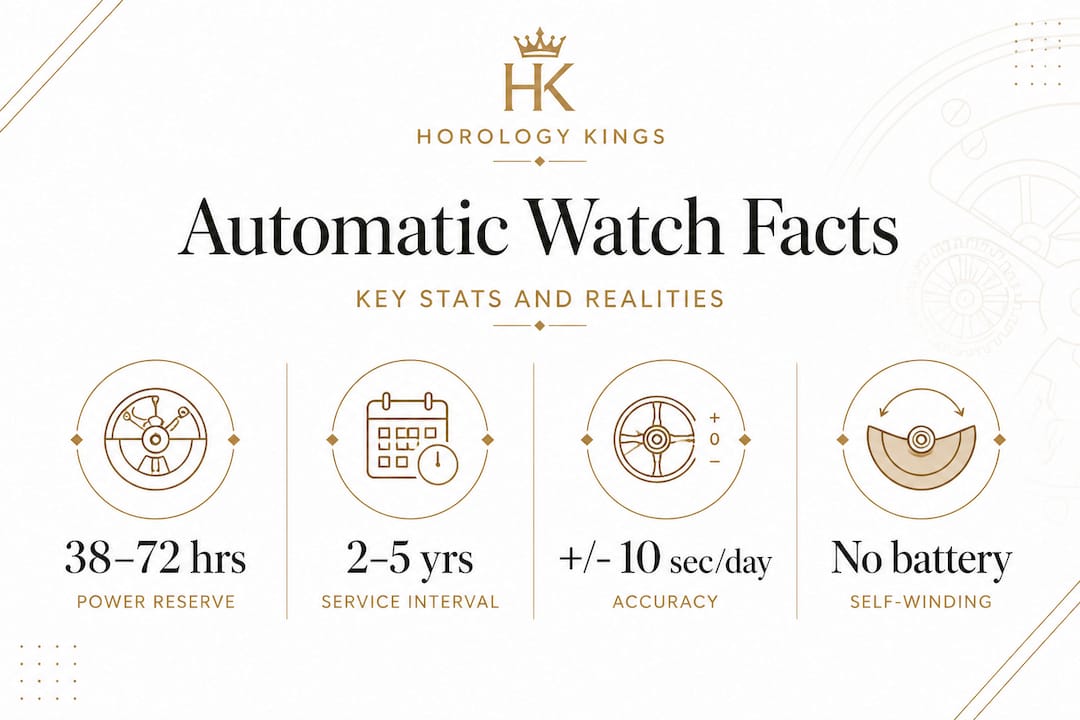
The most persistent myth in automatic watch ownership is the idea that “automatic” implies exceptional accuracy. It does not. Accuracy comes from the escapement and balance regulation, as well as the movement’s quality and condition, while the rotor mainly provides convenience by keeping the mainspring topped up. The rotor is a winding mechanism, not a precision component.
To understand what that means in practice, consider the following:
COSC chronometer certification (from the Contrôle Officiel Suisse des Chronomètres) requires a movement to perform within minus 4 to plus 6 seconds per day. That is considered outstanding for a mechanical movement. Most standard automatics drift by 5 to 20 seconds per day.
A quartz movement typically performs within plus or minus 15 seconds per month, which is roughly 30 times more accurate than a standard automatic.
Regulation matters enormously: a freshly serviced and properly regulated automatic will outperform a neglected one of ostensibly superior pedigree.
Position affects rate: most automatics run at different rates depending on whether the watch is laying crown-up, crown-down, or dial-up. This is normal. High-end movements are regulated in multiple positions to minimise the variance.
“Expecting an automatic to keep time like a quartz watch is like expecting a hand-rolled pasta to cook identically to factory pasta. The appeal is in the process, the craft, and the character — not the uniformity.”
The second major myth is that automatics require no maintenance. In reality, the lubricating oils inside a mechanical movement degrade over time, regardless of how often the watch is worn. Dried or degraded oils increase friction, accelerate wear, and ultimately affect both accuracy and longevity. Following luxury watch maintenance tips is not optional — it is essential for protecting a significant investment.
Statistic: Industry consensus, supported by major Swiss manufacturers including Rolex and Patek Philippe, recommends watch servicing options every 3 to 5 years. Neglecting this interval can turn a minor service into a costly movement rebuild.
For first-time buyers, the realistic ownership picture is this: an automatic watch is not complicated to own, but it does reward attentive ownership. Wear it regularly, service it on schedule, and store it correctly. Follow these simple principles and it will preserve watch value for decades, potentially appreciating rather than depreciating over time.
Practical advantages and buying considerations
To bring all of this knowledge together, let’s focus on the practical side — what really matters for your next (or first) automatic.
Understanding the mechanics unlocks a clearer view of what you are actually paying for. Automatic watches are powered by stored mechanical energy rather than a battery, and that fact carries both practical and philosophical weight. You are buying a piece of engineering that operates without disposable power sources, that can theoretically last for generations with proper care, and that represents centuries of horological tradition compressed into a 30mm movement.
Here are the tangible practical advantages:
No battery replacement: no need for trips to the jeweller every 2 to 3 years for a battery swap
Emotional engagement: the feeling of wearing a living mechanism fosters a different relationship with timekeeping
Longevity: quality automatics, properly serviced, outlast the people who first wear them
Resale and collectible value: mechanical movements, particularly from Swiss houses, hold and appreciate in value in ways that quartz pieces rarely do
Craftsmanship: visible through exhibition case backs, the movement itself becomes an aesthetic object
Buyer type | Is an automatic right for them? | Key consideration |
Daily wearer | Yes, ideal | Chooses a robust movement (Rolex, Omega) |
Occasional wearer | Yes, with caveats | Needs a longer power reserve or winder |
Investor/collector | Strongly yes | Service history and movement quality are paramount |
First-time buyer | Yes, with education | Must understand maintenance expectations |
Sports/active user | Depends | Water resistance and shock rating are critical |
Before purchasing, always investigate the following:
Service history: a watch with documented service records is worth significantly more than one without. Ask for paperwork.
Movement type and origin: in-house calibres (made by the brand itself) typically command higher prices and greater collector interest than movements sourced from third-party suppliers such as ETA.
Power reserve: matched to your wearing habits
Condition of the rotor: easy to inspect through an exhibition case back and revealing about overall movement care
Knowing how to read these watch value signs separates buyers who pay fair prices from those who overpay for marketing rather than substance. If you are thinking about investable timepieces, understanding the movement type is arguably the single most important factor after brand pedigree.
Why understanding the mechanics is essential for buyers
Most watch guides stop at the surface. They tell you that automatics are elegant, that they are powered by movement, and that you should service them occasionally. What they rarely tell you is that mechanical knowledge is your most powerful purchasing tool — and the absence of it is exactly what sellers of overpriced or poorly maintained pieces rely upon.
We have seen, time and again, buyers who purchased an automatic from a grey market dealer or auction house without verifying the movement’s service history or condition. The watch ran acceptably for a year, then began losing 40 or 50 seconds a day. A service revealed dried lubricants, worn jewels, and a rotor bearing that had degraded. The repair cost exceeded 15% of the original purchase price. All of it was avoidable.
Here is the uncomfortable truth about luxury watch marketing: the dial is designed to sell the watch. The movement is what you are actually buying. Brands invest enormously in dial design, case finishing, and aspirational storytelling. Far fewer advertise their service intervals, rotor efficiency, or escapement regulation standards. Buyers who understand what to ask for, and how to interpret the answers, consistently make better decisions.
Knowing how a bidirectional rotor functions, why a COSC-certified movement matters, and what signs of wear to look for in a pre-owned piece transforms you from a passive buyer into an informed participant. It also makes your collection more enjoyable. There is a qualitatively different pleasure in watching a finely decorated movement through an exhibition back when you understand the function of each component.
Before any significant purchase, we strongly recommend reviewing a watch authentication guide so you approach every transaction with the confidence and knowledge that protects your investment.
Explore and source your next automatic with Horology Kings
If this guide has sharpened your understanding of automatic watches, the next question is where to find one you can genuinely trust.

At Horology Kings, based in Hertfordshire, we specialise in sourcing, buying, and selling authenticated luxury automatics from Rolex, Patek Philippe, Audemars Piguet, Omega, and Cartier. Every piece we handle is verified by our in-house experts, and we provide complete transparency on service history, condition, and provenance. Whether you want to source an automatic watch from our expert network or require a professional watch repair service to restore your current timepiece to peak performance, our team is here to make the process straightforward, secure, and genuinely satisfying. Reach out to discuss your requirements with no obligation.
Frequently asked questions
Do automatic watches need to be worn daily?
Automatic watches benefit from regular wear but may need manual winding if unworn for extended periods. Since they are powered by wrist movement, a watch left unworn will eventually stop once the power reserve depletes.
Are automatic watches more accurate than quartz?
No. Quartz movements are generally far more accurate. Accuracy depends on regulation and build quality, not the winding mechanism, and most automatics drift several seconds daily compared to a quartz’s monthly deviation.
What is the difference between automatic and mechanical watches?
All automatics are mechanical, but not all mechanical watches are automatic. Automatic winding uses a rotor to keep the mainspring topped up, while manual mechanicals rely entirely on crown winding by the wearer.
How often should an automatic watch be serviced?
Most manufacturers and independent experts recommend a full service every 3 to 5 years. Consistent servicing protects the movement’s internal components, maintains accuracy, and preserves the long-term value of the watch.
Recommended
Comments