.png)
Luxury watch finishing: what every collector must know
TL;DR:
Luxury watch finishing combines genuine craft, engineering purpose, and marketing, often concealing true quality beneath visual appeal.
Collectors should distinguish between functional and decorative finishing, assessing consistency, sharpness, symmetry, and depth, while verifying claims through independent sources.
The finishing on a luxury watch is rarely what it appears to be at first glance. Beneath the polished surfaces and decorative motifs lies a complex interplay of genuine craft, engineering purpose, and, at times, skilfully packaged marketing. Finishing techniques serve both functional and decorative intent, with methods like black polishing adding corrosion resistance alongside visual beauty, but not every motif carries equal weight. For serious collectors and investors, knowing how to read finishing is as critical as knowing how to read a balance sheet. This guide gives you the framework, the techniques, and the practical tools to judge finishing with genuine authority.
Table of Contents
Key Takeaways
Point | Details |
Functional vs decorative | Distinguish between techniques that protect and improve function and those that purely enhance aesthetics. |
Collector value signals | Hand finishing, especially clean inner angles and rare flourishes, often commands a premium and signals collectability. |
Marketed vs real finishing | Not all visible finishing signals true quality; seek independent verification and avoid being swayed by common motifs alone. |
Impact on watch value | Advanced finishing is linked to higher resale and brand prestige, making it a key investment consideration. |
How to evaluate luxury finishing: collectors’ criteria
The first thing any collector should clarify is the distinction between functional and decorative finishing. This is not merely academic. It directly shapes how much premium a technique justifies and whether a watch holds its value under scrutiny.
Functional finishing genuinely improves a movement’s performance or longevity. Techniques such as perlage (engine-turning) on baseplate undersides reduce surface contact between components, potentially limiting the spread of microscopic debris. Black polishing on steel parts creates a hardened, corrosion-resistant surface that also happens to look spectacular. Finishing motifs serve both functional and decorative purposes in high-end watchmaking, but not all of them deliver dramatic measurable effects.
Decorative finishing, by contrast, exists primarily for visual refinement. Sunburst dials, engraved casebacks, and guilloche (engine-turned) patterns on dials are largely aesthetic choices. That does not make them valueless; aesthetic finishing at a high level still signals investment and intention. But collectors must not confuse beauty with engineering utility.
Here is what you should examine when assessing finishing quality:
Consistency: Are motifs applied evenly across the entire visible surface, or do they fade towards edges?
Sharpness of transitions: Are polished and brushed surfaces crisply delineated, or do they blur into one another?
Inner angles: Are bevelled edges (anglage) crisp and sharp at internal corners, which require hand work?
Symmetry: Do Geneva stripes run in perfectly parallel lines without variation?
Depth of finish: Does black polishing achieve a true mirror quality, or does it reveal tool marks under magnification?
“Finishing can be both a genuine craft differentiator and a marketing battleground. Look for verifiable finishing claims, not just familiar motifs.”
This distinction between marketing language and substantive craft is where collectors often lose ground. Brand catalogues use phrases like “entirely hand-finished” with varying degrees of accuracy. The key is to seek haute horlogerie standards applied consistently, and to consult independent technical sources rather than relying on sales material alone.
Pro Tip: When examining a watch, ask your seller for technical documentation or independent horological assessments, not just brand marketing materials. The finishing visible through a loupe will often tell you more than any brochure.
Understanding how brand reputation and value interact with finishing claims is also essential. A well-established brand may have earned its reputation through consistent quality over decades, but that does not mean every piece at every price point delivers the same standard.
Inside the techniques: what collectors should recognise
With a solid evaluative framework established, it becomes possible to look at individual techniques with genuine critical depth. Each technique carries a different collector significance, functional role, and level of difficulty.
Perlage (engine-turning): This spiral, overlapping circular motif is applied to surfaces that are not ordinarily visible, such as the underside of mainplates. It is one of the most telling indicators of a maker’s finishing commitment because it appears where no buyer will casually glance. Perlage and Geneva stripes may serve functional roles in oil retention and debris management, though these effects are context-dependent and not universally proven.
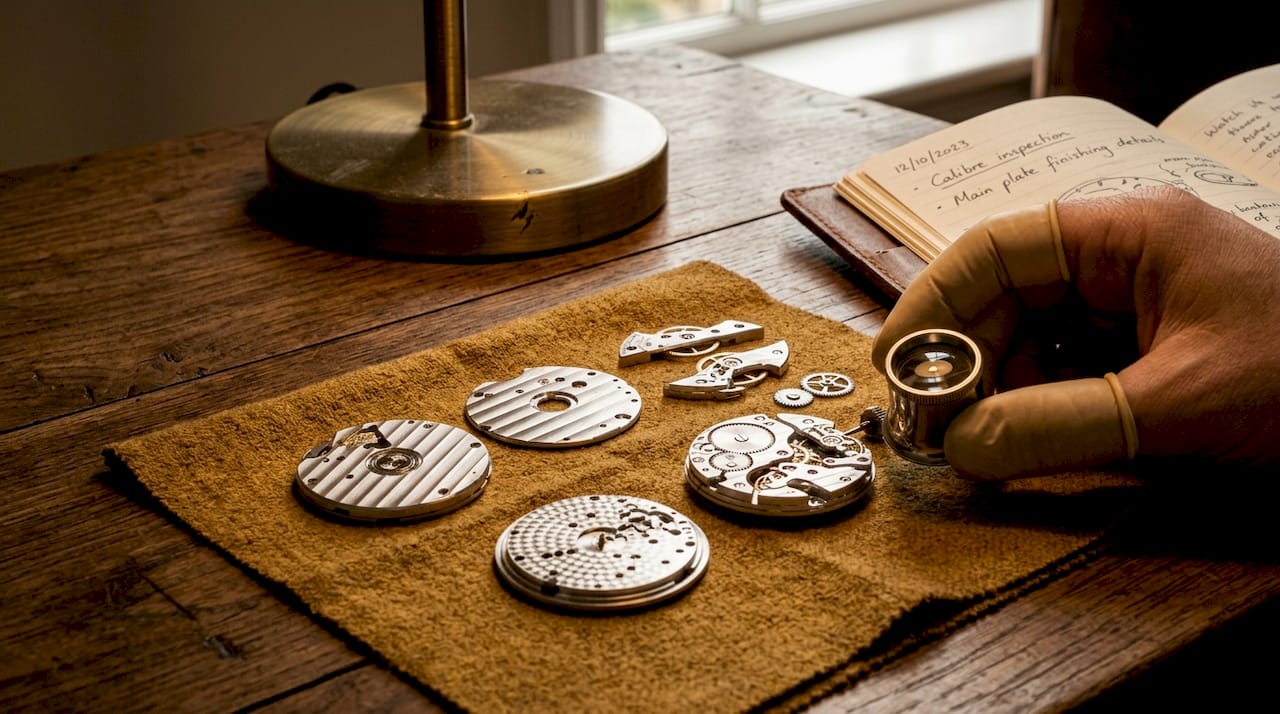
Geneva stripes (Côtes de Genève): The most widely recognised luxury finishing motif, consisting of parallel wave-like ridges applied to bridges and plates. At their finest, they are applied by hand in a single direction using a wooden tool charged with abrasive, creating a nuanced sheen that machine-applied stripes cannot fully replicate.
Anglage (bevelling): The chamfering and subsequent polishing of component edges. When executed on internal angles, anglage is exceptionally demanding, as no machine can yet replicate the control required to achieve a razor-sharp, mirror-polished inner corner. This is widely regarded as the true test of a hand-finisher’s skill.
Black polishing: Applied to flat steel surfaces such as lever arms and click springs, black polishing creates a surface so refined that it appears to have depth, like a still pool of water. The process involves repeated polishing on tin or other laps charged with progressively finer abrasives. It genuinely improves corrosion resistance alongside its dramatic visual appeal.
Heat-blued screws: Achieved by heating polished steel screws to a specific temperature range, producing a vivid blue oxide layer. The bluing is both decorative and functional, improving the screw’s corrosion resistance. Authentic heat-blued screws show a precise gradient of colour, not the flat, uniform blue of chemically treated alternatives.
A. Lange & Söhne applies a comprehensive finishing philosophy, including double-assembly processes to protect untreated German silver plates from fingerprints and contamination. This commitment sets a benchmark that few other brands match.
Technique | Primary purpose | Collector value | Visual marker |
Perlage | Debris control, aesthetics | High (hidden surfaces) | Overlapping circles |
Côtes de Genève | Aesthetics, debris | Medium to high | Parallel ridges |
Anglage | Structural refinement | Very high | Sharp polished edges |
Black polishing | Corrosion resistance, aesthetics | Very high | Mirror-like steel |
Heat-blued screws | Corrosion resistance, aesthetics | High | Vivid blue gradient |
Sunburst finishing | Aesthetics | Medium | Radiating lines on dial |
The finishes that consistently impress experts are those applied to what defines a collector’s timepiece: not surface decoration alone, but a system of refinement that extends to components rarely seen during normal wear.
Hand-made vs machine finishing: myths, realities and collector tips
This is perhaps the most contentious area in luxury watch collecting today. The debate is not simply philosophical. It has real financial consequences for anyone buying or selling investment-grade pieces.
True hand finishing requires a skilled craftsperson to apply abrasive tools manually to each individual component. The hallmark of genuine hand work is the presence of crisp, clean inner angles, particularly in bevelling. These sharp inward corners present a geometric challenge that CNC machines struggle to address because a rotating tool physically cannot reach into a sharp internal corner without leaving a radius. Sharp inner angles remain largely beyond machine capability, though some manufacturers overstate the degree of handwork involved in their finishing processes.
The reality is more nuanced. Many modern luxury watches use CNC machining to shape and rough-finish components, with human hands completing the final stages. This hybrid approach can still produce outstanding results. The question collectors should ask is not “hand or machine?” but rather “where exactly does the human element begin and end?”
Here is a practical comparison to guide your judgement:
Factor | Hand finishing | Machine finishing |
Inner angle sharpness | Achievable with skill | Very difficult |
Consistency across batch | Variable (uniqueness) | High |
Time and cost | Very high | Lower |
Resale appeal | Premium | Standard |
Exclusivity | High | Lower |
To evaluate finishing claims in the marketplace, follow these steps:
Request manufacturer technical documentation specifying which operations are performed by hand.
Examine the watch under magnification, focusing on inner angles of bridges and levers.
Consult independent reviews from trusted horological publications.
Cross-reference with authenticating a luxury watch guides and use a watch authentication checklist.
If in doubt, consult a specialist with physical access to the piece.
Pro Tip: Do not accept the phrase “hand-finished” without asking which specific operations are performed manually. A movement can have one hand-finished component and still be marketed as hand-finished in its entirety. Always drill down to specifics.
“When spotting fake watches or overblown finishing claims, the inner angles never lie. A fake or exaggerated finish almost always reveals itself under 10x magnification at the bevelled edges.”
How finishing influences value: the collector’s edge
Finishing is not merely an aesthetic preference. It is a core driver of watch valuation, resale performance, and long-term investment returns. Understanding this connection gives collectors a meaningful edge in purchasing and selling decisions.
Brands known for uncompromising finishing standards consistently command retail premiums and maintain stronger secondary market values. A. Lange & Söhne’s double-assembly process protects German silver components from tarnishing, a standard that preserves both the physical condition and the perceived value of each watch over decades of ownership. This is the kind of manufacturer commitment that translates directly into sustained resale prices.
The relationship between finishing and value works on several levels:
Retail premium: Watches with verifiably advanced finishing (anglage, black polishing, double-assembly) carry higher initial prices that the market generally sustains.
Collectable appreciation: Pieces from limited series or historical calibres where hand-finishing is documented often appreciate meaningfully over time, particularly those from Patek Philippe, Audemars Piguet, and A. Lange & Söhne.
Resale market performance: Secondary market buyers, particularly experienced collectors, pay close attention to finishing quality when bidding. A movement that photographs beautifully under magnification generates more competition at auction.
Condition sensitivity: Superior finishing shows wear differently. Black-polished surfaces reveal scratches more obviously, which is why condition is particularly prized and rewarded in the resale market.
The techniques most reliably linked to sustained or appreciating value are anglage (especially inner angle work), black polishing, heat-blued screws, and comprehensive double-assembly processes. These are not marketing terms. They are observable, verifiable standards.
For any collector approaching a piece as an investment, understanding watch valuation in the context of finishing quality is essential. A watch with exceptional finishing at a fair price is almost always a stronger long-term hold than an average piece from a prestigious name.
It is also worth noting that brand reputation and value can mask finishing inconsistencies. Some prestigious brands produce flagship movements with extraordinary finishing alongside more modest pieces for broader market segments. Knowing which reference you are holding, and what finishing standard it genuinely represents, is the collector’s real advantage.
My perspective: why finishing remains the true collector’s signal
There is an uncomfortable truth at the centre of this subject. Marketing departments across the luxury watch industry have absorbed the collector’s language, the vocabulary of anglage, perlage, black polishing, and hand-finishing, and deployed it with considerable skill. The result is that the words themselves have partly lost their signal value. What has not lost its signal value is the actual finishing, examined under magnification, in person, by someone who knows precisely what they are looking at.
This is why I believe finishing remains the most reliable separator between genuine investment-grade timepieces and those that merely look the part. Not because finishing guarantees value, nothing in collecting guarantees value, but because a pattern of outstanding finishing across a movement, applied consistently to components both visible and hidden, is rarely accidental. It reflects a culture of manufacturing discipline that typically extends to every other aspect of how a watch is made and supported.
The collectors who develop genuine finishing literacy are a small group. Most buyers rely on brand prestige, model reputation, or the assurances of a seller. That leaves real opportunity for those willing to go deeper. When you can look at a bridge under a loupe and identify whether the inner angle at a jewel hole has been hand-bevelled to a true mirror quality or simply roughed off on a CNC, you are operating with information that most people in the room do not have.
The key discipline is independence. Always verify finishing claims with sources outside the manufacturer’s own material. Consult trusted horological journalists, independent watchmakers, and specialists who have handled the piece physically. The haute horlogerie world has standards, and those standards are observable if you know how to look.
Finishing will not save a poorly conceived watch, and it will not single-handedly determine resale value. But in the top segment of collecting, it is one of the most reliable indicators of where genuine craft ends and marketing begins.
Source expertly finished timepieces with Horology Kings
Putting finishing knowledge into practice means working with specialists who share your standards. For collectors who have developed the critical eye to appreciate genuine craft, the sourcing process itself must match that level of rigour.

At Horology Kings, every piece we handle is assessed with the same depth of scrutiny this article describes. We work with collectors and investors across the UK seeking watches where finishing quality is not just claimed but verifiable. Whether you are looking to acquire a specific reference, sell a piece with outstanding finishing credentials, or need expert guidance on what a particular movement genuinely represents, our team is ready to assist. If you are ready to find a timepiece that truly stands up to examination, source a watch through our network today.
Frequently asked questions
What is the most valuable luxury watch finishing technique?
Hand-executed anglage, particularly with clean, mirror-polished inner angles, is widely regarded as the highest mark of craftsmanship in collectible watchmaking because it cannot be reliably replicated by machine.
Do finishing techniques affect the watch’s value long-term?
Yes, advanced finishing contributes meaningfully to retail premiums, collectability, and resale prices, especially when manufacturer documentation confirms the standard of finishing applied.
Is there a difference between decorative and functional finishing?
Yes, techniques such as black polishing resist corrosion whilst also creating visual depth, whilst other motifs are primarily aesthetic, though many serve both purposes simultaneously in high-end watchmaking.
How can I verify claims of hand-finishing?
Request manufacturer documentation specifying which operations are performed manually, then cross-reference with independent third-party horological assessments or a specialist who can physically examine the piece.
Are all Geneva stripes and perlage decorations added by hand?
Not always. Many modern pieces apply these motifs using machine processes, though the finest houses retain hand-application for their flagship calibres where the quality difference under magnification remains clearly visible.
Recommended
Comments