.png)
What is watch valuation? A 2026 guide for luxury collectors
Luxury watches have evolved from mere timekeeping instruments into recognised alternative assets, with investment-grade timepieces returning 7.5% annually. Yet many collectors struggle to understand what truly drives value in this sophisticated market. Whether you’re considering your first Patek Philippe or evaluating your existing collection, mastering valuation principles is essential for making informed decisions. This guide explores the factors that determine a luxury watch’s worth, from brand heritage and condition to market dynamics and auction performance. You’ll discover practical steps for assessing your timepieces and learn how professional expertise can protect your investment in 2026’s evolving horological landscape.
Table of Contents
Key takeaways
Point | Details |
Alternative asset recognition | Luxury watches now function as wearable financial instruments with proven value retention and market liquidity |
Valuation complexity | Brand prestige, physical condition, complete provenance, and shifting market demand collectively determine worth |
Secondary market strength | Auction results demonstrate sustained global appetite, with Christie’s achieving 96% sell-through rates in 2025 |
Authentication priority | Verified originality and unrestored components preserve value, whilst refinished dials can reduce worth by 50% |
Professional guidance | Expert appraisal and specialist servicing protect investment value and enable confident buying or selling decisions |
The rise of luxury watch valuation as an investment tool
The global luxury watch market has matured into a formally recognised alternative asset class, fundamentally changing how collectors and investors approach timepiece ownership. What was once purely about craftsmanship and heritage now encompasses sophisticated financial considerations. Leading manufacturers like Rolex, Patek Philippe, Audemars Piguet, and Richard Mille dominate this space, offering collectors both aesthetic pleasure and tangible wealth preservation.
The numbers tell a compelling story. Investment-grade watches have delivered average annual returns of 7.5%, often outperforming traditional asset classes during periods of economic uncertainty. Serious collectors now allocate 20-30% of their investable portfolios to horological assets, treating timepieces as strategic holdings rather than simple accessories. This shift reflects growing market sophistication and institutional recognition of watches as legitimate stores of value.
What makes watches particularly attractive as investments is their dual nature. You can wear a Nautilus or Daytona whilst it appreciates, enjoying both utility and capital growth. This “wearable wealth” concept resonates strongly with high-net-worth individuals seeking alternatives to stocks, bonds, or property. Scarcity drives much of this value proposition. Patek Philippe produces fewer than 70,000 watches annually, whilst demand from emerging markets continues accelerating.
“The convergence of limited production, exceptional craftsmanship, and growing global wealth has created a perfect environment for watch values to flourish.”
Several factors underpin this investment thesis:
Manufacturers deliberately restrict production to maintain exclusivity and pricing power
Swiss watchmaking heritage commands premium recognition across all cultures
Physical assets offer tangible security during inflationary periods
Secondary markets provide robust liquidity for established models
Younger collectors embrace watches as status symbols and portfolio diversifiers
For those exploring investable timepieces for 2025, understanding valuation mechanics becomes essential. The market rewards knowledge, punishes speculation, and demands rigorous authentication. As we progress through 2026, professional guidance and market intelligence separate successful collectors from those who overpay or miss opportunities.
Factors that determine watch valuation
Investment-grade luxury watch value is rooted in brand heritage, craftsmanship, and scarcity, but these foundational elements interact with numerous variables that can dramatically affect pricing. Understanding these factors enables collectors to make strategic acquisition and disposal decisions based on objective criteria rather than emotion or marketing hype.
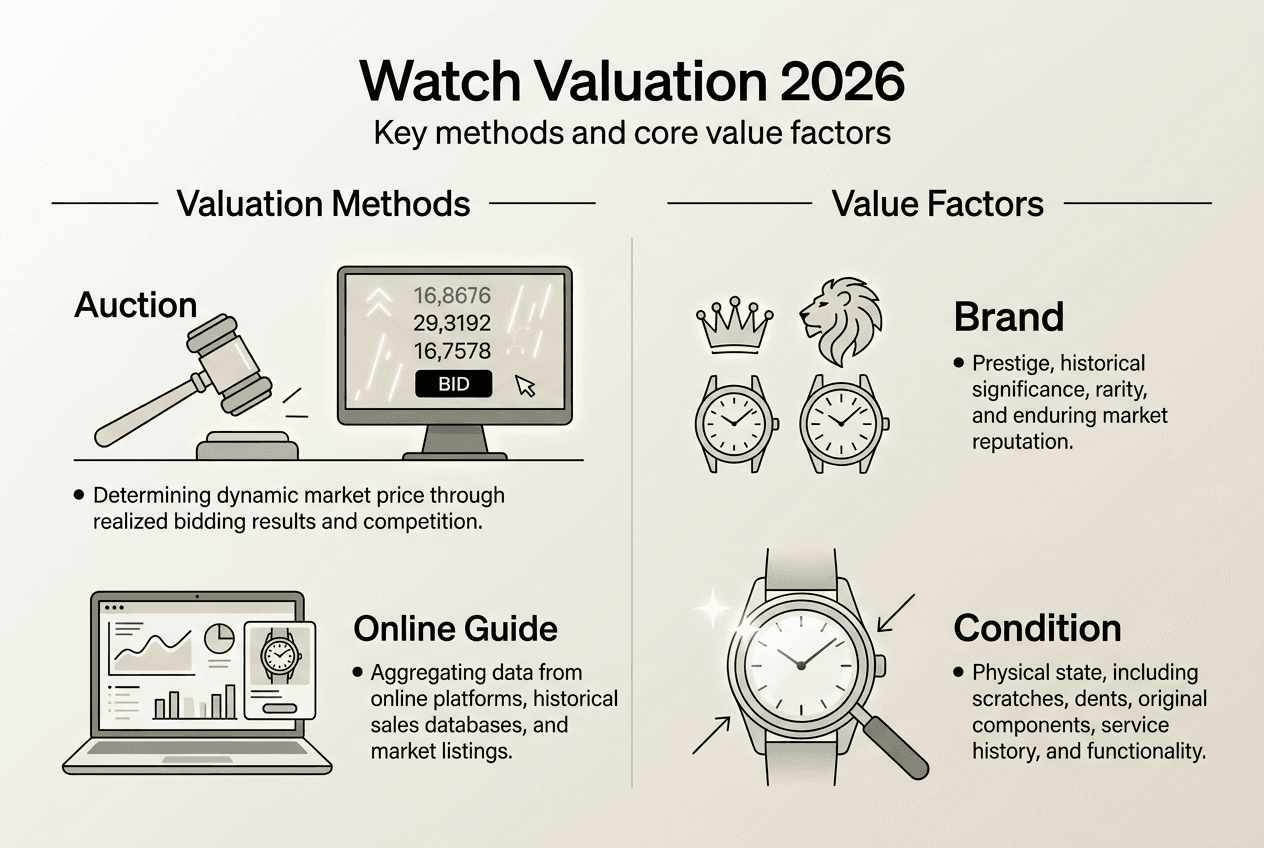
Brand prestige sits at the valuation pyramid’s apex. Patek Philippe, Rolex, and Audemars Piguet command premiums because decades of consistent quality and controlled distribution have built unassailable reputations. A steel Nautilus 5711 trades for multiples of its retail price purely because of the Patek name and deliberate scarcity. Lesser-known brands, regardless of technical merit, struggle to achieve comparable valuations without this heritage foundation.
Condition represents the most controllable yet frequently misunderstood value driver. A refinished dial can cut value by 50% or more, whilst original boxes and papers add 15-25% premiums. Collectors prize originality above cosmetic perfection. An unpolished case with honest wear often commands more than an over-restored example that’s lost its factory finish. Movement condition matters equally, with service history and original components affecting both functionality and worth.
Pro Tip: Never polish a vintage watch case before valuation. What seems like improvement often destroys originality that serious collectors prize, potentially halving your timepiece’s market value.
Provenance documentation transforms good watches into exceptional ones. Complete sets including original warranty cards, boxes, receipts, and service records provide authentication confidence and ownership history. Celebrity provenance or documented participation in significant events can multiply values exponentially. Paul Newman’s Daytona achieved $17.8 million largely because of its famous owner, not purely its technical specifications.
Market dynamics introduce volatility into valuations. Consumer preferences shift, with certain references falling in and out of favour based on social media trends, celebrity endorsements, or broader economic conditions. The pandemic triggered unprecedented demand for sports models, pushing prices to unsustainable levels before corrections occurred. Understanding these cycles helps collectors time acquisitions and disposals strategically.
Authentication underpins every valuation consideration. Sophisticated counterfeits flood the market, making expert verification essential before any significant transaction. Serial number databases, movement inspection, and materials analysis separate genuine articles from convincing fakes. Following guidance on how to authenticate a luxury watch protects both buyers and sellers from costly mistakes.
Maintaining value requires ongoing attention. Regular servicing preserves mechanical integrity, whilst proper storage prevents deterioration. Implementing luxury watch maintenance tips ensures your timepieces retain their appeal and functionality across decades of ownership.
Understanding the secondary market: auctions and resale
The secondary market is driven by physical details, authentication, and shifting consumer preferences, creating a dynamic ecosystem where valuations are tested against real buyer demand. Unlike retail environments with fixed pricing, the secondary market reveals what collectors actually pay rather than what manufacturers suggest. This transparency makes auction results and private sales essential barometers for understanding current values.
Auction houses provide the most visible secondary market mechanism. The ‘Important Watches’ auction at Christie’s achieved $9.3 million with 96% lots sold, demonstrating sustained appetite for quality timepieces even amid broader economic uncertainty. These results aren’t merely academic, they establish market benchmarks that influence private transactions and dealer pricing worldwide. When a particular Rolex reference consistently exceeds estimates, the entire market adjusts valuations upward.
The buyer base has evolved considerably. Whilst European and American collectors traditionally dominated, Asian buyers now represent significant demand, particularly for iconic models from Patek Philippe and Audemars Piguet. Younger collectors entering the market bring different priorities, often favouring contemporary sports models over traditional dress watches. This demographic shift influences which references appreciate and which stagnate.
Auction Stage | Valuation Impact | Collector Consideration |
Pre-sale estimate | Sets market expectations and reserve pricing | Conservative estimates often drive competitive bidding |
Catalogue presentation | Influences perceived desirability and lot positioning | Quality photography and detailed descriptions enhance appeal |
Bidding competition | Reveals actual market demand in real time | Multiple bidders signal strong underlying value |
Hammer price | Establishes public record and comparable sales data | Premium over estimate indicates scarcity or exceptional condition |
Post-sale analysis | Informs future valuations and market trends | Patterns across multiple auctions reveal sustainable demand |
The auction process follows a structured sequence:
Submission and authentication by auction house specialists who verify provenance and condition
Estimate assignment based on comparable sales, current market sentiment, and lot quality
Catalogue production featuring professional photography and detailed technical descriptions
Pre-sale viewings allowing potential bidders to inspect watches physically
Live or online auction where competitive bidding determines final hammer price
Settlement and transfer with buyer’s premium added to achieve total acquisition cost
Pro Tip: Auction estimates typically represent conservative valuations. Strong examples with complete provenance routinely achieve 20-40% above high estimates when multiple serious bidders compete.
Beyond formal auctions, private sales through specialist dealers offer discretion and often faster transactions. These channels suit sellers seeking confidentiality or buyers pursuing specific references outside auction cycles. Platforms connecting private buyers and sellers have democratised access, though they require greater due diligence regarding authentication and pricing fairness.
“The secondary market’s strength lies in its transparency. Unlike opaque retail environments, auction results and verified private sales create objective valuation data that benefits all participants.”
Market sustainability depends on knowledgeable participants rather than speculative flippers. Collectors who understand quality, rarity, and historical significance provide stable demand that supports valuations long term. Learning how to trade high-end watches effectively requires studying market patterns, building relationships with reputable dealers, and developing expertise in specific manufacturers or complications.
Assessing your watch’s value: practical steps and considerations
High-end buyers demand pristine condition and provenance, setting a sustainable tone for growth, which means collectors must approach valuation systematically rather than relying on guesswork or outdated price guides. Whether you’re considering a sale, insurance coverage, or simply understanding your collection’s worth, following structured assessment protocols ensures accurate valuations.
Authentication forms the essential foundation. Verify serial numbers against manufacturer databases, examining case backs, movements, and documentation for consistency. Sophisticated counterfeits replicate external appearances convincingly, but movement finishing and component quality reveal authenticity under expert scrutiny. Following comprehensive guidance to authenticate a luxury watch protects against costly authentication failures that destroy value entirely.
Physical condition assessment requires methodical examination:
Dial inspection for refinishing, replaced hands, or moisture damage that significantly reduces value
Case evaluation checking for excessive polishing, deep scratches, or replaced components
Crystal condition noting chips, cracks, or replacement with incorrect specifications
Movement functionality including accuracy, power reserve, and service history documentation
Bracelet or strap originality with correct end links, clasp codes, and wear patterns
Provenance documentation adds substantial premiums. Gather original boxes, warranty cards, receipts, service records, and any correspondence with the manufacturer. Complete sets command 15-25% more than watch-only examples, whilst celebrity ownership or documented historical significance can multiply values exponentially. Even routine service invoices provide authentication confidence and ownership continuity that buyers prize.
Pro Tip: Photograph your watches with documentation before any service or repair. This creates provenance records and protects against component substitution during third-party servicing.
Professional appraisal provides certified valuations for insurance, estate planning, or sale preparation. Recognised experts examine timepieces physically, research comparable sales, and issue formal reports detailing condition, authenticity, and current market value. Auction houses offer complimentary appraisals for potential consignments, though their estimates may reflect conservative positioning to encourage bidding competition.
Valuation Method | Accuracy | Cost | Best Used For |
Online price guides | Low to moderate | Free | Initial research and broad market trends |
Dealer consultation | Moderate to high | Often complimentary | Quick assessment and potential sale discussion |
Auction house appraisal | High | Free for consignment | Formal valuation and public sale consideration |
Independent certified appraisal | Very high | £200-500+ | Insurance documentation and estate planning |
Insurance considerations extend beyond simple replacement value. Specialist horological insurance covers theft, damage, and loss at agreed values that reflect current market conditions rather than original purchase prices. Annual revaluations ensure coverage keeps pace with appreciation, protecting your investment adequately. Some policies even cover value diminution from necessary repairs, recognising that servicing can affect collectability.
Servicing maintains both functionality and value. Manufacturer service centres provide authenticity assurance but often replace components that collectors prefer original. Independent specialists with manufacturer training offer alternatives that preserve originality whilst ensuring mechanical integrity. Exploring watch repair and servicing options helps balance preservation with proper maintenance.
Implementing preserving watch value strategies protects your investment long term. Proper storage in controlled humidity, avoiding magnetic fields, and regular wearing to maintain lubrication all contribute to condition preservation. Documentation of every service, repair, or modification creates provenance records that future buyers will scrutinise carefully.
Discover expert watch sourcing and servicing at Horology Kings
Understanding valuation principles empowers informed decisions, but partnering with experienced specialists transforms knowledge into results. Whether you’re building a collection, liquidating assets, or seeking that elusive reference, professional guidance navigates the luxury watch market’s complexities with confidence and security.
Horology Kings offers comprehensive services tailored to discerning collectors throughout Hertfordshire and beyond. Our expertise spans authentication, valuation, and transaction facilitation for prestigious Swiss manufacturers including Rolex, Patek Philippe, Audemars Piguet, Omega, and Cartier. We provide transparent valuations grounded in current market data, ensuring you understand exactly what your timepieces are worth in today’s dynamic environment. Visit Horology Kings to explore our curated selection of authenticated pre-owned watches or discuss selling your collection with specialists who prioritise discretion and fair pricing. Our watch repair and servicing maintains your investment’s value through expert care, whilst our source a watch services leverage industry networks to locate specific references that complete your collection. Trust experienced professionals dedicated to luxury horology’s highest standards.
Frequently asked questions
What is watch valuation and why does it matter?
Watch valuation is the systematic assessment of a luxury timepiece’s current market worth based on brand, condition, provenance, and demand factors. It matters because accurate valuations inform buying, selling, insurance, and investment decisions, protecting collectors from overpaying or underselling valuable assets.
Which factors most significantly affect luxury watch values?
Brand heritage and model scarcity drive baseline value, but condition and originality create the largest variations. Unrestored dials, original components, and complete documentation with boxes and papers can add 15-50% premiums, whilst refinishing or replacement parts drastically reduce worth.
How do I obtain a professional watch appraisal?
Contact recognised auction houses, certified independent appraisers, or specialist dealers for formal valuations. Auction houses often provide complimentary estimates for potential consignments, whilst independent appraisers charge fees but offer certified reports suitable for insurance and estate purposes. Always verify appraiser credentials and manufacturer expertise before proceeding.
Do luxury watch values fluctuate significantly?
Yes, market dynamics create volatility, particularly for contemporary sports models subject to trend-driven demand. Vintage pieces with established collector bases show more stability, but all watches experience value shifts based on economic conditions, manufacturer decisions, and changing preferences. Following how to authenticate a luxury watch ensures you’re investing in genuine articles that retain value better than counterfeits.
Should I service my watch before selling it?
This depends on condition and buyer expectations. Recent manufacturer service can add value by confirming functionality, but over-restoration or component replacement may reduce collectability. Consult specialists before servicing vintage pieces, as originality often matters more than perfect operation for serious collectors seeking investment-grade timepieces.
Recommended
Comments