.png)
How to spot fake watches: expert guide for UK collectors
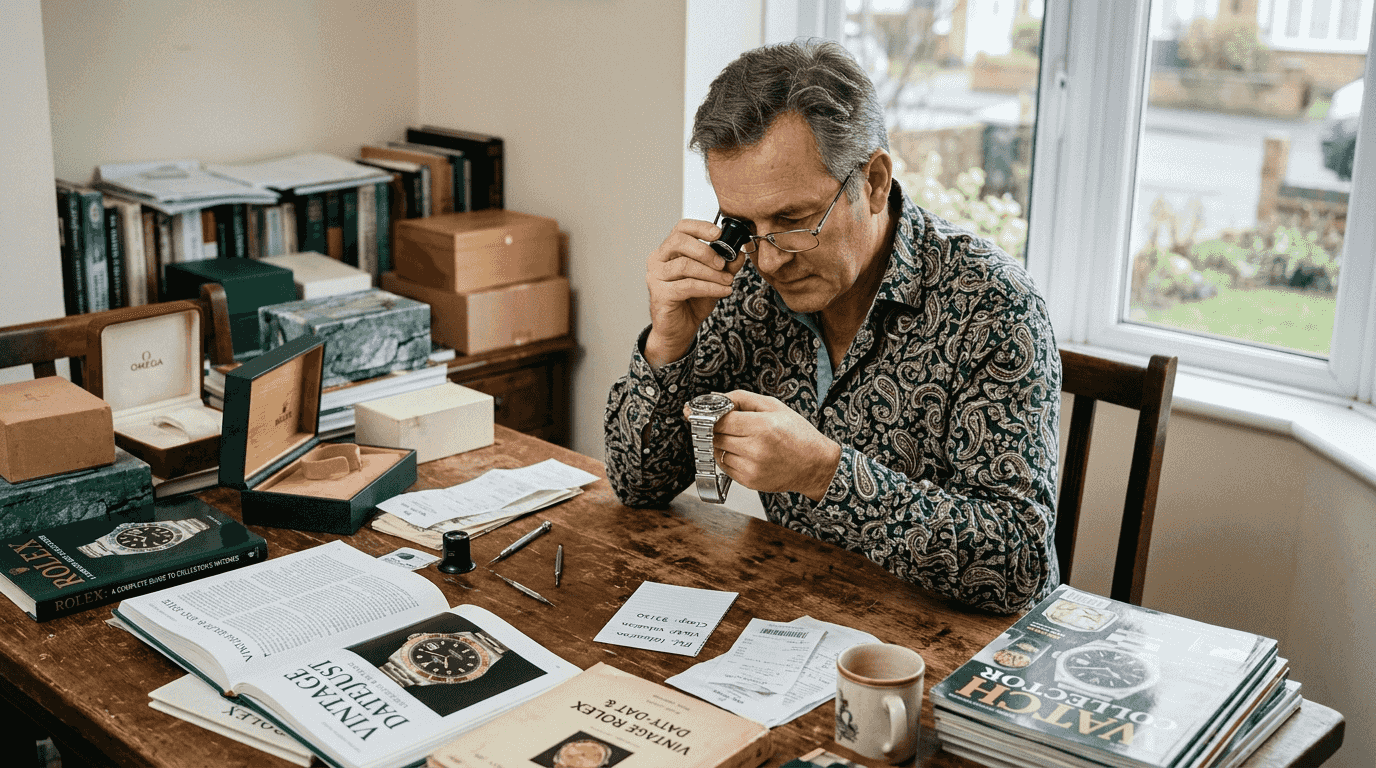
The luxury watch market faces an unprecedented challenge: counterfeit timepieces have become remarkably sophisticated, fooling even experienced collectors. With counterfeit luxury watches causing billions in losses annually, UK enthusiasts risk significant financial disappointment when purchasing high-end pieces. This comprehensive guide equips you with expert techniques to distinguish authentic Rolex, Patek Philippe, and Audemars Piguet watches from clever fakes. You’ll learn systematic examination methods, essential authentication tools, and common pitfalls to avoid when building your collection.
Table of Contents
Key takeaways
Point | Details |
Examine markings carefully | Authentic watches feature precise dial printing, sharp engravings, and correct serial number placement that counterfeiters struggle to replicate perfectly. |
Verify movement quality | Genuine Swiss movements produce distinctive sounds and smooth second hand motion that fake mechanisms cannot duplicate. |
Check documentation | Provenance papers, warranty cards, and service records provide crucial authentication evidence that counterfeiters rarely forge convincingly. |
Use professional tools | Loupes, UV lights, and precision scales reveal material quality and construction details invisible to the naked eye. |
Consult experts | Authorised dealers and certified watchmakers offer authentication services that protect against sophisticated counterfeits. |
Understanding the problem: why spotting fake watches is critical
The counterfeit watch industry has evolved dramatically over the past decade. Modern fakes employ Swiss-grade materials, accurate weight distribution, and convincing packaging that deceive casual inspection. Counterfeit luxury watches have surged globally, with losses exceeding billions annually, creating substantial risks for UK collectors investing tens of thousands in timepieces.
Beyond financial loss, owning counterfeit watches carries legal implications. UK customs authorities can seize fake luxury goods, and reselling counterfeits—even unknowingly—violates intellectual property laws. Your reputation within collector communities suffers irreparable damage when a fake surfaces in your collection.
Counterfeiters deploy increasingly clever tactics:
Stealing genuine serial numbers from authentic watches and replicating them on fakes
Using lower-grade Swiss movements that superficially resemble luxury calibres
Applying authentic-looking hallmarks and brand engravings with laser technology
Creating convincing documentation including warranty cards and service booklets
Mixing genuine components with counterfeit parts in “Franken-watches”
The emotional cost proves equally devastating. Collectors invest passion and research into acquisitions, only to discover their prized Submariner or Royal Oak is worthless. This betrayal undermines confidence and enjoyment of horology.
“The sophistication of modern counterfeits means collectors must approach every purchase with systematic authentication protocols, regardless of seller reputation or apparent provenance.”
Developing expert authentication skills protects your investment and preserves the integrity of your collection. Learning to authenticate a luxury watch systematically transforms you from vulnerable buyer to discerning collector. The knowledge investment pays dividends across every future acquisition.
Preparation: what you need to spot a fake watch
Successful authentication requires specific tools and reference materials before examining any timepiece. Professional watchmakers rely on precision instruments that reveal details invisible during casual inspection.
Essential authentication toolkit:
Jeweller’s loupe (10x magnification): Examines dial printing quality, engraving depth, and finishing details
UV light: Reveals luminous material authenticity and detects aftermarket modifications
Precision scale (0.1g accuracy): Verifies weight matches manufacturer specifications
Digital caliper: Measures case dimensions against official specifications
Bright LED torch: Illuminates dial texture and movement components
Microfibre cloths: Cleans crystal without scratching for clear examination
Reference materials prove equally crucial. Maintain digital files of official brand catalogues, serial number formats by production year, and high-resolution images of authentic examples. Rolex, Patek Philippe, and Audemars Piguet publish detailed specifications that counterfeiters often overlook in subtle ways.
Proper watch valuation requires specific tools and systematic documentation. Create a dedicated workspace with controlled lighting—natural daylight or 5000K LED bulbs reveal colour accuracy that warm lighting masks. A stable surface prevents accidental damage during detailed examination.
Pro Tip: Develop a brand-specific authentication checklist covering dial fonts, crown details, bracelet construction, and movement finishing. Cross-reference each element systematically rather than relying on general impressions that confirmation bias influences.
Tool | Purpose | Usage tip |
Jeweller’s loupe | Inspect printing and engravings | Hold 2-3cm from eye, bring watch to focus |
UV light | Check luminous material | Examine in complete darkness for accurate assessment |
Precision scale | Verify weight specifications | Account for bracelet links and compare to official data |
Digital caliper | Measure case dimensions | Check diameter, thickness, and lug width |
Reference images | Compare details | Use official brand sources, not third-party photos |
Invest in quality tools rather than budget alternatives. A £40 jeweller’s loupe reveals details a £10 magnifying glass misses. Your authentication accuracy depends directly on equipment precision. Consider this essential infrastructure for serious collecting, not optional accessories.
Familiarise yourself with official brand documentation formats. Rolex warranty cards feature specific security elements, Patek Philippe certificates include unique serial number placement, and Audemars Piguet papers display particular fonts and layouts. Study authentic examples before examining questionable pieces. Consulting the comprehensive watch valuation guide helps understand authentication’s role in determining value.
Execution: step-by-step guide to identifying a fake watch
Systematic examination following a consistent protocol reveals authenticity more reliably than intuitive assessment. Professional authenticators follow structured processes that eliminate subjective judgement.
Step 1: Inspect dial printing and typography
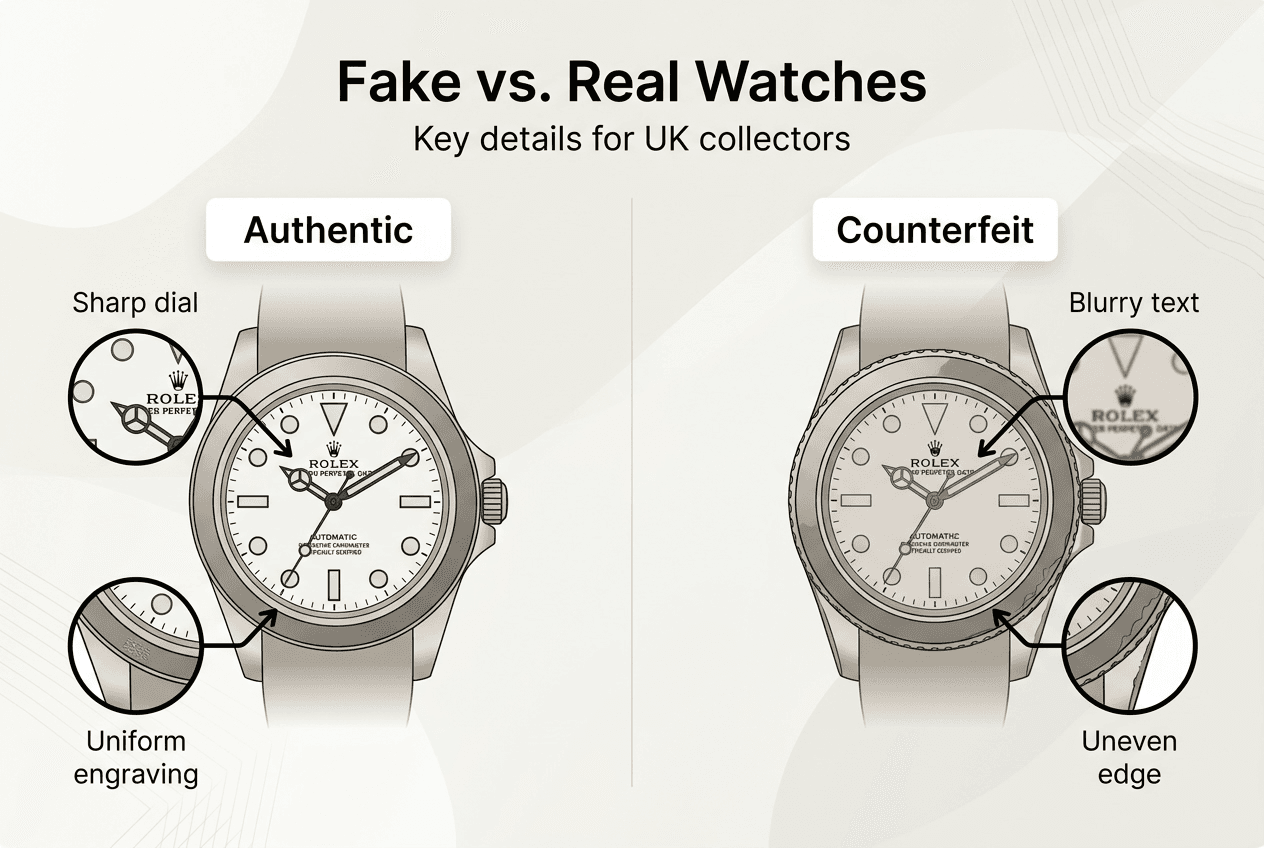
Examine text sharpness under 10x magnification. Authentic luxury watches feature crisp, perfectly aligned printing with consistent depth. Counterfeit dials often show fuzzy edges, uneven spacing, or incorrect fonts. Rolex coronet logos display precise proportions; fakes frequently distort crown points or stem width. Patek Philippe’s intricate guilloché patterns require machinery counterfeiters rarely access.
Step 2: Examine case back engravings and serial numbers
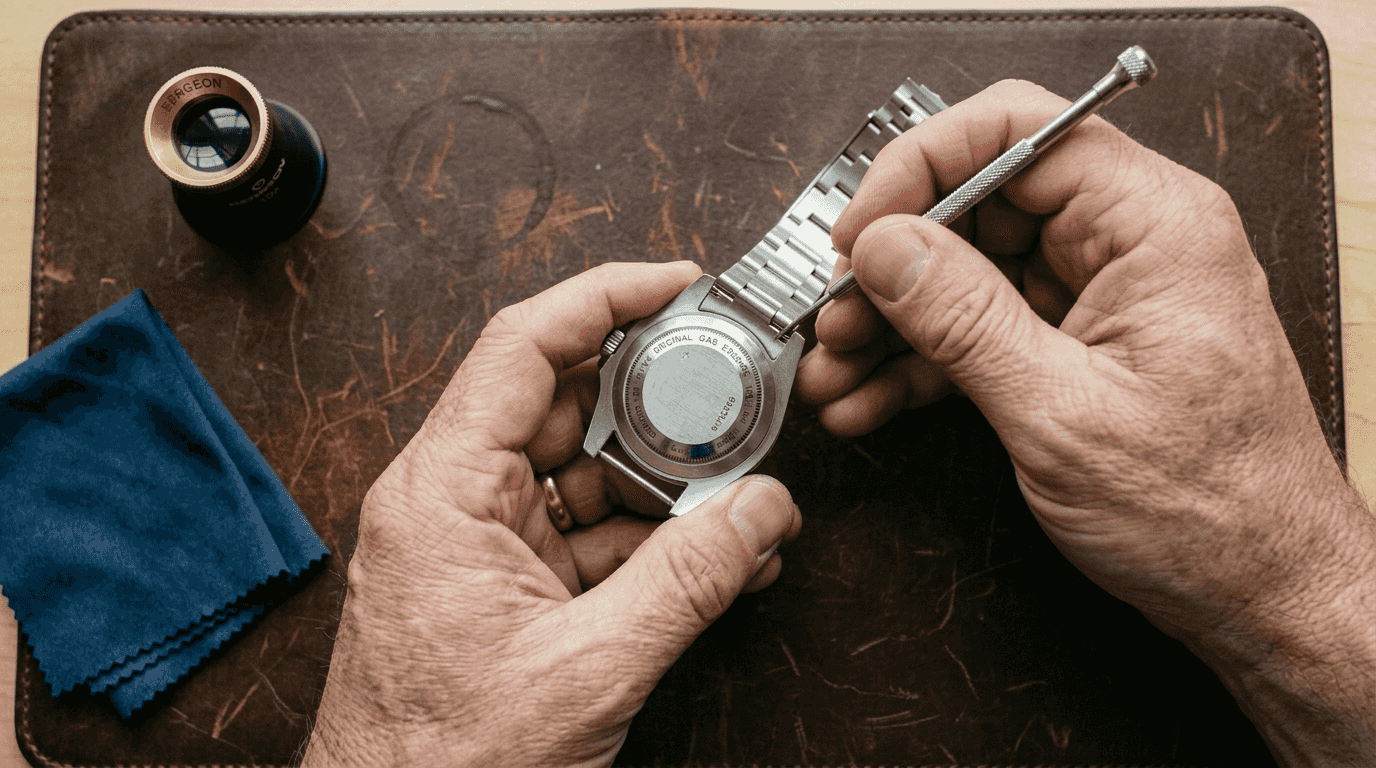
Authentic engravings display uniform depth and sharp edges without tool marks. Remove the bracelet to inspect serial number placement—Rolex engraves between lugs with laser precision since 2008. Earlier models feature hand-engraved serifs with characteristic irregularities that machine fakes lack. Cross-reference serial format against production year databases. Patek Philippe serial numbers follow specific patterns; deviations indicate counterfeits.
Step 3: Assess movement quality and sound
Listen closely to the ticking sound. Genuine Swiss movements produce smooth, refined sounds; cheap quartz or low-grade mechanical movements create louder, harsher ticking. Observe second hand motion—authentic luxury watches sweep smoothly; counterfeits often tick or stutter. If possible, examine movement finishing through the case back. Authentic calibres display Geneva stripes, perlage, and polished bevels that fakes rarely replicate convincingly.
Step 4: Verify materials and weight
Weigh the complete watch and compare against manufacturer specifications. Authentic Rolex Submariners weigh approximately 155g; significant deviations suggest counterfeit materials. Test metal purity if expertise permits—genuine 904L stainless steel or 18k gold displays specific properties. Examine crystal clarity; authentic sapphire crystal resists scratches and shows minimal distortion. Counterfeit mineral glass scratches easily and may display optical imperfections.
Step 5: Check provenance documentation thoroughly
Authentic warranty cards, boxes, and service records feature security elements counterfeiters struggle to replicate. Rolex warranty cards include holographic elements and specific serial number formats. Patek Philippe certificates display watermarks and unique registration numbers verifiable through official channels. Original boxes show precise construction and correct branding details. Missing or suspicious documentation warrants extreme caution regardless of watch appearance.
Feature | Authentic characteristics | Counterfeit indicators |
Dial printing | Sharp, perfectly aligned text | Fuzzy edges, uneven spacing |
Engravings | Uniform depth, clean edges | Shallow, rough tool marks |
Movement sound | Smooth, refined ticking | Loud, harsh mechanical noise |
Weight | Matches specifications precisely | Noticeably lighter or heavier |
Documentation | Security features, verifiable serials | Poor quality, unverifiable details |
Pro Tip: Use a timegrapher or commission professional movement analysis for high-value purchases. This electronic device measures timing accuracy and amplitude, revealing movement quality that visual inspection cannot assess. Authentic Swiss calibres display consistent performance; counterfeit movements show erratic readings.
Close examination of dial printing, movement quality and engraving depth reveals authenticity through systematic comparison. Cross-reference findings with the comprehensive watch valuation guide to understand how authentication affects market value. Never rush authentication—dedicate sufficient time to examine each element thoroughly before committing to purchase.
Verification: common mistakes and how to avoid them
Even experienced collectors fall victim to authentication errors that sophisticated counterfeiters exploit. Understanding these pitfalls strengthens your evaluation process and prevents costly mistakes.
Relying solely on visual appearance
Modern super-fakes replicate external aesthetics convincingly whilst using inferior internal components. Surface-level inspection misses crucial authentication markers. Always examine movement quality, weight accuracy, and material properties beyond superficial appearance. Counterfeiters invest heavily in external details knowing buyers often skip mechanical verification.
Trusting sellers without independent verification
Reputable-seeming sellers occasionally handle counterfeits unknowingly or deliberately. Nearly 30% of collectors misjudge genuine watches due to overlooked subtle signs, creating secondary market risks. Never accept seller assurances as authentication substitute. Commission independent expert evaluation regardless of seller reputation or personal relationship.
Ignoring documentation verification
Authentic-looking paperwork proves surprisingly easy to forge. Counterfeiters photocopy genuine warranty cards and alter serial numbers digitally. Contact brand customer service to verify serial numbers and warranty card authenticity before purchase. Patek Philippe and Rolex maintain registries confirming original sale details for legitimate pieces.
Confirmation bias during examination
Wanting a watch to be genuine unconsciously influences assessment. You might dismiss red flags or rationalise inconsistencies when emotionally invested in acquisition. Combat this by systematically documenting every examination finding before drawing conclusions. Share findings with objective third parties who lack emotional investment in the outcome.
Skipping professional authentication for “obvious” fakes
Some counterfeits appear obviously fake to experienced eyes, yet subtle super-fakes deceive experts initially. Maintain consistent authentication protocols regardless of initial impressions. Overconfidence creates vulnerability that sophisticated counterfeiters exploit deliberately.
Key safeguards:
Cross-reference serial numbers with official brand registries before purchase
Obtain written authenticity guarantees with return provisions from sellers
Commission authorised dealer or certified watchmaker inspection for purchases exceeding £5,000
Review complete service history and verify with original servicing centres
Use escrow services for private transactions protecting both parties
Pro Tip: Before finalising any significant purchase, consult authorised brand dealers or certified watchmakers for professional authentication. Their expertise and access to proprietary verification tools provide security worth the modest fee. Many offer authentication services specifically for pre-owned market purchases.
Develop relationships with reputable dealers who guarantee authenticity and offer return periods. Established businesses like those specialising in trading high-end watches maintain reputations through rigorous authentication standards. Their institutional knowledge and verification processes provide security individual sellers cannot match.
Maintain scepticism proportional to value and rarity. Rare Patek Philippe complications or vintage Rolex sports models appearing at suspiciously low prices warrant extreme scrutiny. If the deal seems too good to be true, it probably is. Patience and disciplined authentication protect your collection’s integrity and financial value over decades.
Discover authentic luxury watches and expert support
Navigating the luxury watch market requires trusted partners who prioritise authentication and transparency. Whether you’re acquiring your first Rolex or expanding a significant collection, working with specialists who guarantee authenticity protects your investment.
Horology Kings provides comprehensive services for discerning UK collectors seeking authenticated timepieces. Our expert team rigorously verifies every watch through systematic protocols covering movement analysis, materials testing, and provenance documentation. We maintain relationships with authorised service centres and brand specialists, ensuring complete confidence in every transaction.
Our watch sourcing service leverages extensive industry networks to locate rare and sought-after models whilst guaranteeing authenticity. From vintage Patek Philippe complications to contemporary Audemars Piguet Royal Oaks, we handle authentication complexities so you focus on enjoying exceptional horology. Additionally, our watch repair and servicing maintains your collection’s authenticity and value through certified procedures.
FAQ
How can I verify a luxury watch’s serial number?
Contact the brand’s official customer service with the serial number and request verification against their production records. Rolex, Patek Philippe, and Audemars Piguet maintain databases confirming original specifications and sale dates. Additionally, examine engraving style and placement—authentic serial numbers display consistent depth and positioning specific to production era. Cross-reference format against documented examples from the corresponding year.
What are the most reliable tools to spot a fake watch at home?
A jeweller’s loupe (10x magnification), UV light, and precision scale form the essential toolkit for home authentication. The loupe reveals printing quality and engraving precision invisible to naked eyes. UV light exposes luminous material authenticity and aftermarket modifications. A precision scale verifies weight matches manufacturer specifications, revealing inferior materials counterfeiters use. Supplement these with official reference materials and high-resolution images of authentic examples. Consult the detailed watch valuation guide for comprehensive authentication methodology.
How can I avoid buying counterfeit watches from unofficial dealers?
Always verify dealer credentials through independent reviews, industry memberships, and customer testimonials across multiple platforms. Request complete provenance documentation including original purchase receipts, service records, and warranty cards. Examine seller return policies and authenticity guarantees—reputable dealers offer written assurances with reasonable return periods. For significant purchases, commission independent authentication from authorised brand service centres before finalising transactions. Use established specialists like Horology Kings who guarantee authenticity through rigorous verification protocols and maintain industry reputations built over years.
Can counterfeit watches pass initial authentication checks?
Sophisticated super-fakes occasionally deceive preliminary visual inspections, which is why systematic multi-point authentication proves essential. Modern counterfeits may feature correct weight, convincing engravings, and accurate external dimensions whilst using inferior movements or materials. Only comprehensive examination covering movement analysis, materials testing, and documentation verification reliably exposes high-quality fakes. Professional authenticators employ proprietary tools and databases unavailable to individual collectors, making expert consultation worthwhile for valuable acquisitions.
What should I do if I discover I own a counterfeit watch?
Cease wearing or displaying the watch immediately, as possessing counterfeits carries legal risks in the UK. Do not attempt to sell or gift the piece, as knowingly transferring counterfeit goods violates intellectual property laws. Contact the seller requesting a full refund with written explanation of authentication findings. If the seller refuses or proves unreachable, report the transaction to Trading Standards and consider legal action for fraud. Document all authentication evidence including expert reports, photographs, and correspondence. Dispose of the counterfeit responsibly—some collectors destroy fakes to prevent re-entering the market, whilst others surrender them to brand representatives or authorities.
Recommended
Comments