.png)
Wristwatch provenance: what every collector must know
TL;DR:
Provenance involves verifiable ownership, service, and physical history, not just paperwork.
Strong provenance significantly increases a watch’s market value and desirability.
Physical inspection and expert verification remain essential, as documents alone can be forged.
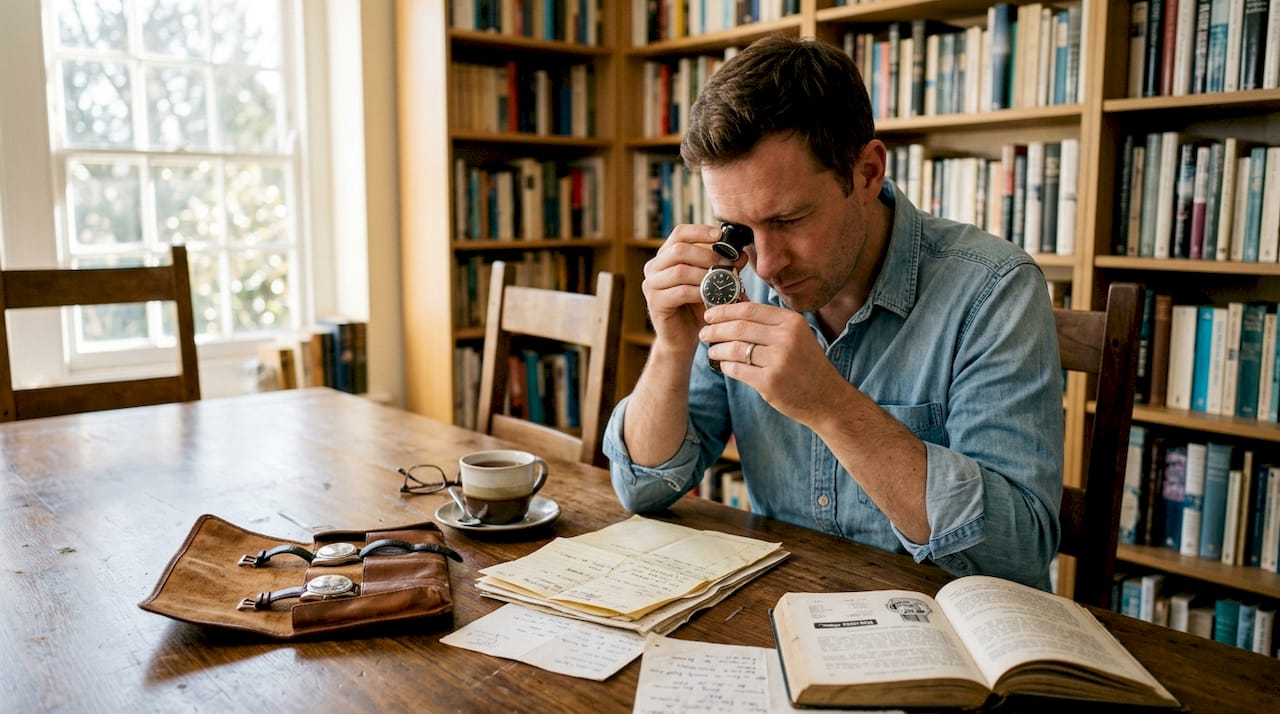
Many collectors assume that a luxury watch with its original box and papers is automatically authentic and investment-grade. That assumption can cost you dearly. Box and papers alone offer no guarantee of authenticity, and even experienced buyers have been caught out by convincing forgeries. True provenance runs far deeper than documentation. It shapes desirability, protects value, and determines whether a timepiece is a sound investment or an expensive mistake. This guide walks you through what provenance genuinely means, how it moves markets, and what you can do to build and protect it.
Table of Contents
Key Takeaways
Point | Details |
Provenance is multi-layered | It covers documents, expert assessment, and a watch’s entire verified story. |
Value hinges on history | A well-documented history of ownership and care directly boosts a watch’s market value and appeal. |
Inspection trumps paperwork | Expert physical and movement checks are essential because papers can be forged. |
Digital tools add, not replace | Blockchain and NFC help, but human skills remain vital in verifying provenance. |
Record and protect provenance | Diligently documenting and safeguarding your watch’s story is your best tool for future profit and trust. |
Defining wristwatch provenance: more than papers and boxes
Provenance, in the context of luxury watches, refers to the complete, verifiable history of a timepiece. Where it was made, who owned it, how it was serviced, and whether each of those facts can be substantiated. It is not simply a synonym for authenticity, though the two are closely related. A watch can be genuine without having strong provenance, and a watch with impressive paperwork can still carry serious doubts if the physical evidence does not match.
Think of provenance as a chain of trust. Every link matters. A break anywhere in that chain, whether a missing service record or an undocumented ownership transfer, introduces uncertainty. Uncertainty, in the luxury watch market, translates directly into reduced value.
The major components of strong provenance include:
Ownership history: A traceable record of who has owned the watch and when, ideally supported by invoices or correspondence.
Expert verification: Independent authentication by a qualified horologist or specialist dealer.
Service and repair records: Dated receipts showing where and when the movement was serviced, and which parts, if any, were replaced.
Physical inspection: Examination of the case, dial, movement, and engravings to confirm they match the reference and production period.
Original documentation: Warranty cards, certificates, and instruction booklets that are consistent with the watch’s serial number and production date.
It is worth understanding how brand value and provenance interact. A Patek Philippe with full provenance commands a fundamentally different market position than an identical reference with gaps in its history, even if both watches are genuine.
Element | Strong provenance | Weak provenance |
Ownership history | Documented and traceable | Unknown or unverifiable |
Service records | Complete with dated receipts | Missing or inconsistent |
Physical inspection | Passes expert scrutiny | Unverified or skipped |
Documentation | Consistent with serial number | Generic or mismatched |
Pro Tip: Never let paperwork be the final word. UK experts prioritise movement inspection and physical verification above all else. If a seller resists an independent inspection, treat that as a significant warning sign.
The pitfall many buyers fall into is treating documents as proof. Documents can be copied, altered, or simply purchased separately from the watch they are supposed to accompany. Physical evidence, particularly the movement, is far harder to fabricate convincingly.
How provenance impacts value and market desirability
Once you understand what provenance comprises, its influence on price becomes obvious. But the scale of that influence often surprises even experienced collectors.
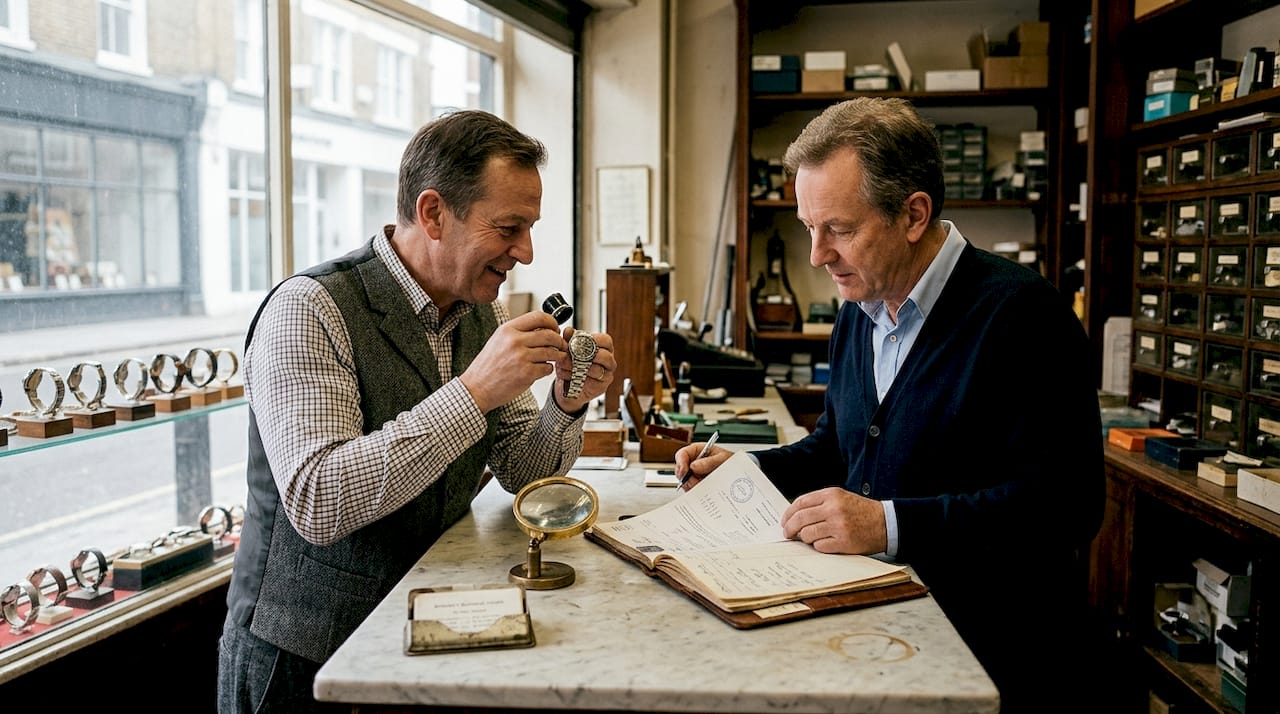
Consider two examples of the same Rolex Daytona reference. One comes with a full ownership chain, original warranty card matching the serial number, and service records from an authorised centre. The other arrives with generic paperwork and no traceable history. At auction, the difference in hammer price can reach 20 to 40 per cent, sometimes more if the first watch carries a notable previous owner or a particularly early production date.
Celebrity-linked or historically significant pieces represent the extreme end of this spectrum. A watch worn by a public figure, with photographic evidence and a clear chain of ownership, can achieve multiples of its standard market value. The provenance itself becomes part of the object.
“Valuation and authentication are the cornerstones of realising genuine investment value in the luxury watch market.”
Inherited watches present a particular challenge. Many arrive with sentimental value but fragmented documentation. The previous owner may have lost the original papers, used an independent watchmaker for servicing, or simply never kept receipts. In these cases, the watch may be entirely genuine, but proving it requires more legwork.
Here is a practical process for assessing and strengthening provenance when you acquire a watch:
Request all available documentation before purchase, including warranty cards, receipts, and any correspondence related to the watch.
Commission an independent inspection from a qualified expert who can examine the movement, case, and dial.
Cross-reference the serial number with the manufacturer’s production records where possible.
Photograph everything at the point of purchase, including the watch, documents, and packaging.
Use a structured valuation checklist for collectors to ensure no element is overlooked.
When sourcing rare watches, provenance research should begin before you commit to any price. The secondary market rewards those who do the groundwork.
Scenario | Provenance strength | Likely market impact |
Full papers, known ownership | Very strong | Premium above market rate |
Genuine watch, no papers | Moderate | Below average market rate |
Celebrity-linked, documented | Exceptional | Significant premium |
Unknown history, mismatched docs | Weak | Discount or unsaleable |
Expert approaches to authentication: documents, inspection, and digital tools
Knowing that provenance adds value is straightforward. Knowing how professionals actually verify it is where collectors gain a real edge.
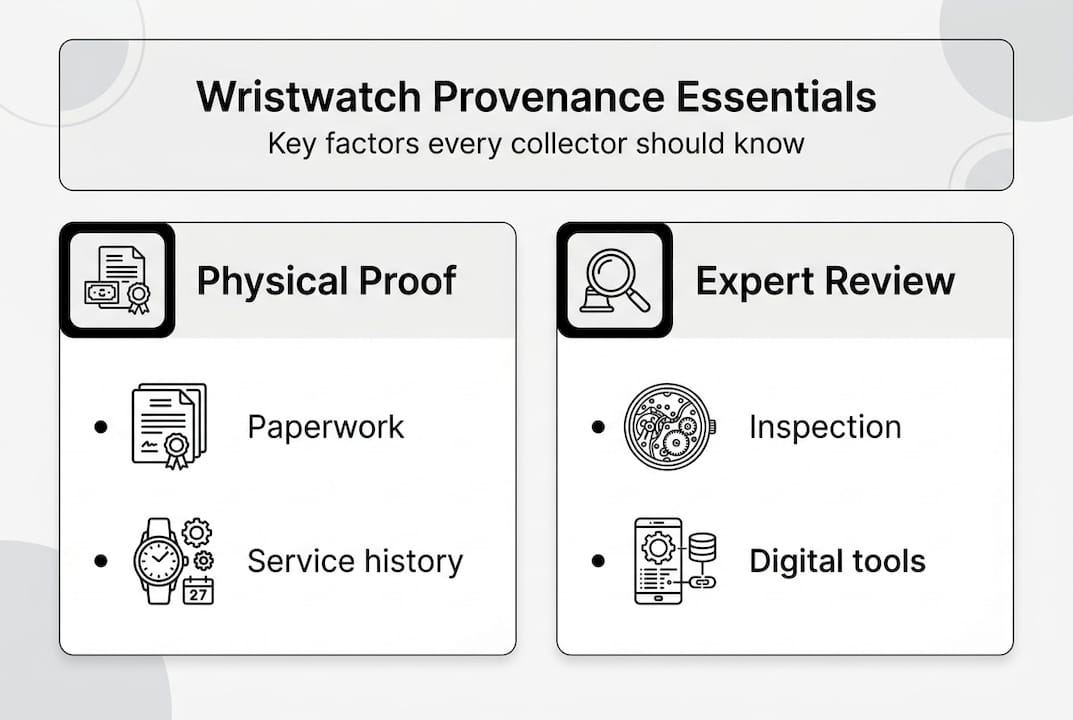
Experts begin with the physical watch itself, not the paperwork. The movement is examined under magnification for signs of tampering, replacement parts, or inconsistencies with the stated reference and production era. Case engravings are checked for sharpness and consistency. The dial is scrutinised for reprinting, refinishing, or incorrect fonts. Even the crown and pushers receive attention.
Beyond the watch itself, experts look for:
Consistency between serial number and production date as recorded by the manufacturer.
Matching reference numbers across the case back, movement, and documentation.
Service stamps and authorised centre records that align with the watch’s age and condition.
Signs of polishing that would indicate the case has been refinished, potentially removing original finishing and reducing value.
Correct fonts and print quality on warranty cards and certificates, since forged documents often carry subtle inconsistencies.
The risks of relying on documents alone are well established. Blank warranty cards have been sold separately for decades. A convincing-looking set of papers can be assembled without any connection to the watch being sold. This is why spotting fake watches requires physical expertise, not just document review.
Digital tools are changing part of this landscape. Blockchain-based provenance registries and NFC-enabled certificates are being adopted by some manufacturers and dealers. These systems create tamper-resistant records that can be verified independently. However, blockchain and NFC tools are still emerging, and the vast majority of pre-owned watches in circulation predate these technologies entirely.
Pro Tip: When authenticating luxury watches, always insist on a physical inspection by a specialist who has handled multiple examples of the same reference. Familiarity with a specific model is what separates a useful opinion from a superficial one.
Human expertise remains the gold standard. Digital tools can support and record, but they cannot replace the trained eye of someone who has examined hundreds of the same reference.
Building and transferring provenance: best practices for collectors
Provenance is not fixed at the point of manufacture. You can actively build it, maintain it, and transfer it in a way that protects value for the long term.
Here is how to document a watch’s journey effectively:
Keep every invoice and receipt related to the purchase, including any auction or dealer documentation.
Record all servicing with dated receipts from the watchmaker or authorised service centre, noting which parts were inspected or replaced.
Secure original certificates and warranty cards in a dedicated folder or archive, separate from the watch itself to protect against loss or damage.
Commission a written appraisal from a recognised expert, particularly before insuring or selling the watch.
Photograph the watch regularly, including the movement if it is opened for service, to create a visual record of its condition over time.
When passing a watch on, whether through sale or inheritance, the transfer of documentation is as important as the transfer of the object. A clear, written account of the watch’s history, signed by the outgoing owner, adds a layer of trust that no document alone can provide.
Things to avoid:
Never polish the case unless you are prepared to accept a reduction in value. Original finishing is part of the watch’s story.
Avoid using unauthorised watchmakers for significant work, as this can introduce doubt about which parts are original.
Do not discard packaging, even if it seems worn. Original boxes carry their own value and contribute to the overall provenance.
Do not misrepresent the watch’s history when selling. Inaccurate provenance claims carry legal risk and damage trust in the market.
Expert verification and service history are consistently cited as the factors that most increase resale value. If you are considering selling watches securely online, having this documentation in order before you list will strengthen your position significantly. Working with trusted luxury watch dealers also ensures that your watch’s provenance is presented accurately and compellingly to the right buyers.
The uncomfortable truth about provenance: why it’s never as simple as it looks
After years in the luxury watch market, we have seen one pattern repeat itself more than any other. Collectors who treat provenance as a checklist get caught out. Those who treat it as an ongoing investigation rarely do.
Even a seemingly perfect ownership chain can be manufactured. Documents can be assembled, stories can be rehearsed, and photographs can be staged. We have encountered watches with immaculate paperwork that failed physical inspection at the first serious look. The paperwork was real. The watch was not what it claimed to be.
The mindset shift that separates serious collectors from vulnerable ones is this: scepticism is not rudeness. Asking for an independent inspection, cross-referencing serial numbers, or requesting a second opinion is not an insult to the seller. It is due diligence. Any reputable seller will welcome it.
Our advice, built from genuine market experience, is to always use multiple verification routes. Never rely on a single source of confirmation, whether that is a document, a seller’s word, or even one expert’s opinion. The expert discreet sale processes that protect both buyers and sellers exist precisely because the stakes are high and the risks are real. Trust the physical evidence first, the paper trail second, and always verify both.
Connecting you to trusted provenance and luxury watch solutions
Understanding provenance gives you a genuine advantage in the market. But applying that knowledge confidently requires access to experts who share your standards.
At Horology Kings, we work with collectors and investors across the UK who prioritise authenticity, transparency, and long-term value. Whether you are looking to source authentic watches with verified provenance, or need access to expert servicing and repair that preserves your watch’s history, our team brings the expertise and discretion that serious collectors deserve. Every transaction we facilitate is built on the same principle: physical evidence and expert opinion come first. Get in touch to discuss your collection and discover how we can support your next acquisition or sale.
Frequently asked questions
What counts as strong provenance for a luxury wristwatch?
Strong provenance includes a traceable ownership history, consistent original documentation, a complete service record, and a passed physical inspection by a qualified expert. Experts prioritise movement and case inspection above paperwork alone.
Can luxury watch papers and box be forged?
Yes, papers and boxes can be forged or sourced separately from the watch itself. Physical inspection is crucial and should never be skipped, regardless of how convincing the documentation appears.
Is digital provenance technology trustworthy for wristwatches?
Digital solutions such as blockchain registries are promising for new watches, but cannot replace human expertise for the majority of pre-owned pieces currently in circulation.
How does provenance affect watch investment value?
Watches with strong, documented provenance consistently command higher prices and attract more serious buyers. Valuation and authentication are the key factors in realising full investment value at the point of sale.
Recommended
Comments