.png)

What is a watch waiting list? your complete guide
- lewisvrichards3
- Jul 16
- 8 min read

TL;DR:
A watch waiting list is a relationship-based system used by authorized dealers to allocate highly sought-after luxury watches. Building long-term rapport with a dealer and demonstrating genuine interest increases the chances of getting the desired watch, especially for models with long waits like the Rolex Daytona or Patek Nautilus. Alternatively, buyers can explore the secondary market for immediate access, though at a higher cost.
A watch waiting list is a relationship-based allocation system used by authorised dealers to distribute highly sought-after luxury watches to their most valued clients. This is not a traditional queue where patience alone wins. Brands such as Rolex, Patek Philippe, and Audemars Piguet produce far fewer units of their most desirable models than the market demands. Dealers hold the power to decide who receives those watches, and they base that decision on purchase history, loyalty, and personal rapport. Understanding this system is the difference between waiting indefinitely and actually getting the watch you want.
What is a watch waiting list and how does it work in practice?
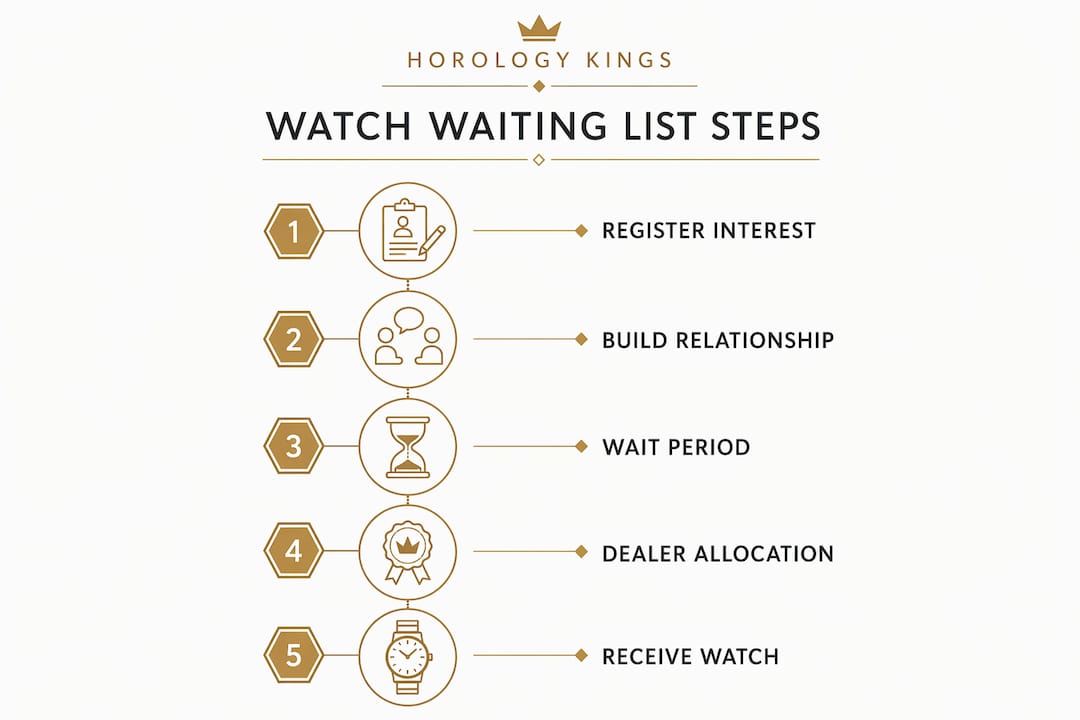
A watch waiting list is, in practice, an internal interest register managed independently by each authorised dealer. No centralised global list exists. Every dealer maintains their own records and allocates stock entirely at their own discretion.

The system changed significantly between 2017 and 2019. Before that period, many dealers operated rough chronological lists. Then social media demand surged, secondary market prices exploded, and speculators began joining lists purely to flip watches for profit. Dealers responded by abandoning the queue model entirely. Allocation became a reward for loyalty rather than a prize for patience.
Today, dealers weigh several factors when deciding who receives a coveted piece:
Purchase history: Clients who have bought multiple watches from the same dealer over several years rank highest.
Client loyalty: Attending brand events, maintaining a consistent relationship, and showing genuine enthusiasm for the brand all count.
Spend profile: Buying across a range of models, not only the most desirable ones, signals that you are a collector rather than a speculator.
Dealer relationship: Personal rapport with the sales team matters more than most buyers realise.
Wait times reflect this complexity. Allocation timelines vary widely, from one to three years for a Rolex Submariner to five years or more for a steel Daytona, and multi-year relationships are required before Patek Philippe Nautilus allocation is even considered. Some references carry waits exceeding eight years in competitive markets.
Pro Tip: Register your interest at a single authorised dealer rather than spreading yourself across several. Dealers notice divided loyalty, and concentrating your purchases in one place builds your profile far faster.
Why do certain luxury watches have waiting lists and others do not?
Waiting lists exist only for a narrow group of models. Iconic sports references such as the Rolex Submariner, Rolex Daytona in steel, Patek Philippe Nautilus, and Audemars Piguet Royal Oak Jumbo carry lists because demand outstrips supply by a significant margin. The rest of each brand’s catalogue is generally available without any wait.
Brands deliberately control production volumes. This is not simply a manufacturing limitation. It is a considered strategy to protect desirability and brand integrity. A watch that anyone can walk in and buy loses the cultural weight that makes it worth owning in the first place.
Social media accelerated the problem. Platforms such as Instagram and YouTube brought these models to a global audience that had never previously engaged with fine watchmaking. Demand grew faster than any manufacturer could or would match. Secondary market prices climbed to two to three times retail, which attracted speculators who had no interest in wearing the watches at all.
The table below illustrates how allocation timelines differ across model categories:
Model category | Typical wait | Key factor |
Rolex Submariner | 1–3 years | Strong purchase history required |
Rolex Daytona (steel) | 5+ years | Loyalty investment often exceeds £80,000 |
Patek Philippe Nautilus | Multi-year relationship | Dealer discretion, no formal list |
Audemars Piguet Royal Oak Jumbo | 2–5 years | Event attendance and client profile |
Non-sports luxury models | Often immediate | Standard retail availability |
Allocation systems protect brand integrity by filtering out buyers who intend to flip rather than collect. Dealers favour clients who share the brand’s values, and that preference is entirely deliberate.
How can buyers improve their chances of allocation?
The single most effective strategy is building a genuine, long-term relationship with one authorised dealer. This takes time, and there are no shortcuts. Buyers who treat the process as transactional rarely succeed.
Asking for a highly sought model as a first purchase is almost always counterproductive. Dealers use those watches as rewards for established clients. Walking in and requesting a steel Daytona on your first visit signals that you are not a collector. It signals that you are a speculator.
A practical approach to building dealer rapport looks like this:
Choose one authorised dealer and commit to them. Spreading purchases across multiple dealers dilutes your profile at each one.
Buy non-hot models first. Purchasing watches from the broader catalogue demonstrates genuine interest in the brand rather than a single trophy piece.
Attend brand events. Dealers invite valued clients to launches, dinners, and exhibitions. Accepting those invitations builds personal rapport.
Be consistent over years, not months. Allocation decisions reflect a client’s history over time. A single year of purchases rarely qualifies anyone for a top-tier model.
Communicate honestly. Tell your sales contact which model you ultimately want. Transparency about your goals helps them advocate for you internally.
Learn how to negotiate effectively. Understanding the etiquette of luxury watch transactions improves every interaction with a dealer.
The financial commitment involved is real. Cumulative purchases before allocation for a steel Daytona can exceed £100,000 in some markets, reflecting years of loyalty investment. That figure is not a rule, but it illustrates the scale of commitment that top-tier allocation can require.
Pro Tip: Ask your dealer contact directly what their allocation criteria look like. Most will not volunteer this information, but a direct, respectful question often produces a candid answer that shapes your strategy.
What alternatives exist to waiting lists?
The secondary market is the most immediate alternative to dealer allocation. Watches available through resellers, auction houses, and independent dealers like Horology-kings can be acquired without any wait. The trade-off is price. Secondary market premiums on the most sought-after references regularly run well above retail, reflecting the cost of immediacy.
Buyers considering the secondary market should weigh the following:
Authenticity verification: Always buy from a reputable source that provides full documentation, service history where available, and a clear provenance trail.
Price premium: Paying above retail is normal for hot references. Paying significantly above the current secondary market rate is not. Research comparable sales before committing.
Condition: Pre-owned watches vary widely in condition. Polished cases, missing box and papers, or replaced components all affect long-term value.
Timing: Secondary market prices fluctuate. Models that trade at a large premium today may soften if demand shifts or production increases.
The secondary market also influences authorised dealer behaviour. When resale prices climb sharply, dealers tighten allocation further to prevent flipping. This creates a feedback loop where secondary market activity makes dealer allocation harder to obtain, which in turn pushes more buyers toward the secondary market.
For buyers who want a specific reference without a multi-year wait, working with a trusted independent dealer or specialist sourcing service is often the most practical route.
Key takeaways
A watch waiting list is a relationship-based allocation system, not a queue, and dealer discretion determines who receives the most sought-after models.
Point | Details |
No central list exists | Each authorised dealer manages their own internal interest register independently. |
Loyalty drives allocation | Purchase history, event attendance, and long-term commitment outweigh simple patience. |
Only select models carry waits | Sports references like the Rolex Daytona and Patek Nautilus face the longest waits. |
Secondary market offers immediacy | Buying pre-owned avoids the wait but typically costs more than retail price. |
Strategy matters more than timing | Building a single, consistent dealer relationship is the most effective path to allocation. |
The reality most buyers learn too late
The most common mistake I see is buyers treating a watch waiting list like a ticket in a raffle. They join the list, they wait, and they expect the watch to arrive eventually. That is not how this works, and it has not worked that way for nearly a decade.
What dealers actually want is a client who buys with genuine enthusiasm across the catalogue, shows up to events, and treats the relationship as ongoing rather than transactional. The allocation is the result of that relationship, not the starting point. I have spoken with collectors who spent three years building a dealer relationship before receiving a call about a Submariner. I have also spoken with buyers who spent considerably more money but spread it across five dealers and received nothing from any of them.
The shift that happened between 2017 and 2019 was permanent. The old chronological list is gone. Patience alone does not guarantee allocation. What guarantees it, as much as anything can, is being the kind of client a dealer genuinely wants to call first. That means buying watches you actually like, attending events you find interesting, and building a relationship that feels real on both sides. Collectors who approach it that way tend to get the watches they want. Those who treat it as a system to game rarely do.
If the wait feels too long or the strategy too uncertain, the secondary market and specialist sourcing services exist for exactly that reason. Knowing your options is half the battle.
— Lewis
How Horology-kings can help you source the watch you want
Navigating dealer allocation takes years. For buyers who want a specific reference now, Horology-kings offers a direct alternative. Based in Hertfordshire, Horology-kings specialises in sourcing hard-to-find watches from brands including Rolex, Patek Philippe, Audemars Piguet, Omega, and Cartier. Every watch is authenticated, and every transaction is handled with full transparency and secure UK bank transfer. Whether you are buying, selling, or looking for a reference that no authorised dealer will offer you today, the Horology-kings platform connects you with the expertise and network to make it happen.
FAQ
What does a watch waiting list actually mean?
A watch waiting list is an internal interest register held by an authorised dealer, used to allocate highly sought-after models to preferred clients. It is not a formal queue and carries no guarantee of allocation.
How long is the wait on a luxury watch waiting list?
Wait times range from six months to over five years depending on the model and market. Steel Rolex Daytonas and Patek Philippe Nautilus references carry the longest waits, sometimes exceeding eight years.
Can I join a watch waiting list at any authorised dealer?
You can express interest at any authorised dealer, but allocation decisions rest entirely with the dealer. Clients with an established purchase history and personal relationship with the dealer are prioritised over new enquiries.
Why are some watches on a waiting list and others are not?
Waiting lists apply only to models where demand significantly exceeds supply, such as the Rolex Submariner, Patek Nautilus, and Audemars Piguet Royal Oak Jumbo. Most watches in each brand’s catalogue are available without any wait.
What is the fastest way to get a watch that is on a waiting list?
Building a loyal relationship with a single authorised dealer over several years is the most reliable path. For immediate acquisition, the secondary market or a specialist sourcing service such as Horology-kings offers access without the wait, though typically at a premium above retail.
Recommended
Comments