.png)
Your guide to watch authentication in 2026
TL;DR:
Buying a luxury watch without proper verification risks falling for sophisticated counterfeits, Frankenwatches, or superclones that can deceive even experts. A structured authentication process combining visual checks, documentation cross-referencing, movement examination, and professional services is essential to protect your investment. Relying solely on serial numbers is insufficient, especially with high-value vintage pieces or complex fakes, making expert verification highly recommended.
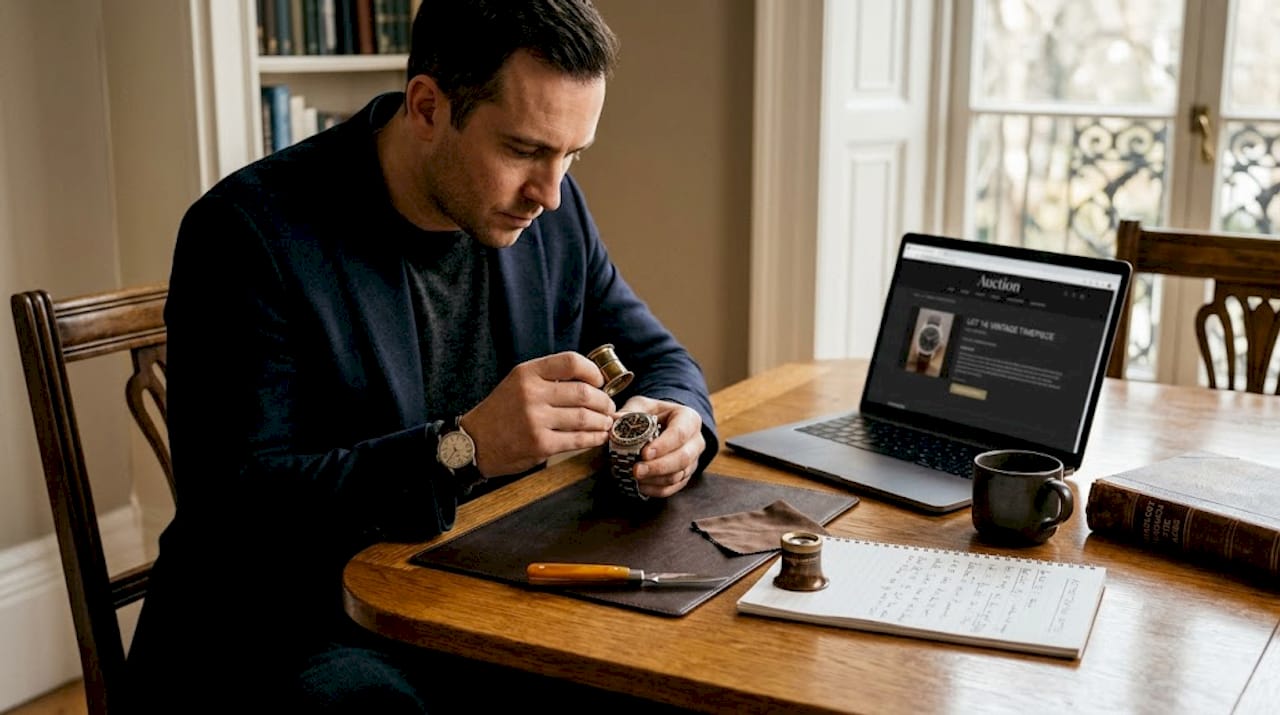
Buying a luxury watch without proper verification is a gamble that costs collectors thousands every year. Modern counterfeits have reached a level of sophistication that routinely fools experienced buyers, and the risks go beyond obvious fakes. Frankenwatches assembled from genuine parts, superclones with near-perfect finishing, and watches with copied serial numbers from auction archives all circulate freely in the pre-owned market. This guide to watch authentication gives you a structured, expert-level process to verify any luxury timepiece before money changes hands, whether you are a first-time buyer or a seasoned collector protecting a significant investment.
Table of Contents
Key takeaways
Point | Details |
Counterfeits deceive experts | Modern superclones and Frankenwatches pass casual checks; structured multi-step verification is the only reliable defence. |
Documentation absence shifts risk | A watch missing box or papers is not automatically fake, but it places the full burden of proof on the buyer. |
Serial numbers alone are insufficient | Counterfeiters copy legitimate serials; always cross-reference with movement details, case markings, and production era. |
Professional authentication is worth the cost | Roughly 34% of watches submitted for professional checks fail, proving self-authentication has real limits. |
Combine methods for reliable results | No single tool or check is definitive; combining visual inspection, database verification, and expert review gives the strongest result. |
The complete guide to watch authentication: tools and preparation
Before you inspect a single dial, you need the right equipment and knowledge. Walking into an authentication attempt without preparation is where most self-checks go wrong.
The basic toolkit
You do not need a watchmaker’s workshop, but you do need a few specific items:
10× loupe or jeweller’s loupe: The single most important tool for inspecting dial printing, case finishing, and engravings at close range
Macro camera or smartphone macro lens: Allows you to photograph details for comparison against reference images and for independent expert review
UV light (365nm): Reveals refinishing work, reluming jobs, and certain dial replacements that are invisible under normal light
Soft lint-free mat: Protects the watch during inspection and prevents scratching
Precision calipers: Useful for verifying case dimensions against published specifications
Reference database access: Model-specific resources covering dial variants, serial number ranges, and production details for brands such as Rolex, Patek Philippe, Audemars Piguet, Omega, and Cartier
Documentation and provenance
Original documentation is your first line of evidence. The box, warranty card, chronometer certificate, hang tag, and service records collectively tell the story of a watch’s life. Missing accessories are not automatic red flags, but absence of box or papers can reduce resale value by 10 to 20 percent on high-value modern watches and should prompt a more rigorous inspection process.
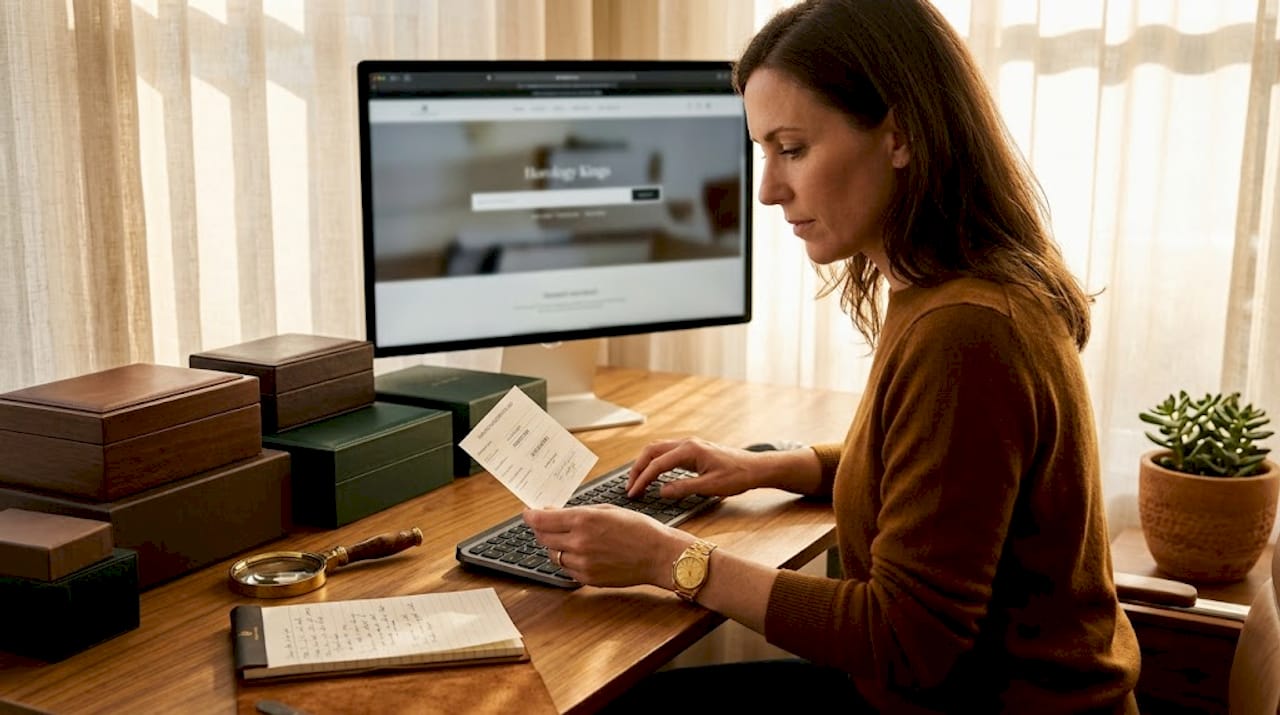
Cross-reference the serial number on the warranty card against the case and, where possible, the movement. Any discrepancy between these three sources requires explanation from the seller before you proceed.
You should also run the serial number through Enquirus, the globally recognised free database for checking whether a watch appears on any lost or stolen registry. It takes two minutes and can save you from purchasing stolen property unknowingly.
Pro Tip: Before arranging a physical viewing, research the seller’s return policy, transaction history, and any professional affiliations. A reputable seller will welcome authentication requests. Reluctance is itself a signal worth noting.
Step-by-step watch authentication process
A structured stepwise approach to authentication leaves far less to chance than a general visual impression. Work through each stage methodically.
Visual inspection of the dial. Examine the dial under your loupe in good natural light. Look at the printing quality, alignment of text, spacing between characters, and depth of any applied indices. Genuine luxury dials use multi-step printing and lacquering processes that produce sharp, clean lettering. Blurred edges, inconsistent font weights, or slightly misaligned text are immediate red flags.
Hands and crown examination. Check that the lume plots on the hands match the dial indices in colour and finish. On authentic watches, lume ageing is consistent across all parts. Inspect the crown for correct logo engravings and appropriate knurling depth. A shallow or asymmetric crown logo is a common tell.
Case and bracelet finishing. Genuine Swiss-made cases alternate between brushed and polished surfaces in precise patterns specific to each model. Run your fingernail across the transition points. Counterfeits frequently blur these lines through over-polishing. Check the bracelet clasp for correct engravings, appropriate stamping depth, and solid feel when engaging.
Serial and reference number verification. Locate the serial number (typically between the lugs on older Rolex models, on the rehaut on modern references) and the reference number. Verify both against published production records or model-specific databases. Counterfeiters copy serials from auction archives, so the number must match the movement calibre, case material, and production period, not just exist in a database.
Movement examination. If the seller permits opening the case back, examine the movement. Confirm the correct calibre designation, check for brand-specific engravings and finishing (Geneva stripes, bevelled edges, perlage), and compare rotor design against reference images. Professional authentication uses specialised tools and deep knowledge of production variations that go well beyond what the naked eye can detect, but even a basic movement check reveals obvious inconsistencies.
Document crosscheck. Match the serial on the warranty card against the case and movement. Confirm the reference number aligns with the correct dial configuration, bracelet type, and bezel variant for the production year. Service records should list the model and reference number accurately.
UV and tool-assisted inspection. Use your UV light to check for replaced lume or dial refinishing. Authentic original dials will often show consistent vintage patina under UV. A refinished or replaced dial will typically fluoresce differently. Calipers can confirm case diameter and lug width against published specifications.
Pro Tip: Photograph the watch systematically: dial straight on, case back, both sets of lugs, crown, clasp, and movement if accessible. A timestamped photo record protects you in disputes and gives independent experts all they need for a remote assessment.
Watch out for these specific red flags during your check:
Mismatched fonts between different sections of the dial
Cyclops lens on date models that does not magnify to 2.5× (Rolex standard)
Bracelet end links that flex or show visible gaps at the case junction
Caseback engravings that are too shallow, poorly centred, or slightly misspelled
Hands that are too thick or have imprecise lume plots
Common pitfalls and advanced fraud tactics
Even a thorough self-authentication can be defeated by the most sophisticated fakes on the market today. Understanding where the process breaks down is as important as knowing the steps themselves.
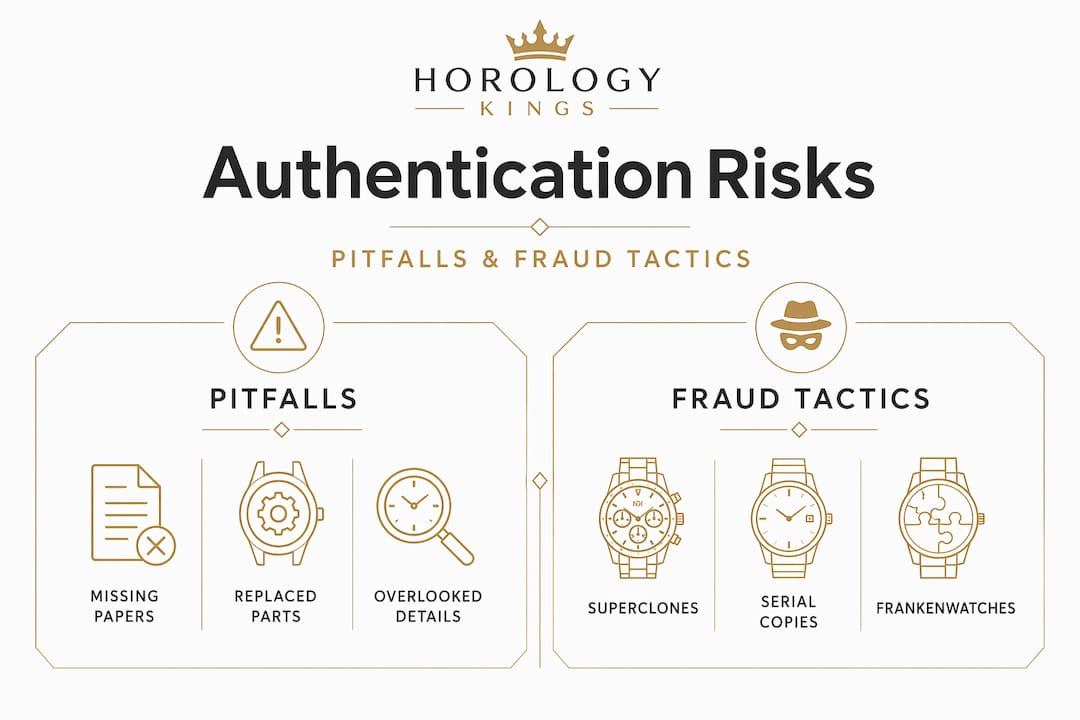
Frankenwatches are perhaps the most insidious category. These watches are assembled from genuine components, perhaps a real Rolex dial, a correct movement, and an authentic bracelet, but the parts come from incompatible models or periods. Every individual component passes a parts-level check. The watch as a whole, however, is not an authentic model and carries significantly reduced value. Detecting Frankenwatches requires a deep understanding of which components are correct for a specific reference number and production year, knowledge that most buyers simply do not have.
Superclones represent the other major risk. These are high-quality counterfeits that replicate genuine watches to within fractions of a millimetre in some dimensions. They use movements that superficially resemble the genuine calibre, and the case finishing quality has improved markedly. Visual checks alone cannot reliably distinguish superclones from genuine watches in all cases.
“No single tool or check is definitive. Combining methods and a healthy scepticism is the most reliable approach available to any buyer.”
Vintage watches introduce a different set of complications. Legitimate service replacements over decades mean a watch may have a correct-era movement but a later-production dial, or vice versa. Missing factory archives for certain references make definitive authentication extremely difficult. For vintage pieces especially, provenance documentation and a traceable ownership history are worth more than almost any individual component check.
Serial number replication is standard practice for sophisticated counterfeiters, who lift real serials from auction records and apply them to fakes. This means a serial that checks out against a production database is a necessary but not sufficient condition for authenticity. Always pair serial verification with consistent component checking across the case, movement, and documentation.
When you are dealing with any of these edge cases, self-authentication should be treated as preliminary screening, not final verdict. Request a professional third-party inspection or a brand service centre assessment before committing to a purchase.
Professional authentication services
For watches valued above £5,000, third-party certification is not optional. It is the only way to protect your investment with any real confidence. The cost of a professional inspection is a fraction of the risk you absorb by skipping it.
Here is what you should look for in a professional authentication service:
Written authentication report covering visual inspection, movement examination, serial verification, and documentation review
Clear statement of what the service does and does not certify
Transparent turnaround times (typically two to seven working days for standard assessments)
Secure shipping or in-person submission options
Return policy and liability terms clearly stated in advance
Platforms such as eBay UK offer an Authenticity Guarantee programme for qualifying luxury watches, which uses independent specialists to verify timepieces before they reach buyers. Independent horological experts and brand-authorised service centres also provide formal assessments, often with greater depth for complex or vintage references.
Service type | Best for | Typical turnaround |
Independent horological expert | All price points, complex references | 2 to 5 working days |
Brand service centre | High-value modern pieces, warranty work | 1 to 4 weeks |
Platform guarantee (e.g. eBay) | Marketplace purchases | Pre-delivery |
Specialist auction house | Rare and vintage watches | Case by case |
Pro Tip: Before finalising any purchase, ask the seller directly whether they will permit a third-party inspection and allow the watch to be sent to an authenticator at your cost. A genuine seller has nothing to lose. If they decline, treat that as a serious warning sign and walk away.
After authentication, maintaining your watch in pristine condition is part of protecting its verified value. Proper care and maintenance preserves both condition and resale premium over time.
My honest view on authenticating luxury watches
I have seen buyers with decades of experience get caught out. Not by crude fakes with wobbly printing and hollow cases, but by sophisticated assemblies that sailed through their own checks and only failed when the movement was pulled and examined under proper magnification by someone who had seen thousands of the same calibre. That experience changed how I think about authentication permanently.
The watch verification process is not a single moment of inspection. It is a discipline of structured doubt. You are not trying to confirm a watch is genuine. You are trying to find evidence it is not, and only concluding it is probably genuine once you have exhausted every reasonable line of enquiry. That mental shift makes a real difference to how thoroughly you approach each step.
My honest advice for anyone navigating the luxury watch acquisition process is this: treat your own self-authentication as a first pass, not a conclusion. It will catch obvious fakes and surface questions worth asking. But for anything significant, combine your own checks with a professional opinion before committing. The fee is always cheaper than the regret.
For vintage or undocumented watches, be especially conservative. The romance of a watch with a patchy history is real, but so is the risk. If the provenance cannot be established, price that uncertainty into what you are willing to pay.
Distrust and verification are not incompatible with enjoying the hobby. They are what make it sustainable.
— Lewis
Authenticated watches from Horology-kings
If you want to skip the anxiety of private market authentication entirely, Horology-kings offers a curated selection of verified luxury timepieces bought, sold, and sourced with full transparency. Based in Hertfordshire, the team specialises in Rolex, Patek Philippe, Audemars Piguet, Omega, and Cartier, with every watch assessed before it reaches a buyer. You can browse authenticated luxury watches directly, or use the dedicated source a watch service to have the expert network locate a specific reference for you. For personalised guidance on any purchase or authentication question, contact the team directly. Buying through a trusted specialist dealer is one of the most reliable best practices for watch authentication you can follow.
FAQ
What does a guide to watch authentication involve?
A thorough watch authentication guide covers visual inspection, serial and reference number verification, movement examination, documentation crosscheck, and UV-assisted testing. For watches above £5,000, professional third-party certification is strongly recommended.
Are serial numbers enough to authenticate a watch?
No. Serial numbers are insufficient on their own because counterfeiters routinely copy legitimate serials from auction records. The serial must be consistent with the movement, case, and production period to carry any real evidential weight.
What is a Frankenwatch and why is it hard to detect?
A Frankenwatch is assembled from genuine components that do not belong together as an original model. Because every part may be authentic, standard checks often fail to catch them, making expert knowledge of model-specific component combinations the only reliable way to identify them.
When should I use a professional authentication service?
For any luxury watch valued above £5,000, or any watch lacking original documentation, professional authentication is the recommended standard. The cost is minimal relative to the financial risk of purchasing an unverified piece.
Does missing paperwork mean a watch is fake?
Not automatically. Missing documentation shifts the verification burden entirely to the buyer and reduces resale value, but it does not by itself indicate a counterfeit. It does, however, make independent expert authentication non-negotiable before purchase.
Recommended
Comments