.png)
The role of certificates in watch resale value
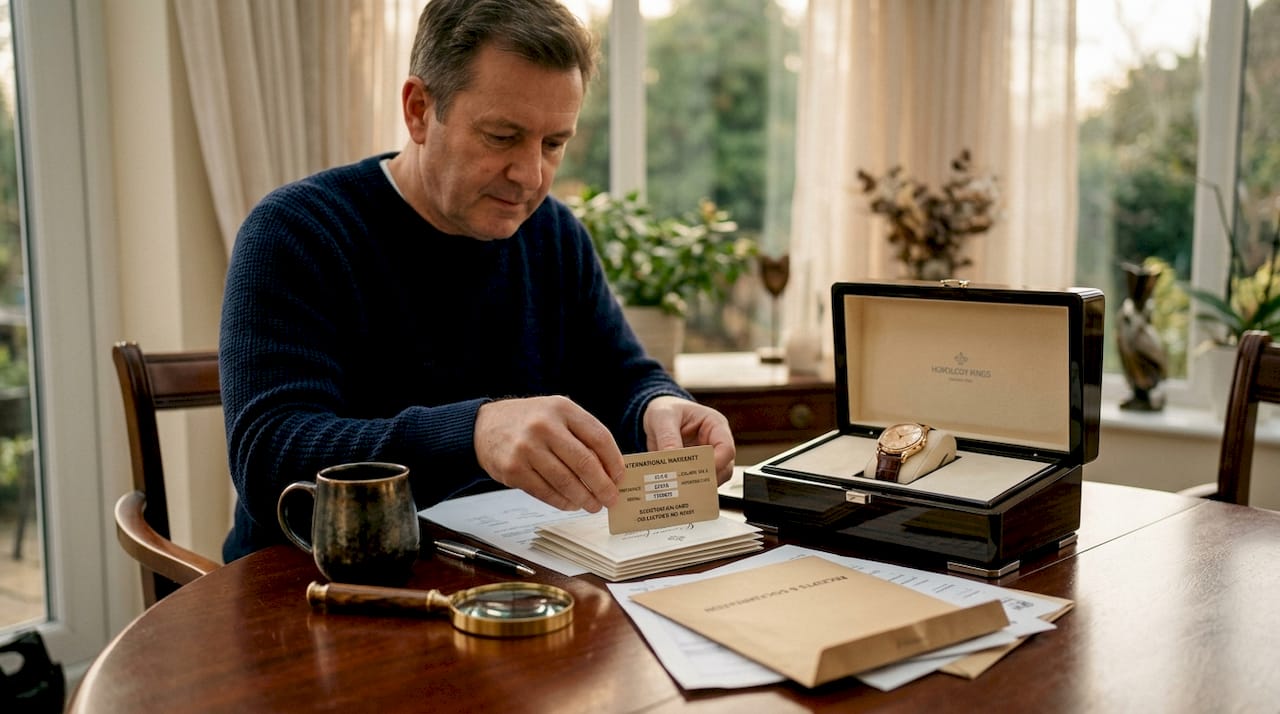
TL;DR:
Certificates significantly enhance a luxury watch’s resale value, often adding up to 25 percent.
Maintaining original documentation like warranty cards and service records builds buyer confidence and expedites sales.
Digital certificates are emerging as future standards, further emphasizing the importance of preserving all paperwork.
If you are preparing to sell a luxury watch, the role of certificates in watch resale is almost certainly something you have underestimated. Most sellers focus on condition and presentation, yet documentation consistently determines the difference between a swift sale at a strong price and a prolonged negotiation that ends in compromise. Certificates for luxury watches are not mere formalities. They carry serial numbers, validate provenance, and signal to every serious buyer that your timepiece is exactly what you claim it is. What follows will show you precisely why paperwork commands a premium and how to use it to your advantage.
Table of Contents
Key takeaways
Point | Details |
Certificates raise resale prices | A full set with box and papers can add 10 to 25 per cent to the sale price of a luxury watch. |
Watch-only sales lose buyers | Without documentation, a watch attracts fewer serious buyers and typically sells for 10 to 20 per cent less. |
CPO programmes have raised standards | Brand-backed Certified Pre-Owned programmes have made verified provenance an expectation, not a bonus. |
Preservation matters greatly | Keeping original papers, warranty cards, and service records intact protects your long-term resale position. |
Digital authentication is growing | Emerging digital certificates are becoming part of the secondary market and will influence future valuations. |
Types of certificates for luxury watches
Before you can leverage certificates effectively, you need to know what you are actually holding. The term “certificate” covers several distinct documents, and each carries its own weight in the secondary market.
Warranty cards and guarantee papers are the foundation of any full set. They contain the watch’s serial number, the retailer’s stamp, and the date of original purchase. This link between serial number and case is what allows a buyer or dealer to verify authenticity quickly and rule out counterfeiting or case-swapping.
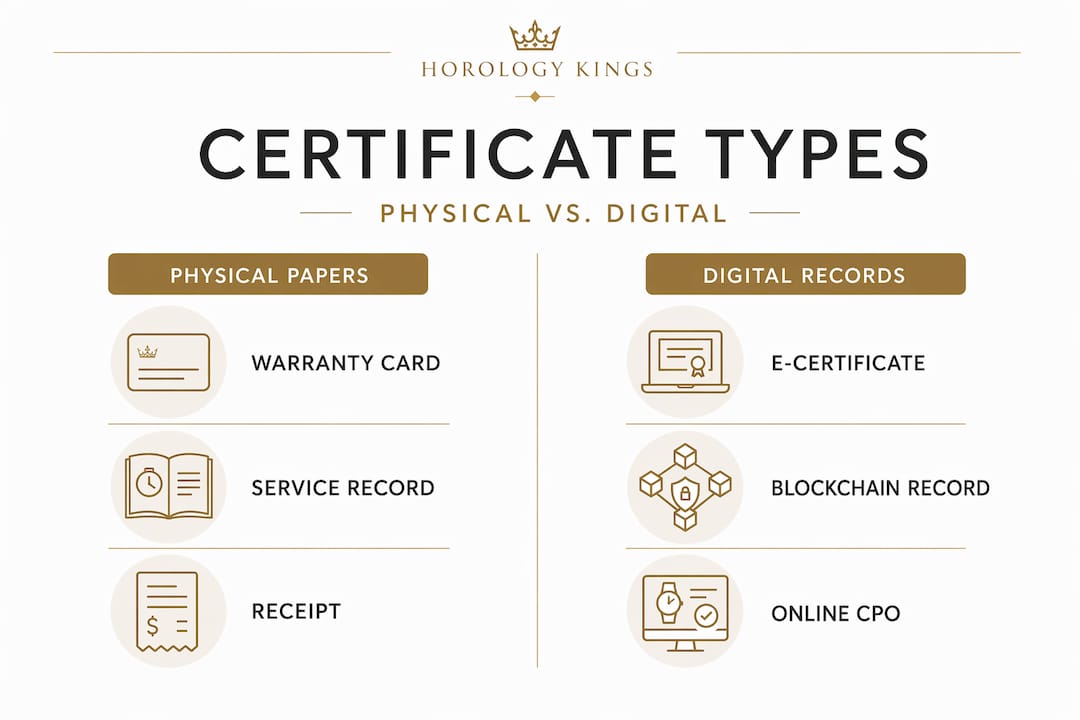
Service history records are often underestimated. When a watchmaker services a timepiece, they document which components were replaced, polished, or left untouched. Service history documentation proves the movement is factory-original and properly maintained, which is a significant factor in buyer confidence. A Patek Philippe that has been serviced by an authorised centre, with paperwork to prove it, is a fundamentally different proposition to one sold with no history at all.
Brand-issued Certified Pre-Owned documents represent the most structured form of certification. Rolex’s CPO programme, launched in 2022, offers a two-year international warranty through authorised dealers after a rigorous multi-point inspection. Owning a watch with this certification places it in an entirely different tier for resale purposes.
Digital certificates are an emerging category. Some brands and resale platforms now issue tamper-proof digital records linked to a specific serial number, creating a permanent, verifiable chain of ownership. Their significance in the secondary market is only set to grow.
Pro Tip: If you still have the original purchase receipt alongside your warranty card, keep them together. The receipt corroborates the papers and adds another layer of authenticity that sophisticated buyers will notice.
How certificates impact watch resale value
This is where documentation moves from paperwork to pounds. The financial case for preserving your certificates is concrete and well-evidenced.
A full set commands a 10 to 25 per cent premium over an identical watch sold without its box and papers. For highly sought-after references such as a Rolex Submariner or Audemars Piguet Royal Oak, that percentage gap translates into thousands of pounds. In the vintage market, the differential can be even more pronounced because original papers provide irreplaceable proof of era and originality.
Conversely, a watch sold without box, warranty card, and documentation typically achieves 10 to 20 per cent less than its full-set equivalent. Beyond price, the absence of papers slows down the sale. Buyers who cannot verify provenance easily will either negotiate aggressively or walk away entirely.
Scenario | Typical price impact | Sale speed |
Full set (watch, box, papers, service records) | +10 to 25% above bare watch | Fast, attracts serious buyers |
Watch and box only, no papers | Moderate reduction | Slower, more negotiation |
Watch only, no documentation | 10 to 20% below full set price | Slowest, limited buyer pool |
Brand CPO certified | Premium pricing, warranty supported | Fast, broadest buyer appeal |
The reasoning behind these figures is straightforward. Provenance from paperwork supports higher liquidity and attracts a wider pool of buyers willing to pay more. Certificates reduce the buyer’s perceived risk. When risk falls, willingness to pay rises.
There is one caveat worth understanding. Aftermarket modifications and refinishing can destroy collector value even when papers are present. Certificates cannot always compensate for an altered dial or polished case. Papers vouch for origin, not for every subsequent decision made by the owner.
Selling scenarios: with and without certificates
The channel through which you sell a watch shapes how much your certificates are worth. Understanding the difference is practical knowledge for any seller.
In a private sale, certificates do almost all the heavy lifting. The buyer cannot rely on institutional authentication, so your paperwork becomes the primary trust signal. Without it, private buyers face a binary choice: pay a specialist to authenticate the watch independently, or walk away.
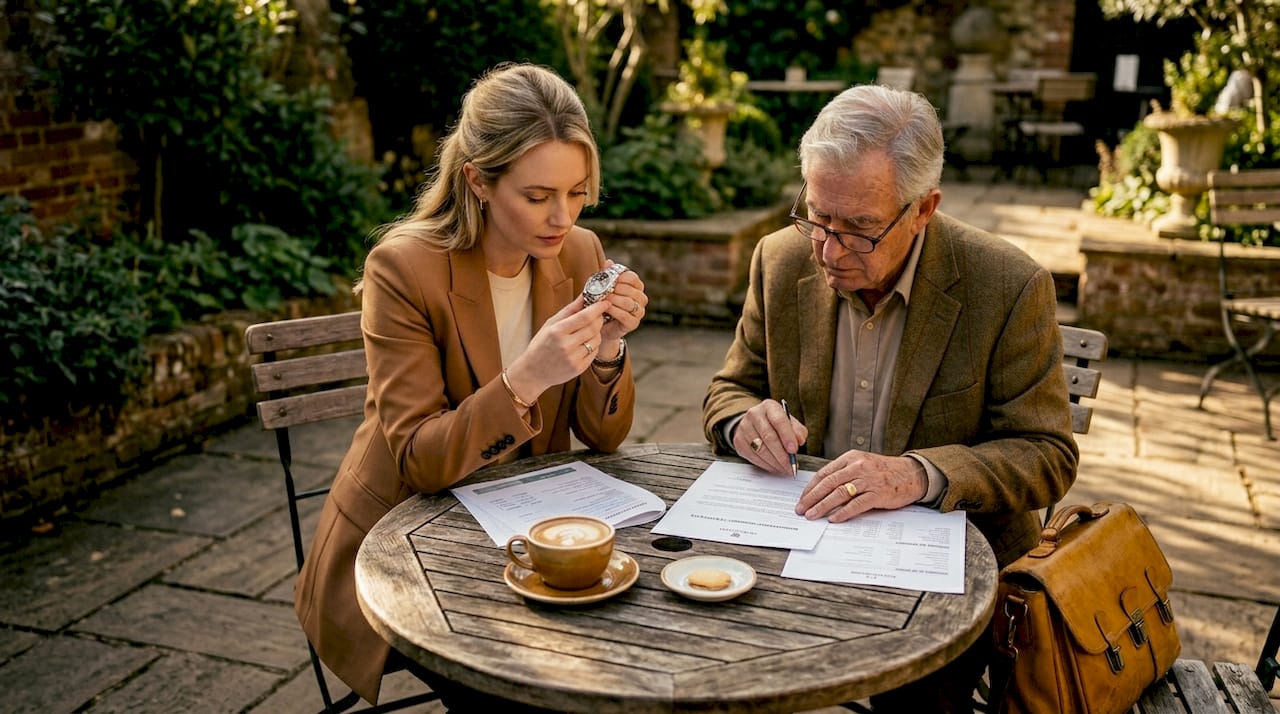
Through an authorised dealer or specialist reseller, the dealer will authenticate the piece regardless. But certificates still affect the price offered to you. A dealer acquiring a Rolex Submariner with full papers, box, and a recent service record will offer more than for an identical watch sold bare, because they know their own resale margin will be stronger.
Brand-backed CPO platforms have changed the conversation entirely. Certified watches on platforms such as those operated by authorised dealers typically cost 20 to 50 per cent less than retail yet still carry warranties and certifications. This creates a new benchmark. Buyers who shop CPO certified expect documented provenance as standard.
Key differences between selling scenarios:
Private sale with full set: highest potential return, slower to find the right buyer
Private sale, no papers: lower price ceiling, harder to generate trust
Specialist dealer with full set: quick sale, competitive offer based on full set value
Brand CPO route: structured inspection and certification, wider buyer reach, warranty-backed
Watch-only through grey market: fastest disposal, lowest return
Steel sport models like the Rolex Submariner and Daytona hold or exceed retail value when paired with papers, reinforcing how the combination of desirable reference and complete documentation creates the strongest possible resale outcome.
Preserving and using certificates effectively
Knowing certificates matter is one thing. Knowing how to protect and deploy them is what separates sellers who maximise their return from those who leave money on the table.
Store papers correctly from the start. Keep warranty cards, receipts, and service records in acid-free sleeves or the original presentation materials. Physical condition of the paperwork matters. Creased, water-stained, or torn papers still have value, but pristine documentation signals care and commands respect.
Document every service from day one. Each time your watch goes to an authorised service centre, request a dated service report and file it with your original papers. This service record builds a narrative of careful ownership that sophisticated buyers pay a premium to see.
Cross-check serial numbers before listing. The serial number on your warranty card must match the one on the watch case and, in many modern references, the movement as well. Any discrepancy will raise immediate red flags. Verify this before any buyer does.
If papers are missing, explore your options honestly. Contact the original retailer to request a duplicate receipt. Check whether the brand offers an authenticity letter for lost documentation. Some authorised service centres will inspect and issue a condition report, which does not replace original papers but provides independent verification.
Present documentation professionally during the sale. Lay papers flat, photograph them clearly alongside the watch, and include them in any listing. Buyers who see documentation displayed confidently are far more likely to proceed at your asking price.
Pro Tip: Never laminate original papers or attempt to restore damaged documents yourself. Altered documentation raises authenticity concerns that can be worse than the original damage.
Certificates and the future of luxury watch resale
The secondary market for luxury watches is not static, and the role certificates play within it is becoming more formalised rather than less.
Consumer demand for verifiable provenance has been accelerating since 2022, driven in large part by brands’ own CPO programmes raising expectations across the board. What was once seen as a helpful addition to a listing is now the baseline expectation for premium pricing.
Digital authentication technology is the next significant shift. Digital certificates and authentication technology will increasingly underpin trust and valuation in future luxury watch sales, with brand-led CPO programmes marking an industry-wide shift towards formal certification standards. For sellers, this means the analogue warranty card alone may eventually be supplemented by a blockchain-verified ownership record or brand-issued digital token linked to the serial number.
“Buyers are prioritising verifiable provenance, making ‘watch-only’ sales increasingly difficult to sell at premium prices.” — Pre-Owned Luxury Watches Buyer’s Guide 2026
Practically speaking, sellers who anticipate this shift and preserve documentation meticulously will be well positioned. Those who treat paperwork casually will face a narrowing pool of buyers at progressively lower price points as the market matures.
My honest take on this
I have seen sellers leave substantial sums on the table because they assumed a great-looking watch would speak for itself. In my experience, it rarely does. Buyers at the level where Rolex, Patek Philippe, and Audemars Piguet change hands are not buying on aesthetics alone. They are buying confidence. Certificates are the physical expression of that confidence.
What I have found most striking over years in this market is that buyers will frequently rank documented provenance above condition. A lightly worn watch with complete papers will outsell a pristine example without documentation. That runs counter to how most sellers think, and it costs them dearly.
My practical advice: treat your certificates as seriously as you treat the watch itself. From the day you purchase a luxury timepiece, build the habit of filing every receipt, every service record, and every bit of correspondence from authorised service centres. When it comes time to sell, that stack of paperwork will feel like money in your hands, because that is precisely what it is.
Brand certifications will only grow in their influence on resale valuations. Getting ahead of that trend now, rather than scrambling to recreate lost documentation later, is the single most cost-effective thing a watch owner can do.
— Lewis
Sell your watch with confidence at Horology-kings
At Horology-kings, we understand that every pound of resale value matters. Whether your watch comes with a full set of papers or you need guidance on how best to present partial documentation, our team provides honest, expert valuations and transparent transactions backed by secure UK bank transfers.
We specialise in buying and selling certified authentic timepieces from Rolex, Patek Philippe, Audemars Piguet, Omega, and Cartier. Our process is straightforward: you contact us, we assess your watch and documentation together, and we make you a fair offer based on the full picture. If you are looking to source a watch or need help navigating the certified pre-owned market, our expert network is at your disposal. Sell with confidence, knowing your paperwork is in the hands of people who know exactly what it is worth.
FAQ
Do certificates affect watch resale prices?
Yes. A full set with box and papers adds 10 to 25 per cent to the resale price of a luxury watch. Without documentation, a watch typically sells for 10 to 20 per cent less than an identical full-set example.
What documents count as certificates for luxury watches?
The most valuable documents are the original warranty card with serial number, the purchase receipt, service history records from authorised centres, and any brand-issued Certified Pre-Owned documentation. Together these form a complete provenance record.
Can I still sell a luxury watch without papers?
Yes, but expect a reduced price and a slower sale. Buyers face greater perceived risk without documentation, which limits your pool of potential purchasers and increases the likelihood of negotiation.
What is a brand CPO certificate?
A brand CPO (Certified Pre-Owned) certificate is issued after an authorised multi-point inspection of a pre-owned watch. Rolex’s programme, for example, includes a two-year international warranty and positions the watch for premium resale pricing.
Will digital certificates replace physical papers?
Not immediately, but digital authentication is growing in importance. Physical papers remain the primary standard, but digital records linked to serial numbers will increasingly complement or supplement them in the years ahead.
Recommended
Comments