.png)
Watch service history: boost value and authenticity
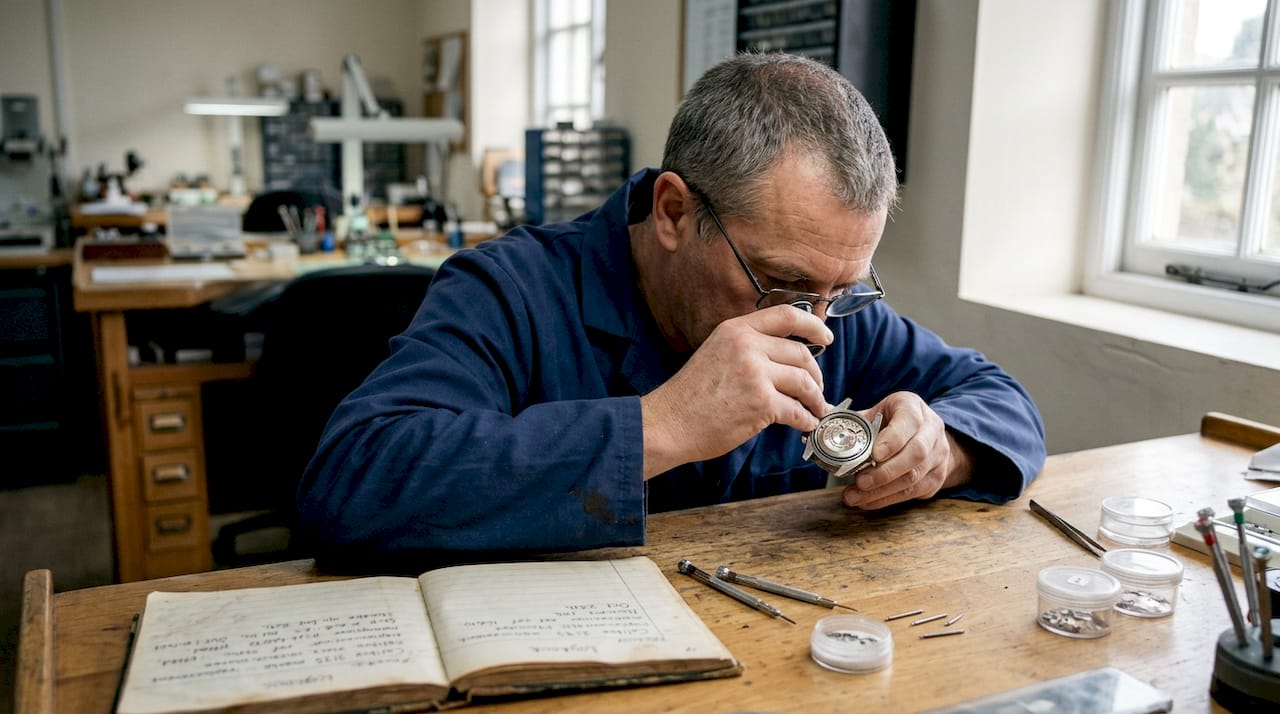
TL;DR:
Service history acts as the watch’s medical record, confirming its condition and authenticity.
Complete, verifiable servicing records increase a watch’s value, resale price, and investor confidence.
Documentation of maintenance and repairs offers critical protection for buying, reselling, and insuring luxury watches.
When collectors and investors evaluate a luxury watch, attention naturally falls on the purchase date, provenance, and original box and papers. Yet the one factor that most reliably reveals a timepiece’s true condition and worth is frequently overlooked: its service history. Think of it as the watch’s medical record, a chronological account of every professional intervention it has ever received. Without it, you are making a significant financial decision with incomplete information. This article demystifies watch service history, explains what it contains, and shows precisely how it shapes value, authenticity, and investment confidence for serious collectors.
Table of Contents
Key Takeaways
Point | Details |
Defines service history | A service history is a detailed maintenance log for a luxury watch, recording all professional repairs and servicing. |
Boosts value and trust | Documented service increases a timepiece’s market value, buyer trust, and long-term performance. |
Essential for insurance | Service records are often required by insurers to validate claims and assure policy cover. |
Verification best practices | Always check for official stamps, detailed service entries, and avoid watches with vague or missing records. |
What is a watch service history?
A watch service history is a chronological log detailing every professional maintenance procedure, mechanical overhaul, and repair that a timepiece has undergone throughout its life. As watch servicing records confirm, service history is a record of all maintenance and repairs performed on a luxury watch. It is not a single document but rather an accumulating body of evidence that grows with each professional intervention.
Understanding what belongs in a genuine service history is essential before you can evaluate one. Standard entries typically include:
Date of service: The precise date each procedure was carried out.
Servicing party: The name, credentials, and ideally the stamp of the workshop or authorised service centre.
Nature of work performed: A description of the specific procedures completed, such as a full movement overhaul, regulation, or water-resistance testing.
Parts replaced: A list of any components swapped out, including gaskets, crowns, crystals, or movement parts.
Observations and notes: Any anomalies noted by the technician, such as evidence of prior unauthorised work or unusual wear.
It is equally important to know what a service history does not include. Incidental cleaning by an owner, unrecorded adjustments, and cosmetic alterations carried out without professional documentation are absent from any credible record. If someone claims their watch was “serviced” but cannot produce paperwork, that claim carries no weight in the collector market.
Service records come in several formats. Older pieces may have a brand-specific logbook with physical stamps from authorised service centres. More recent servicing may be logged digitally, with invoices and job sheets issued electronically. Both formats are valid, provided the source is verifiable.
Pro Tip: Always request stamped service booklets or digital entries from authorised service centres when purchasing a pre-owned piece. A receipt from an independent watchmaker, while not worthless, carries considerably less weight than documentation from a manufacturer’s own service network.
Brands such as Rolex, Patek Philippe, and Audemars Piguet maintain their own service centres and issue official documentation with each completed service. These records are the gold standard. Third-party servicing is not inherently problematic, but the credentials of the workshop and the detail of the paperwork matter enormously.
Why does service history matter for luxury watches?
Understanding the records themselves is only part of the story. Grasping why a service history is indispensable for anyone serious about collectable timepieces is what separates informed collectors from those who learn costly lessons after the fact.
Here are the four core reasons service history is non-negotiable for luxury watch ownership:
Proof of authenticity. A detailed service record tracks original components and reveals any non-authorised interventions. If a movement part was replaced with a non-genuine component, a thorough service record will expose this. Conversely, a clean history from authorised centres confirms the watch remains mechanically authentic.
Value retention and growth. A well-documented service history can add substantial value to resale prices for luxury watches. Watches with complete, uninterrupted service timelines consistently command higher prices at auction and in private sales than comparable pieces with gaps in their records.
Performance assurance. A mechanical watch is a precision instrument. Service history demonstrates that the movement has been properly maintained at appropriate intervals, typically every three to five years for most Swiss movements. This is evidence of mechanical health, not merely aesthetic care.
Investor confidence. Serious buyers and reputable dealers trust timepieces with verifiable service timelines. The lasting value from regular servicing is not incidental; it is the direct result of documented, disciplined maintenance. For investment-grade pieces, this confidence translates directly into liquidity.
Consider a Rolex Submariner with three decades of ownership. Two examples side by side, one with complete authorised service records and one without, will achieve meaningfully different prices. The difference is not cosmetic. It reflects genuine uncertainty about the condition of the movement, the originality of the parts, and the risk a buyer assumes by purchasing blind.
Typical entries you should expect in a watch service record
Given the importance of service documentation, it pays to know precisely what a genuine record looks like and what should raise concern.

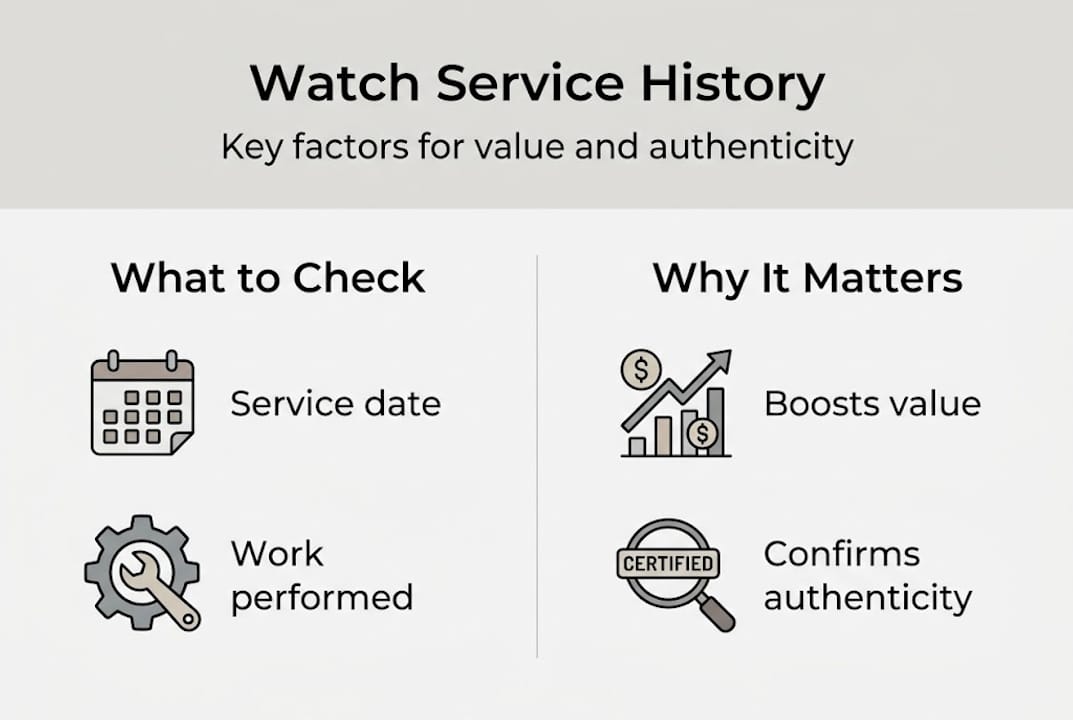
A proper service record includes the service date, work performed, and the service provider’s credentials. Beyond that baseline, here is what to look for when reviewing documentation:
Element | What to look for | Red flag |
Service date | Specific day, month, and year | Vague or approximate dates |
Workshop details | Name, address, official stamp | No identifying information |
Work description | Detailed list of procedures | Generic terms like “full service” only |
Parts replaced | Named components with part numbers | Absent or unspecified |
Technician sign-off | Signature or technician ID | No attribution |
Brand-specific logbooks from manufacturers such as Omega or Cartier are formatted to capture all of this information in a standardised way. They include pre-printed fields, official stamps, and space for the technician’s notes. Universal digital records, such as those issued by independent watchmakers, should mirror this level of detail even if the format differs.
When authenticating service history, look for consistency between the stated service intervals and the age of the watch. A thirty-year-old piece with only one service entry is either exceptionally rare or more likely missing documentation. Similarly, luxury exclusivity insights suggest that the perceived rarity of a piece should never override the need for verifiable documentation.
Bullet points to watch for when reviewing records:
Unauthorised entries from uncredentialled workshops
Missing dates between known ownership periods
Vague descriptions that do not specify procedures
Evidence of polishing not recorded in the service notes
Discrepancies between stated parts and the watch’s current physical condition
How service history influences purchase, resale and insurance
Now that you can identify a reliable service record, it is time to see how this knowledge applies in practical scenarios, whether you are purchasing, reselling, or seeking insurance coverage.
When buying, a complete service history gives you genuine bargaining power and assurance. You know what work has been done, what parts are original, and what the movement’s condition is likely to be. A watch without documentation forces you to price in the cost and uncertainty of an independent service assessment, which can run into hundreds or even thousands of pounds for complex movements.
Here is a practical comparison:
Scenario | With full service history | Without service history |
Purchase confidence | High, verifiable condition | Low, unknown mechanical state |
Resale value | Premium pricing achievable | Discount typically required |
Insurance coverage | Straightforward documentation | Potential claim complications |
Auction performance | Stronger bidder interest | Reduced competitive bidding |
When reselling, the numbers speak clearly. Collectors who have maintained warranty versus service record distinctions understand that a warranty alone does not substitute for ongoing service documentation. A watch sold with its full service dossier will attract more buyers, generate stronger bids, and close faster than an equivalent piece with gaps in its history.
For insurance, the implications are equally significant. Insurers often require confirmed service history for full policy payouts on luxury watches. Without it, a claim may be disputed, reduced, or rejected outright. This is particularly relevant for high-value pieces where the difference between a partial and full payout could be tens of thousands of pounds.
Pro Tip: Request the full service dossier as part of your due diligence, not just the most recent receipt. A single recent service tells you little about the watch’s history before that point. The complete record is what matters.
For those sourcing rare pieces, service history can also reveal whether a sought-after reference has been modified, refinished, or had components swapped, all factors that affect both desirability and price in specialist markets.
The overlooked power of service history in shaping the luxury market
There is a persistent assumption in the collector community that box and papers are the ultimate indicator of a watch’s value and authenticity. We would argue this view is incomplete, and in some cases actively misleading.
Original boxes and papers can be separated from a watch, lost, or in rare cases fabricated. They tell you about the watch’s origins but say nothing about what has happened to it in the intervening years. A watch that left the boutique in pristine condition twenty years ago may have been neglected, modified, or poorly serviced since. The box proves nothing about current mechanical integrity.
Service history, by contrast, is far harder to fabricate convincingly across multiple entries and decades. It is the real proof of enduring value. In our experience at Horology Kings, watches with impeccable service records consistently outperform similarly boxed but poorly maintained pieces at auction and in private transactions. Savvy buyers have learnt to prioritise the service dossier over the packaging.
This matters for the broader market too. As reputable dealers increasingly require documented service history as a condition of purchase, the market is slowly recalibrating around genuine mechanical provenance rather than surface-level presentation. Collectors who understand this shift are better positioned to acquire pieces that hold and grow in value.
Protect your timepiece investment with expert service and documentation
At Horology Kings, we believe that every serious collector deserves complete confidence in the pieces they own, buy, and sell. That confidence begins with proper documentation.

Our team provides authenticated professional watch servicing and ensures that every piece we handle comes with verified, detailed service records. Whether you are looking to source a luxury watch with a clean and complete history, or you need expert guidance on the documentation accompanying a piece in your collection, we are here to help. As a trusted luxury watch retailer based in Hertfordshire, we combine deep horological knowledge with transparent, secure transactions to protect and grow your investment.
Frequently asked questions
Can a missing service record significantly devalue a luxury watch?
Yes, missing service history typically lowers value and makes resale or insurance more difficult for luxury watches. Documented service history adds measurable value, and its absence introduces uncertainty that buyers will price accordingly.
Is a manufacturer’s warranty the same as a service history?
No, a warranty guarantees against manufacturing defects for a defined period, while service history details all care and maintenance actions across the watch’s lifetime. The distinction between warranty and service records is fundamental for any serious buyer to understand.
What documents should I ask for when buying a pre-owned luxury watch?
Always request an official service record, recent service receipts, and documentation of any part replacement. Official service records provide vital authenticity proof that no other document can replicate.
Will my insurer ask for a service record if I make a claim?
Most luxury watch insurance providers require service records to validate claims and confirm coverage. Insurers often require service history for full policy payouts, making documentation a practical financial necessity, not merely a collector’s preference.
Recommended
Comments