.png)

What is a mechanical movement in a watch?
- lewisvrichards3
- Jul 14
- 8 min read

TL;DR:
Mechanical movements are powered by stored spring energy and do not use batteries, relying on core components like the mainspring, gear train, escapement, and oscillator. They require regular servicing every three to five years to maintain accuracy and are favored for their craftsmanship, heritage, and the experience they offer. Manual-wind and automatic are the two main types, with automatic watches winding themselves through wrist motion.
A mechanical movement is defined as a system that powers a watch through stored spring energy, converting that energy into regulated motion without any battery. The mechanism inside the case relies on four core systems: a mainspring, a gear train, an escapement, and an oscillator. Together, these parts form what horologists call a calibre. Understanding how a mechanical movement works separates a casual wearer from a genuine enthusiast, and it is the foundation for appreciating why watches from Rolex, Patek Philippe, and Audemars Piguet command such enduring respect.
What is a mechanical movement and how does it work?
A mechanical movement is a purely mechanical system with no electrical components, relying entirely on the interaction of a mainspring, gear train, escapement, and balance wheel to keep time. That definition matters because it separates the mechanical calibre from quartz and electronic movements, which depend on a battery to send current through a crystal. The mechanical movement’s characteristic sweep of the seconds hand is a visible sign of this complex internal operation.
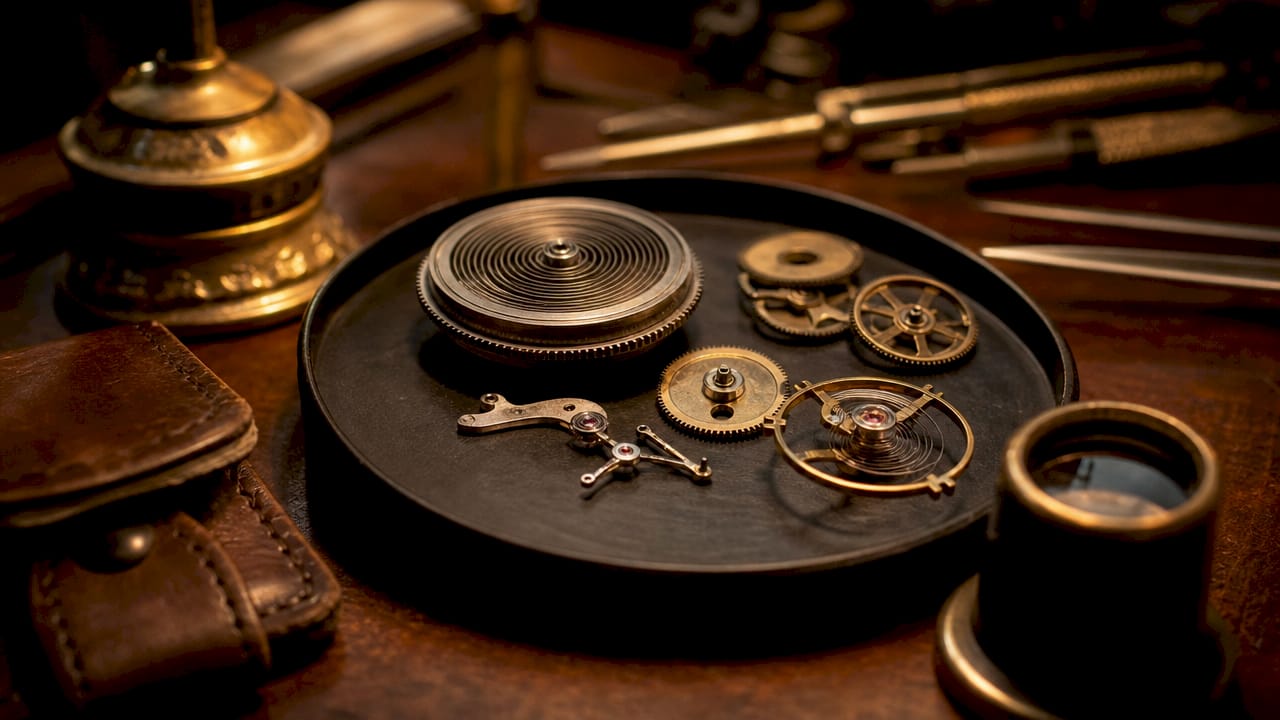
Energy flows through the movement in a specific sequence. The mainspring stores potential energy when wound, then releases it gradually through the gear train to the escapement. The escapement controls the rate of release, and the oscillator sets the rhythm. Every tick you hear is the escapement doing its job.
The mainspring and barrel
The mainspring is a long, coiled strip of metal housed inside a cylindrical barrel. Winding the crown tightens this coil, storing energy. The barrel then releases that energy slowly and steadily into the gear train. Standard power reserves for modern movements range from roughly 40 to 50 hours, with some high-end calibres lasting considerably longer. That range tells you how long a fully wound watch will run before stopping.
The gear train
The gear train transmits power) from the mainspring barrel to the escapement through a series of wheels and pinions. It includes the centre wheel, third wheel, fourth wheel, and motion work. Each wheel steps down the energy to drive the hands at the correct rate. Without the gear train, the mainspring would uncoil in seconds rather than over two days.
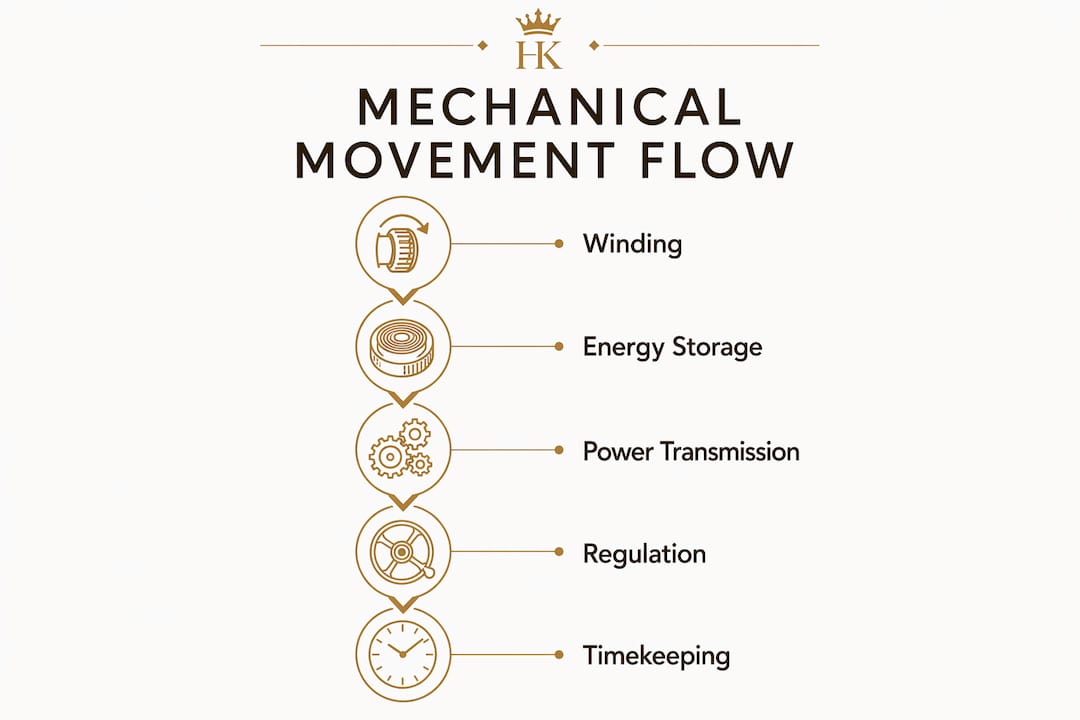
The escapement and oscillator
The escapement acts as a controlled brake. It releases energy to the gear train one tooth at a time, preventing the spring from unwinding freely. The oscillator, comprising the balance wheel and hairspring, swings back and forth at a fixed frequency, giving the escapement its rhythm. This pairing is the heart of mechanical timekeeping.
Component | Function | Key detail |
Mainspring | Stores energy | Housed in a barrel; releases energy gradually |
Gear train | Transmits energy | Wheels and pinions step down power to the hands |
Escapement | Regulates release | Releases one tooth at a time for controlled motion |
Balance wheel | Sets oscillation rhythm | Swings at a fixed frequency to pace the escapement |
Hairspring | Controls balance wheel | Fine coil that returns the wheel to centre each swing |
Pro Tip: If you hold a mechanical watch close to your ear in a quiet room, the tick you hear is the escapement releasing energy. Faster ticking means a higher frequency oscillator, which generally improves accuracy.
What are the types of mechanical movements?
The two types of mechanical movements are manual-wind and automatic. Both use the same core components, but they differ in how the mainspring is wound and how the wearer interacts with the watch.
Manual-wind movements
A manual-wind movement requires the wearer to wind the crown by hand, typically once a day. This direct action tightens the mainspring and restores the power reserve. Collectors often prefer manual winding for the ritualistic aspect, the deliberate, daily act of engaging with the watch. Manual-wind calibres also have a practical advantage: without a rotor assembly, the movement sits thinner inside the case. Manual-wind watches are slimmer as a result, making them the preferred choice for dress watches worn under a shirt cuff.
Automatic movements
An automatic movement’s rotor) swings freely with the motion of the wearer’s wrist, winding the mainspring continuously during normal wear. This eliminates the need for daily winding in most circumstances. Automatic movements suit collectors who wear their watches regularly and value convenience without sacrificing the mechanical experience.
Comparison: manual-wind versus automatic
Feature | Manual-wind | Automatic |
Winding method | Crown by hand, daily | Wrist motion via rotor |
Case thickness | Thinner, no rotor | Slightly thicker |
Best suited for | Dress watches, collectors | Daily wear, active wearers |
Power reserve management | Wearer controls it directly | Self-regulating during wear |
Collector appeal | High, ritualistic connection | High, convenience-focused |
Collector preferences often come down to lifestyle. Those who rotate between several watches tend to favour automatics with longer power reserves or manual-wind pieces they can wind deliberately before wearing. For a deeper look at choosing between the two, Horology-kings has a dedicated guide on automatic vs manual watches that covers the decision in full.
Pro Tip: If you own an automatic watch and plan to leave it unworn for several days, a watch winder keeps the rotor moving and maintains the power reserve. This also prevents the lubricating oils inside the movement from settling.
How do mechanical movements keep time accurately?
Precision in a mechanical movement depends on consistency, not speed. The escapement functions as a brake, ensuring that energy reaches the gear train in steady, controlled pulses rather than in one uncontrolled rush. That consistency is the hallmark of fine watchmaking.
The balance wheel oscillates back and forth at a fixed frequency, typically measured in vibrations per hour. The hairspring pulls it back to centre after each swing. Every complete oscillation advances the gear train by exactly one tooth of the escape wheel. The result is a predictable, repeating cycle that drives the hands forward at a known rate.
Several factors determine how well a mechanical movement holds time:
Frequency of oscillation. Higher frequency movements are less susceptible to external shocks because each vibration represents a smaller unit of time.
Quality of the hairspring. A well-tempered hairspring returns the balance wheel to centre consistently, reducing rate variation.
Lubrication. Correct oils on the correct surfaces reduce friction and keep the escapement running smoothly.
Temperature stability. Metal components expand and contract with heat and cold, affecting the hairspring’s tension and the movement’s rate.
Quartz movements use a battery to vibrate a crystal at a far higher frequency, which is why they typically keep better time by the numbers. The mechanical calibre accepts that trade-off in exchange for the craft, heritage, and tactile experience it delivers. For collectors, that trade-off is not a compromise. It is the point.
How to maintain a mechanical movement properly
Mechanical movements need regular servicing to stay accurate and reliable. The general recommendation is a full service every three to five years, during which a watchmaker disassembles the movement, cleans every component, replaces worn parts, and relubricated the escapement and gear train. Skipping this interval allows oils to degrade and friction to increase, which shortens the movement’s life.
Practical maintenance habits make a real difference between services:
Wind at the same time each day. For manual-wind watches, a consistent winding routine keeps the power reserve stable and reduces rate variation.
Stop winding when you feel resistance. Modern mainsprings include slip clutches to protect against overwinding, but continuing to force the crown past resistance still causes unnecessary wear on the winding components.
Wear your automatic regularly. Daily wear keeps the rotor active and the mainspring wound, which also keeps the lubricating oils distributed evenly across the movement.
Avoid strong magnetic fields. Magnetism affects the hairspring, causing the movement to run fast. Many watchmakers offer demagnetisation as a quick, inexpensive fix.
Store carefully. Keep unworn watches in a cool, dry place away from direct sunlight and humidity.
Pro Tip: Before sending a watch for service, note its daily rate gain or loss. A good watchmaker will use that information to regulate the movement to within a few seconds per day, and you will have a baseline to compare against after the service.
Horology-kings offers professional watch repair and servicing for mechanical timepieces, covering everything from routine maintenance to full movement overhauls. For broader guidance, the Horology-kings article on watch maintenance tips covers the full range of care practices for luxury pieces.
Key takeaways
A mechanical movement is the most technically demanding and culturally significant way to power a watch, relying on a mainspring, gear train, escapement, and balance wheel to keep time without a single battery.
Point | Details |
Core definition | A mechanical movement uses stored spring energy, not electricity, to drive a watch. |
Four essential systems | Mainspring, gear train, escapement, and oscillator each play a distinct role in timekeeping. |
Two movement types | Manual-wind suits dress watches and collectors; automatic suits daily wear and convenience. |
Precision principle | Accuracy depends on consistent energy release from the escapement, not on speed. |
Maintenance interval | Service every three to five years to preserve oils, accuracy, and component life. |
Why mechanical movements still captivate me after years in horology
The question I get most often is some version of “why bother with mechanical when quartz is more accurate?” I understand the logic, but it misses the point entirely.
A mechanical movement is not just a timekeeping device. It is a physical argument that human ingenuity, applied to metal and spring, can produce something that runs for decades with nothing more than periodic care. When I wind a manual-wind watch in the morning, I am not performing a chore. I am completing a circuit between myself and the person who designed that calibre, sometimes a century ago.
What surprises most newcomers is how much variation exists within the mechanical category. A high-beat movement from a modern Swiss manufacture feels entirely different under the caseback from a vintage hand-wound calibre. Both are mechanical. Neither is better. They represent different philosophies about what a watch should be.
The misunderstanding I see most often is the assumption that mechanical means imprecise. A well-regulated mechanical calibre, properly serviced, keeps excellent time. The craft involved in achieving that consistency, by hand, at a microscopic scale, is exactly what makes these movements worth understanding and owning.
— Lewis
Horology-kings and your mechanical watch collection

Horology-kings works with collectors and enthusiasts across the UK who are serious about mechanical watches. Whether you are looking to acquire a specific reference, sell a piece from your collection, or have a movement serviced by experts who understand what they are working on, the team at Horology-kings handles every transaction with care and transparency. The focus is always on authentic timepieces from the brands that define mechanical watchmaking: Rolex, Patek Philippe, Audemars Piguet, Omega, and Cartier. Visit Horology-kings to browse the current collection or to speak with the team about sourcing a specific watch. If you need a movement serviced, the watch repair service is available for enquiries directly through the site.
FAQ
What is a mechanical movement in simple terms?
A mechanical movement is the engine inside a watch that uses a wound spring to power the hands, with no battery required. It relies on a mainspring, gear train, escapement, and balance wheel working together.
How long does a mechanical movement power reserve last?
Standard power reserves for modern mechanical movements range from roughly 40 to 50 hours. Some high-end calibres offer significantly longer reserves depending on the design.
What is the difference between manual and automatic mechanical movements?
A manual-wind movement requires daily winding by hand, while an automatic movement winds itself using a rotor that swings with wrist motion. Both use the same core mechanical systems.
How often should a mechanical movement be serviced?
A mechanical movement should be serviced every three to five years. Servicing involves cleaning, replacing worn parts, and relubrication to maintain accuracy and extend the movement’s life.
Are mechanical movements less accurate than quartz?
A well-regulated mechanical movement keeps very good time, though quartz movements are typically more accurate by the numbers due to their higher oscillation frequency. For most collectors, the craft and heritage of a mechanical calibre outweigh the small difference in daily rate.
Recommended
Comments