.png)

Automatic vs manual watches: which movement suits you?
- lewisvrichards3
- Jun 22
- 8 min read

TL;DR:
Automatic watches wind themselves through wrist movement, while manual watches require daily hand-winding. Manual watches are typically slimmer and have unobstructed casebacks, making them ideal for dress styles. Both types need regular servicing, but automatic watches may be more practical for daily wear.
The difference between automatic and manual watches comes down to one thing: how the mainspring is wound. Automatic watches wind themselves through a rotor that spins with your wrist movement. Manual watches require you to turn the crown by hand, typically every one to two days. This single mechanical distinction shapes everything from case thickness to daily ritual to long-term maintenance.
Both types are mechanical movements, meaning neither uses a battery. That shared DNA is what separates them from quartz and makes them appealing to purists who value the craft behind every tick. Understanding the distinction helps you buy with confidence, whether you are purchasing your first timepiece or adding to an established collection.
What is the difference between automatic and manual watches mechanically?
The core mechanical difference between automatic and manual watches lies in the winding system. An automatic movement contains a semi-circular rotor, mounted on the movement, that swings freely as your wrist moves. That motion transfers energy through a series of gears to tension the mainspring. A manual movement has no rotor at all. You wind it by rotating the crown, which directly tensions the mainspring through the gear train.
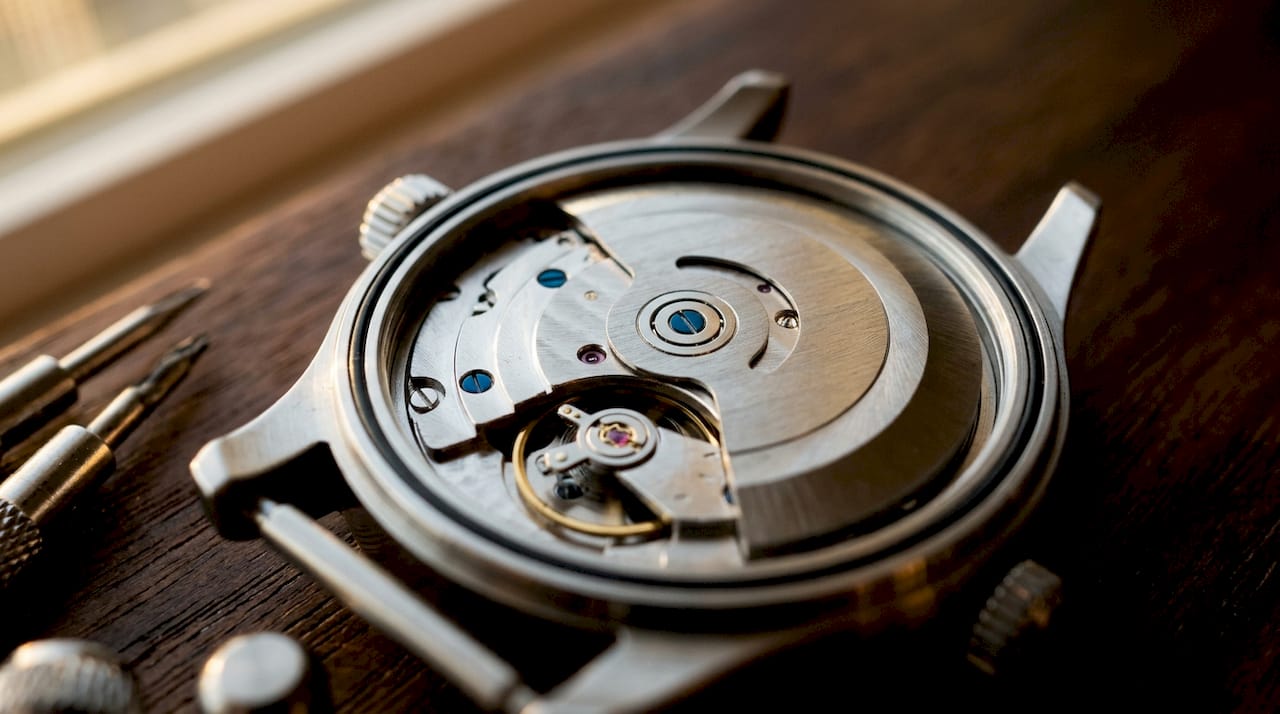
Both types use a slipping clutch to prevent overwinding. Once the mainspring reaches full tension, the clutch disengages. This protects the movement in both cases, though the mechanism differs slightly between designs.
Power reserve and accuracy vary between the two types:
Automatic watches deliver 38–80 hours of power reserve with a daily accuracy variance of approximately -5 to +15 seconds.
Manual watches typically offer 36–60 hours of power reserve with a variance of approximately -10 to +20 seconds.
Both types require professional servicing, with costs typically running £150–£350 every five to seven years depending on the calibre.
One detail that catches many buyers off guard: most modern automatics also allow hand-winding via the crown. However, frequent manual winding of an automatic can strain the winding gear train, which is not designed for daily use in that way. Wind an automatic by hand only to start it after it has stopped, not as a regular habit.
Pro Tip: If your automatic watch stops overnight, give it ten to fifteen gentle turns of the crown before putting it on. This sets the mainspring in motion before your wrist takes over, preventing the sluggish timekeeping that can occur when a watch restarts from zero.
What are the design and aesthetic differences?
The absence of a rotor in a manual movement has a direct impact on case design. Manual watches produce slimmer cases because the movement sits lower without the rotor’s added height. This makes them the natural choice for dress watches, where a thin profile under a shirt cuff is a mark of refinement.
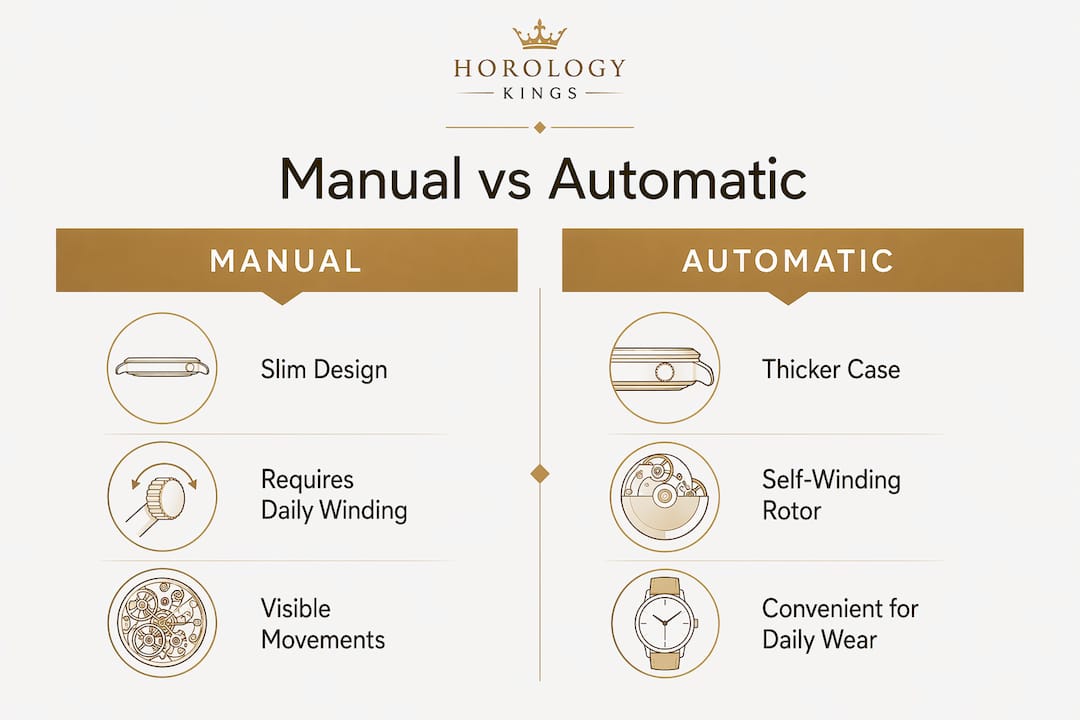
Automatic movements are generally thicker. The rotor adds depth, which suits sport and tool watches where a larger case is expected and even desirable. A Rolex Submariner or an Omega Seamaster carries that thickness with authority. A Patek Philippe Calatrava, by contrast, relies on a slim manual movement to achieve its elegant proportions.
The aesthetic difference extends to the caseback. Display casebacks show a cleaner view on manual watches because no rotor obscures the movement. Collectors who appreciate hand-finishing, perlage, and côtes de Genève decoration get an unobstructed view of the watchmaker’s work. On an automatic, the rotor dominates the caseback window, which can be visually impressive in its own right but hides much of the movement beneath.
Feature | Manual watch | Automatic watch |
Case thickness | Slimmer profile | Thicker due to rotor |
Caseback view | Unobstructed movement | Rotor partially obscures movement |
Best suited to | Dress watches, slim designs | Sport, tool, and everyday watches |
Winding method | Crown, by hand | Wrist motion, rotor |
Notable examples | Patek Philippe Calatrava | Rolex Submariner, Omega Seamaster |
The craftsmanship visible through a manual watch’s caseback is one of the most compelling arguments for the type among serious collectors. When a movement is finished to exhibition standard, you want to see all of it.
What are the pros and cons of each watch type?
Choosing between manual and automatic watches is a lifestyle decision as much as a technical one. Neither type is objectively superior. Each suits a different kind of wearer.
Automatic watch advantages:
No daily winding required. Wear it regularly and it stays wound.
Suits active lifestyles and daily wearers who do not want to think about maintenance.
Wide availability across all price points, from entry-level Swiss movements to high-end calibres from Rolex and Audemars Piguet.
Good compromise between mechanical character and practical convenience for first-time buyers.
Manual watch advantages:
Slimmer case profile, making them ideal for formal wear.
Fewer moving parts. No rotor means one less component to service or fail.
The daily winding ritual creates a physical bond between wearer and watch that many enthusiasts find deeply satisfying.
Unobstructed caseback view for appreciating movement finishing.
The robustness question is worth addressing directly. Rotor bearings in automatic watches are a known failure point under shock or impact. A dropped automatic can damage the rotor bearing in ways that a manual movement, with its simpler construction, would survive. For buyers in physically demanding environments, this is a genuine consideration.
Maintenance costs are comparable for both types. Expect to pay for a professional service every five to seven years regardless of which movement you choose. The watch repair and servicing requirements are similar in scope, though automatics carry the additional complexity of the rotor assembly.
Pro Tip: Never leave a manual watch fully wound for extended periods without wearing it. The mainspring holds maximum tension and the lubricants in the gear train can dry out faster under sustained load. Wind it down gently if you plan to store it for more than a few weeks.
How should collectors and first-time buyers decide?
The right choice depends on how you actually live with your watches, not just how you imagine you will.
Daily wearers benefit most from an automatic. If you wear one watch consistently, the rotor keeps it wound without any thought. An Omega Seamaster or a Rolex Datejust suits this pattern perfectly. You put it on in the morning and it runs reliably throughout the day.
Collectors with multiple watches face a different challenge. Automatics in rotating collections need watch winders to stay powered when not being worn. A quality watch winder adds cost and requires its own maintenance. Manual watches sidestep this entirely. You pick one up, wind it, and it is ready. For collectors who rotate frequently, a mix of both types often works best.
First-time buyers should consider these factors:
If you want a watch you never have to think about, choose an automatic.
If you are drawn to the ritual and the idea of a daily connection with your timepiece, a manual watch rewards that instinct.
If slim profile and visible movement finishing matter to you aesthetically, a manual is the stronger choice.
If you are buying a sport or tool watch, an automatic is the natural fit.
If you are interested in building a luxury collection over time, understanding both types from the start gives you a stronger foundation.
Pricing does not reliably separate the two types. Both manual and automatic movements appear across the full spectrum of the market, from affordable Swiss-made pieces to six-figure complications from Patek Philippe. The movement type alone does not determine value. Finishing quality, brand heritage, and rarity matter far more to long-term worth.
Vintage buyers should note that manual movements dominate watches made before the 1970s. If your interest runs to vintage Rolex, early Omega, or pre-quartz crisis Cartier, you will encounter manual movements as the standard. Learning to appreciate the winding ritual is part of engaging with that era of horology.
Key takeaways
Automatic watches wind via a rotor powered by wrist movement, while manual watches require daily hand-winding, and this single difference drives every practical and aesthetic distinction between the two types.
Point | Details |
Core mechanical difference | Automatics use a rotor; manuals require crown winding every one to two days. |
Case thickness | Manual movements produce slimmer cases, making them better suited to dress watches. |
Caseback aesthetics | Manual watches offer an unobstructed view of the movement through a display caseback. |
Robustness | Manual watches have fewer moving parts and no rotor bearing, reducing shock vulnerability. |
Collector considerations | Automatics need watch winders in rotating collections; manuals always require hand-winding. |
Why I think the manual vs automatic debate misses the point
Most articles frame this as a binary choice. In practice, the collectors I respect most own both types, and for good reason.
I have worn automatics daily for years and found the convenience genuinely freeing. You put the watch on and it simply works. There is no ceremony, no obligation. For a watch you wear every day, that is a real advantage. But I have also spent time with manual watches, particularly older pieces, and the winding ritual changes your relationship with the object entirely. You handle it every morning. You feel the crown engage. You notice when the resistance builds. That tactile connection is not nostalgia. It is a different kind of ownership.
The misconception I encounter most often is that manual watches are somehow inferior or outdated. They are not. A well-finished manual movement from a respected maker is frequently more technically demanding to produce than an equivalent automatic. The absence of a rotor is not a limitation. It is a design choice that prioritises thinness, visibility, and simplicity.
My honest view: if you are buying your first serious watch, an automatic is the more forgiving entry point. If you already have one and want something that deepens your engagement with horology, a manual movement will do that. The two types are not competitors. They are complements.
— Lewis
Horology-kings: find your next automatic or manual watch
Horology-kings specialises in authentic luxury timepieces from Rolex, Patek Philippe, Audemars Piguet, Omega, and Cartier, covering both automatic and manual movements across the full range of styles and price points.

Whether you are a first-time buyer weighing up movement types or a collector seeking a specific reference, the team at Horology-kings offers expert guidance, transparent valuations, and secure UK bank transfers on every transaction. For rare or hard-to-find pieces, the source a watch service connects you with an expert network built for exactly that purpose. Browse the full selection and speak with the team at Horology-kings to find the right timepiece for your collection.
FAQ
What is the main difference between automatic and manual watches?
An automatic watch winds itself via a rotor powered by wrist movement, while a manual watch requires the wearer to wind the crown by hand every one to two days. This difference in winding mechanism affects case thickness, movement visibility, and daily maintenance.
Are manual watches more accurate than automatic watches?
Neither type holds a clear accuracy advantage. Automatic watches typically run within -5 to +15 seconds per day, while manual watches run within -10 to +20 seconds per day. Both are subject to regulation and can be adjusted by a watchmaker.
Do automatic watches need servicing as often as manual watches?
Both types require professional servicing every five to seven years. The cost and frequency are comparable, though automatic movements carry the additional complexity of the rotor assembly, which can be a source of wear over time.
Which is better for a first-time buyer: automatic or manual?
An automatic watch is generally the better starting point for first-time buyers. It requires no daily winding and suits an active lifestyle, while still delivering the mechanical character that makes Swiss watches worth owning.
Can you manually wind an automatic watch?
Most modern automatic watches allow hand-winding via the crown, but doing so frequently can wear the winding components. Wind an automatic by hand only when restarting it after it has stopped, not as a daily practice.
Recommended
Comments