.png)
€10,000 Cash Rule: KYC for UK Watch Sales, What Dealers Must Do

If you’re accepting €10,000 or more in cash for a watch, or your linked payments from one customer add up to that, you must register with HMRC as a high-value dealer and carry out KYC on that customer. Below that threshold, KYC isn’t legally compulsory, but it’s still the sensible default for any sale over a few thousand pounds. The immediate action: verify the buyer’s identity now, and refuse large cash payments until your registration is confirmed.
TL;DR:
Register as a high-value dealer before accepting cash payments totaling €10,000 or more, including linked transactions across multiple deals.
Verify buyer identities with documents like passports or driving licenses and cross-check serial numbers before releasing watches.
Implement strict payment policies, preferably avoiding cash over £1,000, and log every transaction to detect linked payments or suspicious patterns.
Conduct enhanced due diligence for international buyers, high-risk transactions, or vague sources of funds, ensuring identity checks are completed beforehand.
Maintain detailed records, including risk assessments, compliance officer appointment, and five-year transaction logs, to ensure HMRC compliance during inspections.
Table of Contents
Quick checklist: steps to take before any high-value watch changes hands
Who must register as a high-value dealer: the €10,000 rule explained
Practical KYC and CDD steps: documents, verification and when to escalate
Record-keeping, risk assessment and your nominated compliance officer
How Horology Kings applies KYC and fraud prevention in practice
What is KYC for watch sales UK and why it matters now
KYC, or “know your customer,” is the identity verification process behind every legally compliant high-value transaction in the UK. In watch sales, it means confirming who you’re actually dealing with before goods or money change hands. This sits inside a wider legal framework: customer due diligence, or CDD, is the formal term HMRC uses, and it’s mandatory once you fall under money laundering regulations for luxury goods.
Watch sales compliance UK rests on a simple logic. Watches are portable, easily resold, and hold their value across borders, which makes them attractive to anyone trying to move dirty money. That’s precisely why HMRC treats high-value dealers as a distinct supervised sector, sitting alongside estate agents and casinos. If you sell, source, or broker watches above certain values, the rules apply to you whether you’re a registered business or a private seller doing it regularly enough to look like trade.
Quick checklist: steps to take before any high-value watch changes hands
Before you accept an offer or send a watch, run through this sequence.
Set a payment policy. Cap cash acceptance well below the legal threshold, ideally under £1,000, and prefer bank transfer for anything of real value.
Verify identity for online retail and in-person deals alike. Collect photo ID, proof of address, and confirm date of birth.
Record beneficial ownership if someone is buying or selling on behalf of a company or another individual.
Cross-check the serial number and papers against the watch itself before releasing it.
Log every transaction, flagging anything that resembles staged or linked payments from the same buyer.
Pro Tip: Verify identity on every deal over roughly £2,000, not just when you think the law demands it. Linked transactions are retrospective. You often don’t know a customer has crossed the threshold until the third payment lands.
Who must register as a high-value dealer: the €10,000 rule explained
An HVD is any business or individual accepting or making cash payments of €10,000 or more, in a single transaction or across several connected ones. This is one of the most misunderstood parts of watch selling legally UK: it isn’t just about one big cash handover. It’s about the cumulative pattern.
Linked transactions count. If a customer pays £4,000 cash for a watch strap this month and £7,000 cash for the watch next month, HMRC treats those as connected and the combined total triggers registration.
Both directions apply. Accepting cash from a buyer and paying cash to a seller can each trigger the obligation.
Registration should happen before you take the payment, not after. Most dealers build in a working buffer of around 30 days to get HMRC paperwork sorted once they realise they’re approaching the threshold.
Failing to register as an HVD when required is a criminal offence, not a paperwork slip. Penalties can include fines and a criminal record, and HMRC has actively pursued jewellers and watch dealers who assumed the rule was for someone else.
Non-compliance also has a quieter cost: banks and payment processors increasingly ask new business customers whether they’re HVD-registered before opening merchant accounts.
Practical KYC and CDD steps: documents, verification and when to escalate
Verify identity for watch purchases with the same rigour every time, regardless of how well you think you know the buyer. HMRC’s guidance on customer due diligence sets a consistent baseline: name, current address, and date of birth, each independently verified rather than simply asked for.
Acceptable documents: passport or photo driving licence for identity, a recent utility bill or bank statement for address.
Verification methods: visual document checks in person, electronic identity verification services for remote sales, and matching the paying bank account name to the customer’s stated identity.
Beneficial ownership: if a company, trust, or third party is involved, record who ultimately controls the funds or the watch, not just who signs the invoice.
Representatives: if someone collects or delivers on a buyer’s behalf, note their relationship to the actual customer.
Enhanced due diligence, or EDD, kicks in for higher-risk scenarios: unusually large sums relative to the customer’s apparent means, international buyers based in jurisdictions with weak anti-money laundering controls, or any deal where the source of funds is vague or unverifiable. HMRC’s guidance is explicit that EDD isn’t optional once these indicators appear.
Pro Tip: Complete identity verification before releasing the watch or taking final payment, whichever comes first. Chasing ID checks after a Rolex has already left the building solves nothing.

Fraud red flags and how to protect provenance on every sale
Most watch fraud follows recognisable patterns. Unusual urgency is the biggest tell: a buyer pushing for same-day collection, insisting on cash, or offering above asking price with no negotiation. Offshore intermediaries who won’t provide verifiable details, inconsistent paperwork (a service history that doesn’t match the case back, or a box set with mismatched serial numbers), and unexplained overpayments followed by a refund request are the classic three.
Authentication needs to run alongside your KYC checks, not instead of them.
Cross-check the serial and model number against the watch’s papers and, where possible, the manufacturer.
Request full service history and confirm it lines up with the watch’s actual condition.
Use independent authentication for anything above a few thousand pounds, particularly with brands frequently counterfeited, such as Rolex and Audemars Piguet.
Check for CITES documentation on watches with exotic leather straps. Missing paperwork can mean seizure at the UK border.
When something doesn’t sit right, pause the sale rather than pushing through it. Escrow arrangements, staged delivery against cleared funds, and authenticated courier services all reduce risk without insulting a genuine buyer.
VAT and tax rules that shape your KYC and record-keeping
New watches carry standard 20% VAT, no exceptions. Pre-owned watches are different: eligible sales can use the VAT margin scheme, where VAT is only due on your profit margin rather than the full sale price, provided your records meet HMRC’s exacting standard.
The margin scheme cannot be used on imported watches where import VAT has already been paid.
You need a granular stock book recording each acquisition, its supplier, and proof of purchase, not a rough spreadsheet reconstructed later.
Watch dealers have had margin-scheme claims disallowed by HMRC after tribunals found stock records too thin to support the treatment claimed.
Undisclosed or vague suppliers are one of the fastest ways to invalidate an otherwise legitimate margin-scheme position.
Treat your KYC records and your VAT stock book as two halves of the same discipline. Detailed acquisition records protect margin-scheme eligibility and double as your audit trail if HMRC ever asks who you bought a watch from.
Record-keeping, risk assessment and your nominated compliance officer
HMRC expects three concrete things from any HVD, and they’re checked during inspections.
A written risk assessment, covering customer types, geographic exposure, and the transaction patterns typical of your business. Review it annually or whenever your customer base shifts significantly.
A nominated compliance officer, someone named and accountable for AML decisions, even in a one-person business. The NAJ Code of Practice treats this role as non-delegable in spirit, even where it’s practically held by the owner.
Transaction monitoring and cash logs, retained for at least five years, covering every deal above your internal threshold.
Keep documents organised as if an inspection could happen next week, because it can. HMRC officers expect to see the risk assessment, the CDD records for recent sales, and the cash log produced within the visit, not promised for later.
How Horology Kings applies KYC and fraud prevention in practice
Horology Kings runs identity verification on every high-value transaction, not just the ones that legally require it, and settles exclusively through secure UK bank transfer rather than cash. Every watch passing through the business goes through an authentication checklist covering serial numbers, service history, and provenance documents before any offer is finalised.
For international or high-value buyers, enhanced due diligence extends to verifying the source of funds and confirming banking details match the stated identity before goods move. Sellers considering a managed transaction rather than handling KYC themselves can read more on selling a watch securely online, while buyers sourcing a specific reference can see how vetting works on the watch sourcing service. Anyone importing a watch should also check the customs duties guide before a cross-border deal proceeds.
Where to register and read the official guidance
Register directly with HMRC as a high-value dealer if you accept or make cash payments anywhere near the €10,000 threshold. Read the NAJ Code of Practice for a practical implementation walkthrough.
Review your written risk assessment against current HMRC guidance.
Confirm your nominated compliance officer is named in writing.
Explore Horology Kings’ watch acquisition guide if you’re buying and want to understand what checks to expect.
Why most guides on this topic miss the point
The conventional advice treats HVD registration as a bureaucratic tick box, something you sort once and forget. That’s the wrong frame. The real risk in watch sales compliance UK isn’t the registration form. It’s the informal deal that never gets logged: the friend of a friend paying in instalments, the “cash today, papers later” arrangement that feels harmless until it’s the third payment from the same buyer and you’ve quietly become an unregistered HVD.
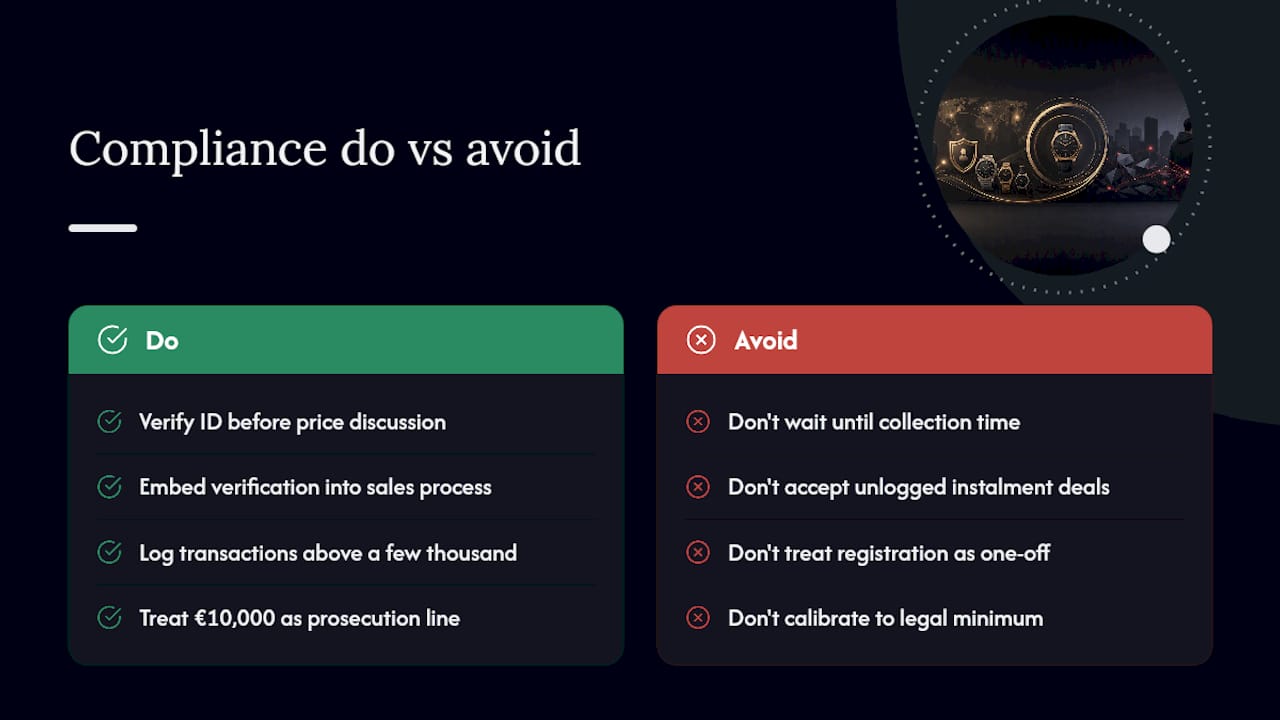
What gets underweighted is timing. Most sellers think about KYC after they’ve agreed a price, when the buyer is already asking to collect. By then, refusing the deal or demanding ID feels confrontational. Build verification into your process before a price is even discussed, and it stops being an awkward conversation.
If you take one thing from this: don’t calibrate your compliance to the legal minimum. The €10,000 threshold is a prosecution line, not a good-practice line. Dealers who verify identity and log transactions on everything above a few thousand pounds rarely get caught out by linked-transaction rules, because they were never close to the edge in the first place.
— Lewis
Sources
Recommended
MM88 khiến mình chú ý đến sự cân bằng giữa số lượng danh mục và khả năng nhận diện từng khu trên giao diện. Game bài, casino và bắn cá được phân chia riêng, nên mình có thể xác định hướng lựa chọn mà không cần xem từng nội dung cụ thể ngay lập tức. Mỗi khu đóng vai trò như một phạm vi để mình tiếp tục tìm kiếm khi cần. Mình đánh giá cách bố trí này giúp giao diện có nhiều hướng khám phá nhưng không tạo cảm giác phải xử lý tất cả cùng lúc. Khi đã quen cấu trúc, mình có thể tìm lại từng khu khá chủ động.