.png)
Identify watch models: a luxury collector's guide
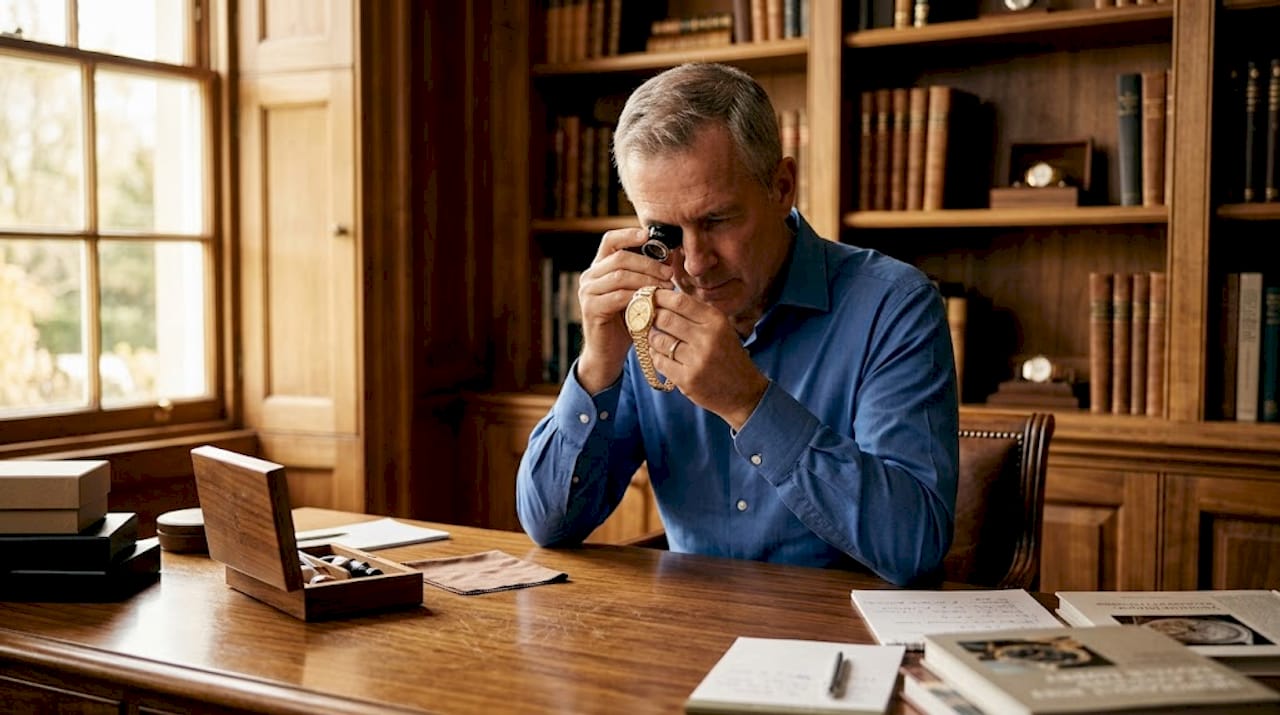
TL;DR:
Proper tools, photography, and knowledge of brand-specific serial locations are essential for accurate identification.
Cross-referencing serial and reference numbers with trusted databases and expert inspection confirms authenticity.
Physical examination and layered verification are vital, as counterfeiters can produce convincing documentation and serials.
You’re holding a watch you’ve just inherited, or eyeing one at auction, and the stakes are high. The case looks right, the dial seems original, but you’re staring at a cluster of digits on the lugs with no clear sense of what they mean or whether they match the story you’ve been told. For UK collectors, this moment of uncertainty is remarkably common, and the financial consequences of getting it wrong can run into the tens of thousands of pounds. This guide breaks down the full process of identifying luxury watch models, from gathering your tools to advanced cross-referencing, so you can approach every acquisition with genuine confidence.
Table of Contents
Key Takeaways
Point | Details |
Know your numbers | Model and serial numbers are crucial for accurate identification and valuation. |
Combine methods | Never rely on a single point—verify with serials, archives, physical checks, and market knowledge. |
Avoid common traps | Watch out for erased numbers, frankenwatches, and misleading paperwork in the pre-owned market. |
Consult experts | UK collectors should leverage reputable dealers and databases for maximum security. |
What you need to identify a watch model
Before you examine a single digit, preparation matters enormously. Rushing in without the right tools is how details get missed and mistakes get made.
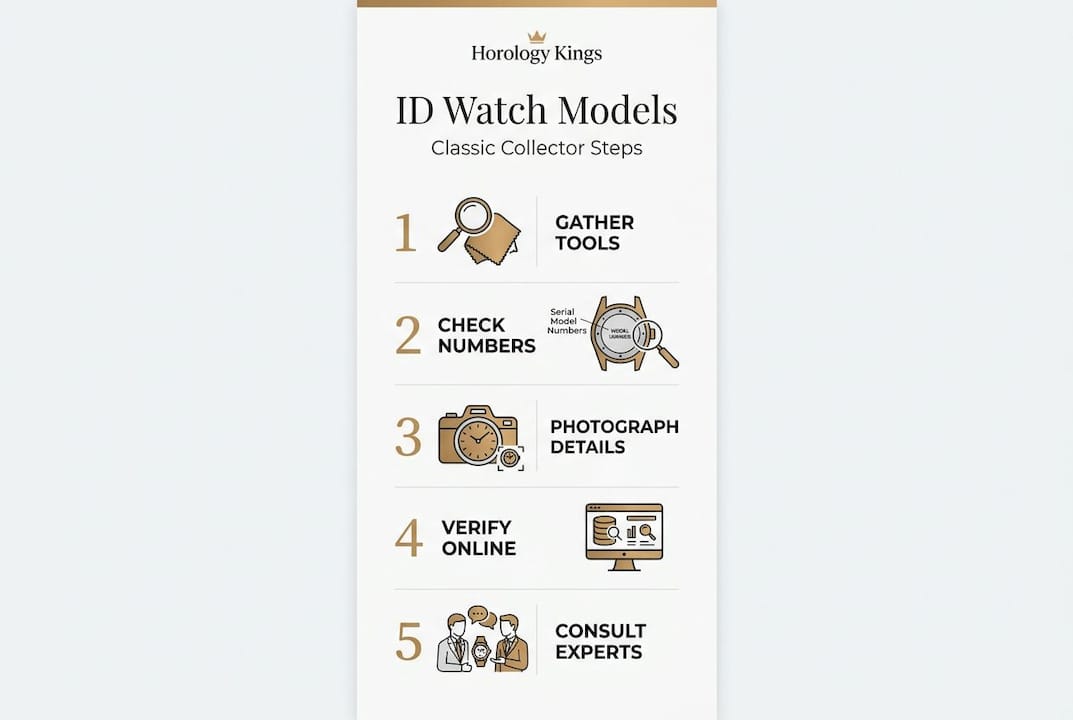
The minimum kit for serious identification includes a quality loupe (at least 5x to 10x magnification), a reliable torch with focused light, a spring bar tool if you need to remove a bracelet, and access to either reference books or a reputable online database. Brand-specific databases and published catalogues are invaluable, and for collectors focused on one marque, owning a dedicated reference book pays dividends quickly.
Where to look by brand:
Brand | Primary serial location | Primary reference location |
Rolex | Between lugs at 6 o’clock (pre-2005); rehaut post-2005 | Between lugs at 12 o’clock |
Omega | Caseback (modern); lugs (vintage) | Caseback or inner caseback |
Patek Philippe | Inner caseback | Outer caseback |
Audemars Piguet | Inner caseback or lugs | Caseback |
Cartier | Caseback | Caseback |
The primary method for luxury watch identification is locating and decoding serial and reference numbers, typically engraved between the case lugs (requiring bracelet removal), on the rehaut for post-2005 Rolex, or on the caseback. Knowing precisely where your brand hides these numbers saves considerable frustration.
One rule stands firm regardless of brand: do not open the caseback yourself. Improperly opened cases risk gasket damage, movement contamination, and, critically, they can erase tamper-evidence that authenticators rely upon. If you need to see the inner caseback, take it to a qualified watchmaker.
Pro Tip: Before removing anything from the watch, photograph every angle of the case, bracelet, and dial in natural light. These images serve as a baseline record and can be invaluable if anything shifts during handling.
A solid understanding of authenticating luxury watches before you buy is the single best investment you can make as a collector.
Reading serial and reference numbers across brands
Once your tools are ready, the real work begins. Numbers unlock a watch’s identity, but only if you know how to read them correctly.
Step-by-step process for finding and decoding numbers:
Remove the bracelet carefully using a spring bar tool to expose the lug engravings.
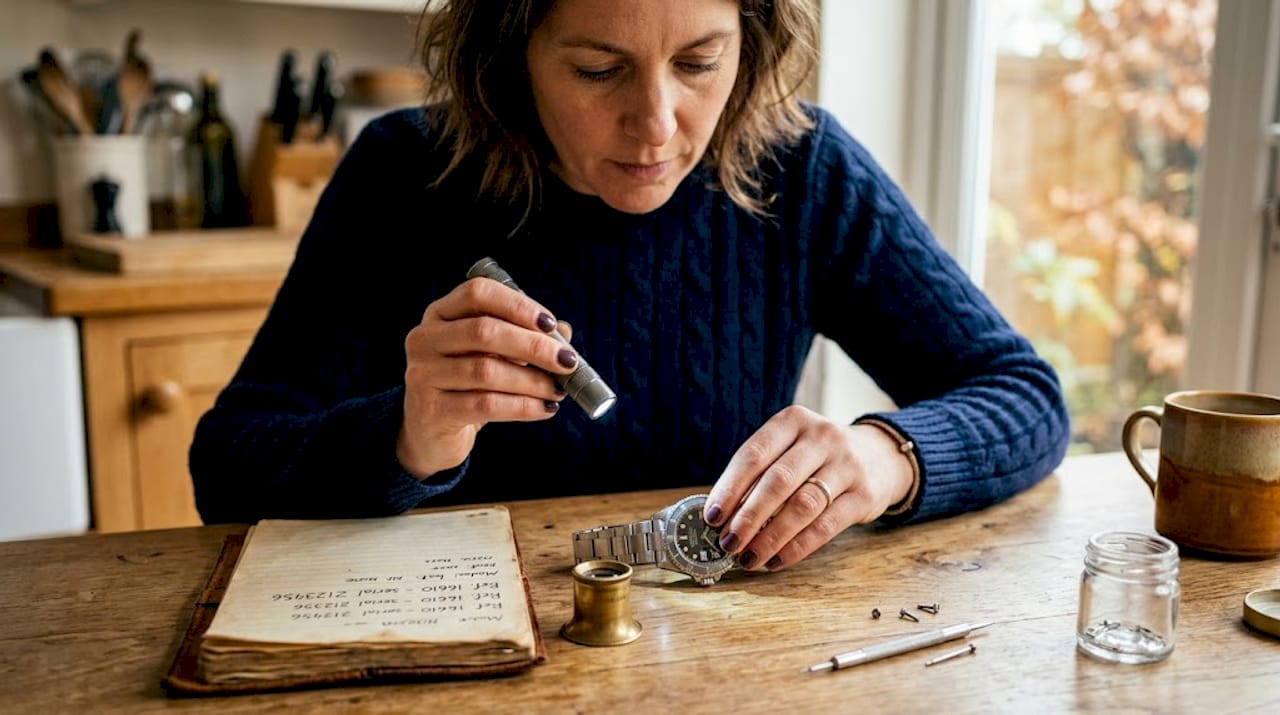
Use your loupe and torch at an oblique angle to read shallow or worn engravings clearly.
Note both numbers separately: the serial (production date) and the reference (model identifier).
Cross-check what you’ve found against a reputable database or brand catalogue immediately.
Record the numbers in writing, not just memory, before reassembling anything.
Rolex: Rolex reference numbers run four digits for vintage pre-1970s pieces, five digits for the period from the 1970s through to 2000, and six digits for modern references such as the 116520 Daytona. Serials dated production sequentially before 1954, shifted to letter prefixes from 1954 to 2010 (the letter “G” placing a watch in the early 2010s, for example), and then moved to fully randomised serials after 2010. This randomisation means you can no longer reliably date a modern Rolex by serial alone without official records.
Patek Philippe: Patek reference numbers follow a logical but layered system. The first digits indicate the model family (3 or 5 or 6 prefix for men’s, 4 or 7 for ladies’ pieces), a slash and three further digits indicate the material (300 denotes baguette gem-set, for example), and a final suffix identifies the dial and bracelet variant, with 001 typically representing the original configuration. Understanding these suffixes is essential when comparing two watches that appear identical but carry meaningfully different values.
Omega: Omega uses a calibre-based system on modern references. The first digits of the reference identify the case family, and subsequent digits specify the movement and material. Vintage Omega pieces often carry the serial on the inner caseback and are best dated using the brand’s published vintage serial tables.
A 2023 industry report found that roughly 40% of pre-owned luxury watches entering the secondary market show signs of inauthenticity or component mismatch. That figure underscores exactly why reading and cross-referencing these numbers carefully is not optional.
Pro Tip: When reading lug engravings, hold your torch at a low, raking angle rather than shining it straight on. This technique casts shadows across the engraved characters and makes even shallow or polished-over digits dramatically more legible.
Consulting an experienced watch dealer for verification adds a further layer of confidence, particularly when numbers are ambiguous or partially obscured.
Spotting warning signs and edge cases
Knowing what to look for is only half the challenge. The other half is recognising when something is wrong.
Red flags that should prompt immediate caution:
Lugs that appear over-polished, rounding edges that should be crisp and sharp
Engravings that look too deep, too shallow, or use an inconsistent font compared to known genuine examples
Serials that do not correspond to the claimed production era for the reference number
Case proportions or finishing that feel slightly off under magnification
Mixed components: a genuine Rolex dial fitted to a non-genuine case, commonly called a “Frankenwatch”
Frankenwatches are particularly deceptive because individual components may genuinely be authentic. A collector could unknowingly pay full market value for a watch assembled from parts of multiple pieces, none of which individually constitute the complete, original article.
Lume (luminous material on hands and indices) provides a valuable dating clue. Rolex used radium until the late 1950s, tritium (marked “SWISS T<25”) from the 1960s through to the 1990s, and luminova thereafter. If a claimed 1970s piece carries luminova, something is wrong.
Hallmarks on the case are equally revealing, particularly for UK-imported vintage pieces. British import regulations required gold and platinum watches to be assayed and marked by a UK assay office, so the presence or absence of these marks on a claimed vintage import can confirm or contradict provenance.
Important: Never purchase a significant watch based solely on photographs or online descriptions. Physical inspection by a qualified expert is the only reliable safeguard against sophisticated counterfeits and component mismatches. Equally, never open the caseback of a watch you are evaluating for purchase, as this can compromise authentication evidence and void service records.
Pro Tip: Run your torch slowly around the entire perimeter of the case, including under the lugs. Counterfeiters and restorers sometimes erase or re-engrave serials in locations that aren’t immediately obvious, and hidden alterations often become visible under directed light.
Luxury watch authentication is a discipline that rewards patience. Never allow urgency or enthusiasm for a piece to shortcut the process.
Advanced verification and cross-referencing
For significant acquisitions, basic serial reading is only the beginning. Expert collectors and dealers use a layered verification approach that combines archival records, independent databases, and hands-on inspection.
Steps for rigorous cross-verification:
Request a Patek Philippe Extract from the Archives (currently around $300 USD), which confirms the original specification, date of sale, and any factory modifications
Search Omega’s vintage serial database to confirm production year and original movement specifications
Check The Watch Register, the UK’s primary stolen watch database, to confirm the piece is not listed as stolen
Use AI-assisted tools such as Loupe This for a preliminary cross-reference, bearing in mind these are screening tools rather than definitive verdicts
Ask an authorised dealer or independent watchmaker to verify that the movement serial matches the case serial and corresponds to the correct calibre for the reference
Review all accompanying documentation for consistency with the watch’s specifications
Cross-verification using brand archives and independent tools-%7C-Spot-Fakes-Verify-Rolex-Omega-Patek-Philippe) is the gold standard, combining brand records, The Watch Register stolen database, AI tools such as Loupe This, and in-person movement inspection to confirm authenticity. No single step is sufficient on its own.
Comparison: online tools vs. in-person inspection
Method | Strengths | Limitations |
Online databases | Fast, accessible, covers known references | Cannot detect superfakes or component swaps |
AI identification tools | Good for initial screening | Unreliable on modified or obscure pieces |
Watchmaker inspection | Physical access to movement | Requires trusted specialist |
Brand archive extract | Definitively confirms original spec | Costly, not available for all brands |
A thorough watch valuation checklist helps ensure nothing is overlooked at this stage, and understanding provenance insights adds essential context to any verification process.
Understanding value: what model identification means for collectors
Correct identification does not just satisfy curiosity. It is the foundation upon which every valuation, insurance policy, and resale decision rests.
In the UK market, auction houses including Christie’s and Bonhams actively scrutinise provenance and model specifics before accepting consignments. A misidentified watch, even an innocent error, can result in rejection, reclassification, or a significant reduction in estimated value. For private sales, the situation is no different: buyers at the informed end of the market will verify everything, and discrepancies discovered after sale create serious disputes.
Value-boosting factors for UK collectors:
Correct and confirmed reference number matching documented production records
Unpolished case with original surfaces and sharp lug edges
Complete box and papers (original box, guarantee card, chronometer certificate)
Single-owner provenance with documented service history
Discontinued or limited references with strong collector demand
Original dials with no restoration or refinishing
Matching serial numbers across case, caseback, and movement
Original box and documentation can increase value by 20 to 50 percent for UK collectors, with materials, complications, rarity, and auction house demand also factoring significantly. For vintage pieces, this premium is especially pronounced: a Rolex Submariner with full box and papers from a known collector can command a price dramatically above an equivalent watch sold loose.
Market premium by documentation status:
Documentation status | Approximate value impact |
Full box and papers, original | +20% to +50% |
Papers only (no box) | +10% to +20% |
Box only (no papers) | +5% to +10% |
No documentation | Baseline market value |
Understanding how watch valuation works gives collectors the framework to assess any piece objectively, and tracking secondary market dynamics keeps you ahead of shifting demand curves for specific references.
Why model identification alone isn’t enough: a collector’s view
Here is something most identification guides will not tell you directly: matching a serial to a database entry is the easiest part of authenticating a serious watch. It is also the part that counterfeiters have become most skilled at defeating.
We have seen cases here at Horology Kings where a watch presented with impeccable paperwork and a correctly corresponding serial number turned out to be a sophisticated composite. The documents were genuine, the numbers matched, but the movement inside was from a different generation entirely. Only hands-on inspection by an experienced watchmaker revealed the discrepancy. Serial databases do not look inside the case. Paper extracts confirm what left the factory decades ago, not what is in the case today.
Multi-point verification is essential because serials alone are insufficient as authenticity confirmation, with physical inspection consistently proving more reliable than photographs or AI tools when genuinely sophisticated fakes are involved. UK collectors should make The Watch Register part of every due diligence process without exception.
Our contrarian view is this: the collector who becomes confident purely in database work is the collector most at risk. The skill that separates experienced buyers from vulnerable ones is the ability to read a physical watch, to feel whether the pushers have the right resistance, to notice whether the brushing lines on a bezel are machined or hand-finished, to detect the slight heaviness of a solid gold case versus a gold-plated imitation. These instincts take time to build, and there is no substitute.
For UK collectors blending online and in-person due diligence, the optimal approach is to begin with databases, run a Watch Register check, and then always conclude with a physical inspection by someone whose expertise you trust. The value of a collector’s timepiece is built on certainty, and certainty is built on layered evidence, not a single data point.
Pro Tip: When buying or selling any piece above £5,000, insist on at minimum two independent forms of verification. One should always be physical, in-person inspection by a qualified specialist.
Want expert eyes on your next find?
Navigating the complexities of model identification and authentication is far simpler with a trusted specialist alongside you. At Horology Kings, we bring genuine expertise and transparency to every transaction, whether you are buying, selling, or searching for a specific reference.

Based in Hertfordshire and serving collectors across the UK, we offer expert valuations, authentication support, and a carefully curated selection of pre-owned luxury timepieces from Rolex, Patek Philippe, Audemars Piguet, Omega, and Cartier. If you are looking to source a specific watch, our network reaches rare and sought-after references that rarely appear on the open market. Visit Horology Kings to explore our current selection or to discuss your requirements directly with our team.
Frequently asked questions
Where can I find the serial and reference numbers on my luxury watch?
The exact location depends on the brand and era, but the most common locations-%7C-Spot-Fakes-Verify-Rolex-Omega-Patek-Philippe) are between the lugs (requiring bracelet removal), on the caseback, or on the rehaut for post-2005 Rolex models. Always use a loupe and raking torchlight for legibility.
Are reference numbers enough to guarantee authenticity?
No. Multi-point verification and physical inspection are essential because sophisticated fakes can replicate serial numbers and reference codes accurately. In-person inspection by a qualified specialist remains the most reliable check.
Which UK resources help verify a watch’s history?
The Watch Register is the primary UK resource for stolen watch checks, and established dealers with access to brand archives provide the most thorough provenance verification available to UK collectors.
How much do box and papers increase my watch’s value?
Original box and documentation boost value by 20 to 50 percent, with the premium being most pronounced for vintage references where complete sets are increasingly scarce.
What should I do if I cannot find a serial number?
Check carefully for over-polishing or case alterations, as these are the most common reasons for missing or illegible serials. If the number remains elusive, consult a trusted watchmaker or specialist dealer before drawing any conclusions about the piece.
Recommended
Comments