.png)
Cartier's innovations in luxury horology since 1904
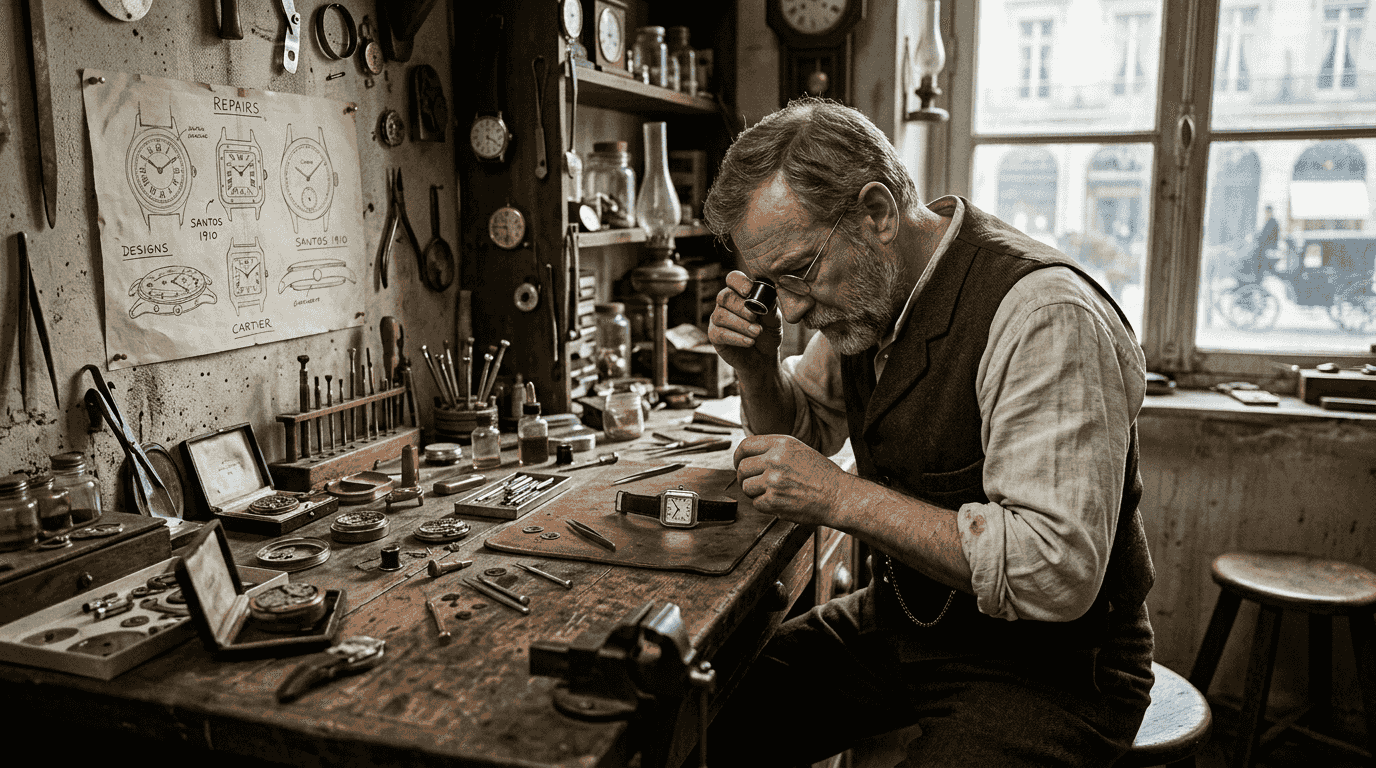
Cartier occupies a unique position in luxury horology, often misunderstood as merely a jewellery house when in fact it pioneered transformative innovations that shaped modern watchmaking. From creating the first practical wristwatch for aviation to inventing mystery clocks and revolutionising case geometry, Cartier’s contributions extend far beyond aesthetic beauty. This article examines Cartier’s landmark horological achievements, exploring how the maison blended artistic vision with technical precision to create timepieces that continue to captivate collectors and investors. You’ll discover why Cartier watches represent both historical significance and enduring value in today’s market.
Table of Contents
Key takeaways
Point | Details |
Wristwatch pioneer | Cartier pioneered the modern wristwatch with the Santos in 1904, designed for aviator Alberto Santos-Dumont. |
Technical innovation | The brand invented mystery clocks in 1912 using transparent sapphire discs and filed over 100 patents since 1904. |
Design revolution | Cartier revolutionised case geometry with non-round designs such as the Tank (1917) inspired by tanks, requiring bespoke movements. |
Collector appeal | Vintage Cartiers are prized for handmade charm while modern Privé revivals blend industrial movements with traditional aesthetics. |
Craftsmanship hallmarks | Hand-polished bevels and Poinçon de Genève certification distinguish high-end models from other manufacturers. |
Cartier’s pioneering innovations in wristwatch design
The early 20th century presented a fascinating paradox in personal timekeeping. Pocket watches dominated gentleman’s fashion, whilst wristwatches remained novelties worn primarily by women as decorative jewellery. Aviation pioneer Alberto Santos-Dumont faced a practical challenge: controlling an aircraft whilst fumbling for a pocket watch proved impossible. This problem sparked a revolution.
Louis Cartier responded in 1904 by creating the Santos watch specifically for aviator Alberto Santos-Dumont, marking the birth of the modern wristwatch. The square case with exposed screws provided immediate legibility during flight, whilst the leather strap secured the timepiece firmly to the wrist. This wasn’t merely adaptation; it represented fundamental reimagining of how humans interact with portable timekeeping.
The Santos demonstrated several breakthrough principles:
Integrated case and strap design for secure wearing during physical activity
Exposed screws serving both structural and aesthetic functions
Square geometry maximising dial legibility compared to traditional round forms
Practical orientation allowing time reading without removing hands from controls
This innovation catalysed broader acceptance of wristwatches amongst men, particularly following World War I when soldiers discovered their battlefield utility. Cartier had effectively transformed horology’s trajectory, proving that luxury watches could prioritise function without sacrificing elegance. The Santos remains in production today, testament to its timeless design language.
“The Santos watch solved a genuine problem for aviators whilst establishing aesthetic principles that would define Cartier’s approach for over a century.”
What distinguished Cartier’s approach was the refusal to simply miniaturise pocket watch movements. The brand developed tonneau-shaped calibres specifically engineered for wrist-worn cases, demonstrating early commitment to integrated design thinking. This philosophy would characterise all subsequent investment in Cartier watches, where form and function exist in deliberate harmony rather than compromise.
Inventing horological artistry: mystery clocks and patented innovations
Cartier’s technical ambition extended beyond wristwatches into realms where horology intersected with optical illusion. The mystery clocks invented in 1912 represented this fusion perfectly. These extraordinary timepieces featured clock hands apparently floating in space, suspended within transparent cases with no visible connection to any mechanism. The secret lay in transparent sapphire discs, nearly invisible to observers, which rotated to carry the hands whilst concealing the driving mechanism.
This innovation required mastery across multiple disciplines:
Precision optical engineering to create flawless sapphire discs without distortion
Mechanical expertise to develop gear trains capable of rotating large transparent elements
Jewellery craftsmanship to frame the mechanism in precious metals and gemstones
Artistic vision to conceptualise timepieces as kinetic sculptures rather than mere instruments
The mystery clock exemplified Cartier’s unique position straddling haute joaillerie and serious horology. Whilst Swiss manufactures focused on chronometric precision and complications, Cartier explored how watchmaking could create wonder and emotion. This wasn’t frivolous decoration; it demanded genuine technical innovation to achieve seemingly impossible visual effects.
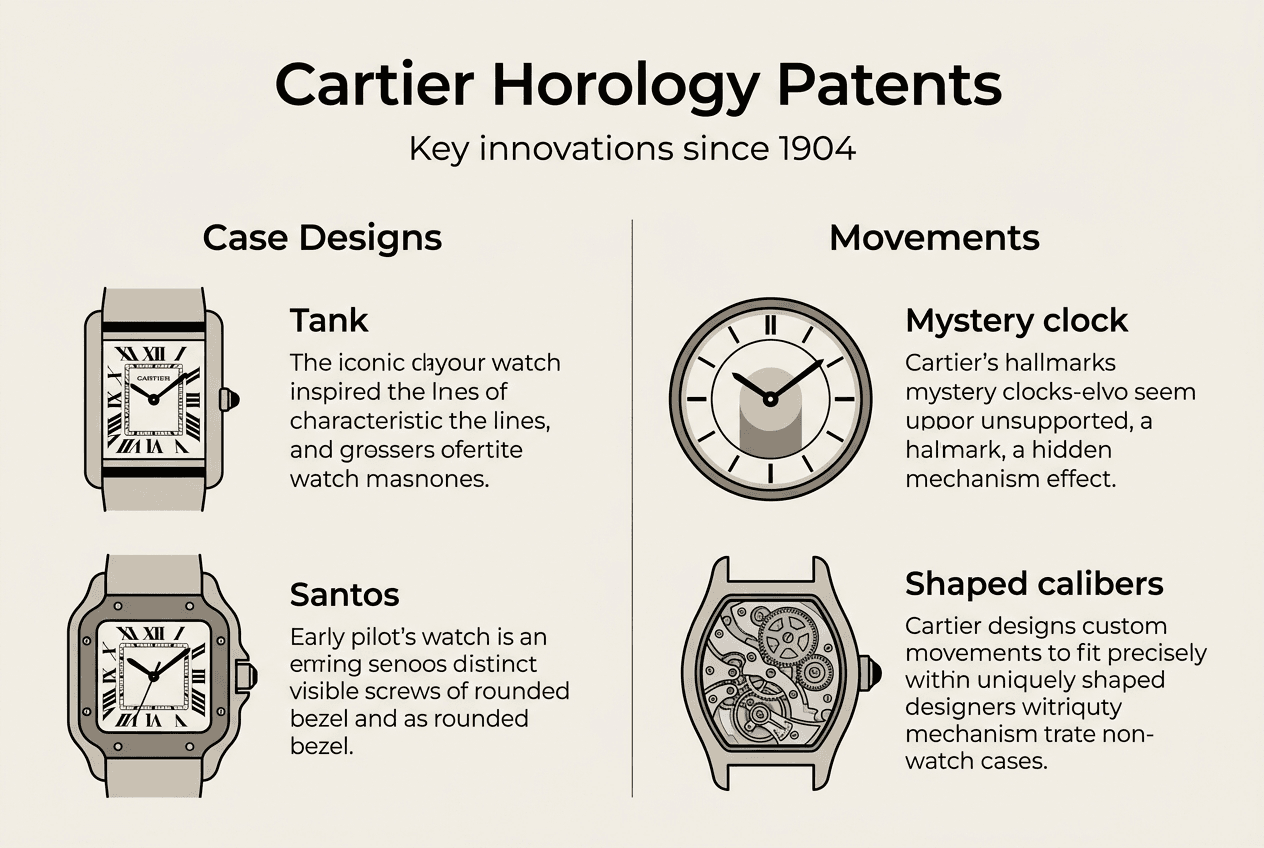
Cartier’s commitment to innovation manifests in over 100 patents filed since 1904, covering everything from case construction to movement architecture. These patents reveal systematic exploration of horological possibilities rather than isolated breakthroughs. Each advancement built upon previous discoveries, creating cumulative expertise that competitors struggled to replicate.
Pro Tip: When evaluating vintage Cartier timepieces, research which patented innovations appear in specific models, as these technical features significantly influence collector value and historical significance beyond aesthetic appeal alone.
The patent portfolio demonstrates Cartier’s dual identity. Some innovations addressed practical concerns like water resistance and shock protection. Others pursued aesthetic goals, developing new case finishing techniques or dial manufacturing processes. This breadth distinguishes Cartier from manufactures pursuing singular visions, instead embracing horology’s full spectrum from engineering to artistry. Collectors increasingly recognise this versatility, seeking pieces that showcase specific horological craftsmanship insights unique to Cartier’s archives.
Revolutionising watch case design: Tank, Santos, and Tortue models
Whilst Swiss manufactures refined round case geometries inherited from pocket watches, Cartier pursued radical alternatives. The brand recognised that wristwatch cases, freed from pocket constraints, could explore entirely new forms. This insight produced three iconic designs that remain instantly recognisable over a century later.
The Tank model introduced in 1917 drew inspiration from military tanks viewed from above, with vertical case sides representing tracks and the horizontal case body suggesting the vehicle’s profile. This wasn’t superficial styling; the rectangular form required developing custom tonneau movements that fit the elongated case whilst maintaining proper proportions. Round movements simply wouldn’t work.

The Santos featured square geometry with rounded corners and exposed screws, creating visual tension between geometric precision and organic curves. Meanwhile, the Tortue embraced asymmetric curves inspired by tortoise shells, demonstrating Cartier’s willingness to pursue beauty over conventional symmetry. Each design demanded bespoke movements engineered specifically for its unique case architecture.
Model | Case Shape | Movement Type | Design Inspiration | Year Introduced |
Santos | Square with rounded corners | Custom tonneau calibre | Aviation instruments | 1904 |
Tank | Rectangle | Elongated tonneau calibre | Military tank tracks | 1917 |
Tortue | Asymmetric curved | Shaped tonneau calibre | Tortoise shell | 1912 |
Ballon Bleu | Round with offset crown | Round automatic | Hot air balloons | 2007 |
These innovations created challenges most manufactures avoided. Developing shaped movements costs significantly more than adapting existing round calibres. Case production requires specialised tooling for each geometry. Even seemingly simple elements like crystals demand custom cutting for non-standard shapes. Cartier accepted these complexities because aesthetic vision drove technical decisions rather than manufacturing convenience.
Pro Tip: The Cartier Santos watch exemplifies how geometric case design influences wearability, as the square form often wears smaller than round watches of equivalent diameter, making it ideal for varied wrist sizes.
Modern collectors appreciate how these case innovations anticipated contemporary design thinking. Today’s watch industry celebrates integrated design where cases and movements develop together. Cartier pioneered this approach decades before it became industry standard, demonstrating foresight that elevates these timepieces beyond period pieces into genuinely forward-thinking creations. The geometric cases also photograph exceptionally well, contributing to strong social media presence that sustains contemporary relevance amongst younger collectors entering luxury horology.
Vintage allure and modern craftsmanship: collector insights and valuation
The collector market for Cartier watches reveals fascinating dynamics between vintage charm and modern precision. Vintage Cartiers are prized for handmade charm whilst modern Privé revivals blend industrial movements with traditional aesthetics, with condition being critical for value assessment. This dual appeal creates opportunities for collectors at various price points.
Vintage pieces from the 1920s through 1970s exhibit characteristics increasingly rare in contemporary watchmaking:
Hand-guilloché dials showing subtle irregularities that confirm artisanal execution
Manually wound movements with visible finishing variations between individual watches
Case proportions reflecting period aesthetics, often smaller and more delicate than modern preferences
Patina development on dials and hands that collectors value as authenticity markers
Condition assessment proves crucial because Cartier watches often served as daily companions rather than safe queens. Cases show polishing wear, dials develop moisture damage, and movements require servicing after decades of use. Professional evaluation becomes essential, as restoration costs can exceed purchase prices for mid-tier vintage models. Understanding watch valuation in 2026 helps collectors make informed acquisition decisions.
Modern Cartier production, particularly the Privé collection, resurrects historical designs with contemporary movements. These pieces appeal to collectors seeking vintage aesthetics without vintage complications. A 2026 Tank Louis Cartier features the same visual proportions as 1920s examples but houses reliable automatic movements with modern power reserves and serviceability. This approach democratises access to iconic designs whilst maintaining Cartier’s aesthetic heritage.
Cartier craftsmanship includes hand-polished bevels and Poinçon de Genève certification on high-end models, contrasting with other manufacturers who may apply Geneva Seal standards inconsistently. These finishing details matter significantly for serious collectors evaluating movement quality. Examining a Cartier movement under loupe reveals chamfered edges, polished screw heads, and Côtes de Genève decoration executed to exacting standards.
Cartier’s approach to movement sourcing distinguishes it from vertically integrated manufactures. The brand historically used quality ébauches from suppliers like Jaeger-LeCoultre and Piaget, then finished them to house standards. Critics sometimes cite this as weakness, but knowledgeable collectors recognise that movement finishing and regulation matter more than in-house production. A well-regulated ETA movement often outperforms poorly finished proprietary calibres.
Maintaining Cartier watches requires specialist knowledge, as case designs and vintage movements demand specific expertise. Following luxury watch maintenance tips preserves both functionality and value, particularly for pieces with complicated case constructions or rare complications. Regular servicing every five to seven years maintains mechanical health whilst preserving originality through careful parts conservation.
Discover Cartier watches at Horology Kings
Having explored Cartier’s rich contributions to luxury horology, you may be considering how to acquire or maintain these exceptional timepieces. Whether you seek a vintage Tank with original patina or a modern Santos with contemporary reliability, expert guidance ensures confident ownership.

Horology Kings specialises in sourcing authenticated Cartier watches for discerning collectors throughout the UK. Our expertise spans vintage rarities and current production models, with particular strength in evaluating condition and provenance. We understand the nuances that separate exceptional examples from compromised pieces, protecting your investment in Cartier watches.
Beyond acquisition, we provide comprehensive services including professional valuations, discreet sales facilitation, and specialist maintenance. Our watch repair and servicing capabilities ensure your Cartier timepieces receive care appropriate to their historical significance and mechanical complexity. For collectors seeking specific references or complications, our source a watch service leverages extensive industry connections to locate rare models that seldom reach public market. Visit Horology Kings to explore current inventory and discuss your collecting objectives with specialists who share your passion for horological excellence.
Frequently asked questions about Cartier in luxury horology
Are Cartier watches considered serious horology by collectors?
Absolutely. Cartier pioneered fundamental innovations including the modern wristwatch, mystery clocks, and geometric case designs that influenced the entire industry. Whilst the brand’s jewellery heritage sometimes overshadows horological achievements, knowledgeable collectors recognise Cartier’s technical contributions and craftsmanship standards rival traditional Swiss manufactures.
How does Cartier finishing compare to other luxury watchmakers?
Cartier applies rigorous finishing standards including hand-polished bevels, Côtes de Genève decoration, and Poinçon de Genève certification on premium models. Whilst movement architecture may utilise quality ébauches rather than entirely proprietary calibres, finishing execution and regulation meet or exceed standards from vertically integrated manufactures. The distinction matters less than overall quality.
What makes vintage Cartier watches valuable to collectors?
Vintage Cartier pieces offer handmade charm with subtle variations confirming artisanal production, historical design language reflecting period aesthetics, and relative rarity compared to mass-produced alternatives. Condition proves critical, as original dials, unpolished cases, and proper provenance significantly influence valuations. Certain references like early Tank models or mystery clocks command substantial premiums.
Should I buy vintage or modern Cartier watches?
This depends on your priorities. Vintage pieces offer historical authenticity and handmade character but require careful condition assessment and potentially expensive maintenance. Modern Privé collections provide vintage aesthetics with contemporary reliability and serviceability. Many collectors pursue both, appreciating different qualities each category offers. Consider your comfort with vintage watch ownership challenges before committing.
How can I verify Cartier watch authenticity before purchase?
Authentication requires examining case signatures, movement markings, dial printing quality, and overall construction consistency with documented examples. Cartier’s complex production history spanning over a century means reference materials prove essential. Professional evaluation provides confidence, particularly for significant purchases. Following comprehensive guides on authenticating luxury watches helps identify common forgery indicators before engaging specialists.
Do Cartier watches hold value compared to Rolex or Patek Philippe?
Cartier watches demonstrate strong value retention, particularly iconic models like Santos, Tank, and mystery clocks. Whilst secondary market liquidity may not match Rolex sports models, serious collectors increasingly recognise Cartier’s historical significance and design excellence. Certain vintage references appreciate substantially, whilst modern limited editions maintain stable values. The market rewards condition, rarity, and provenance regardless of brand.
Recommended
Comments