.png)

Trust in watch transactions: why it matters most
- lewisvrichards3
- Jun 15
- 8 min read
TL;DR:
Trust is essential in luxury watch transactions, influencing every stage from authentication to reputation. Certified Pre-Owned programs and blockchain certificates strengthen trust, but human behavior and clear communication remain crucial. Higher platform commissions reflect the economic value buyers place on guaranteed security and authenticity.
Trust is the foundational currency in luxury watch transactions, determining whether a deal succeeds or collapses before the watch ever changes hands. When a Rolex Submariner or Patek Philippe Nautilus sells for five or six figures, the buyer cannot rely on instinct alone. Authentication systems, intermediary reputation, and pricing transparency each carry equal weight. The role of trust in watch transactions is not a soft concept. It is a measurable, economic force that shapes every stage of the buying and selling process, from the first enquiry to the final bank transfer.
How authentication systems define trust in watch transactions
Authentication is the first line of defence in any luxury watch deal. Without it, buyers face the most damaging risk in the secondary market: paying a premium price for a counterfeit or misrepresented piece.
Certified Pre-Owned (CPO) programmes represent the most structured response to this problem. CPO programmes reduce consumer risk by placing authentication under brand control, routing transactions through authorised channels, and attaching manufacturer-backed guarantees. Rolex, Audemars Piguet, and Omega have each developed CPO frameworks that re-internalise trust within the secondary market. The result is a buyer who does not need to guess. The brand itself has verified the watch.
Blockchain-based certificates offer a different approach. They embed provenance data digitally, creating a tamper-resistant record of ownership history. The appeal is clear. However, blockchain adoption faces friction in consumer uptake, interoperability between platforms, and the practical challenge of linking a digital certificate to a physical object. A blockchain record is only as reliable as the moment the watch was first registered.
Method | Strengths | Limitations |
CPO Programmes | Brand-backed guarantee, authorised channels, warranty | Limited to participating brands and dealers |
Blockchain Certificates | Tamper-resistant provenance record, digital portability | Adoption gaps, interoperability issues, linkage to physical watch |
Independent Expert Inspection | Flexible, applicable to any watch | Relies on individual expertise, no standardised record |
Pro Tip: When buying pre-owned, always request both the original box and papers alongside any CPO certificate. Physical documentation and a digital record together provide the strongest proof of authenticity.
CPO programmes also reshape the competitive landscape. These programmes can divert transactions away from independent resellers, effectively verticalising the secondary market. For buyers, that means more structured protection. For independent dealers, it means the bar for demonstrating trustworthiness has risen considerably. You can explore the practical side of this in a detailed watch authentication checklist that covers the key steps for protecting your investment.
Why intermediary reputation drives remote, high-value deals
The majority of serious luxury watch transactions now happen remotely. A collector in Edinburgh buys from a dealer in Hertfordshire without ever meeting face to face. In that context, the intermediary’s reputation substitutes entirely for physical inspection.
In remote, high-value transactions, deals involving tens or hundreds of thousands of pounds often involve clients who never meet the seller in person. Trust becomes the real currency. A dealer’s track record, their responsiveness, and the clarity of their communication carry more weight than any single piece of paperwork.
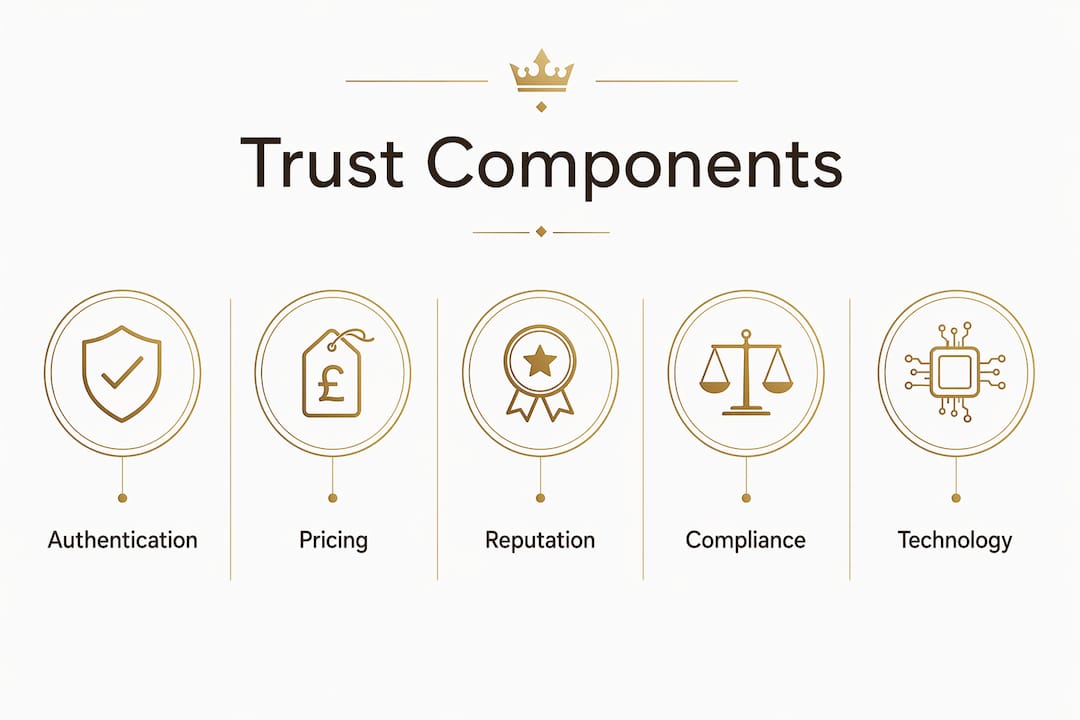
Building that trust requires consistency across every touchpoint:
Authentication: The watch must be verified before listing, not after a dispute arises.
Communication: Buyers expect prompt, honest answers to questions about condition, provenance, and pricing.
Shipping security: Insured, tracked delivery with appropriate packaging signals professionalism.
Follow-up: Post-sale contact, whether to confirm receipt or address a concern, cements long-term relationships.
Transparency: Disclosing service history, known wear, or missing accessories builds credibility rather than eroding it.
Trust is built across the entire transaction lifecycle, not just at the point of product inspection. A dealer who handles a complaint well earns more loyalty than one who never generates a complaint in the first place.
The collector community amplifies this effect. Word travels fast in networks centred on Rolex, Patek Philippe, and Cartier. Prioritising short-term sales over long-term reputation harms trust permanently. Negative word-of-mouth in watch forums and collector groups can undo years of careful reputation building within weeks.
Pro Tip: Before committing to a remote purchase, search the dealer’s name across specialist watch forums such as WatchUSeek and Rolex Forums. Collector communities are candid, and patterns of behaviour surface quickly.
How pricing transparency reduces buyer risk
Buyers in the secondhand watch market face two distinct risks. The first is authenticity uncertainty. The second is not knowing whether the asking price reflects fair market value. Both must be resolved before a buyer commits.
Secondhand watch buyers face these twin risks of unknown authenticity and unclear pricing. Platforms and dealers that address both simultaneously see stronger conversion and fewer abandoned transactions. When only one risk is resolved, buyers hesitate at the final stage.
The steps a trustworthy seller takes to address pricing clarity follow a logical sequence:
Reference market indices: Cite recognised pricing benchmarks to justify the asking price.
Disclose condition grading: Use a consistent, transparent grading system so buyers can compare like for like.
Provide service records: A watch with documented servicing history commands a premium that buyers can verify.
Offer independent valuation: Encouraging a buyer to seek a second opinion signals confidence in the price.
Publish comparable sales: Showing recent transaction data for the same reference removes ambiguity.
Authentication and pricing clarity must co-exist to avoid trust breakdown at the checkout stage. A buyer who is confident in the watch’s authenticity but uncertain about the price will still walk away. Transparency in pricing is not a concession. It is a conversion tool.
Platforms that own authentication and pricing indices control reference prices and market liquidity. This gives them structural authority over what a watch is worth. For individual buyers and sellers, understanding where a price comes from is as important as the price itself. Reading about transparency in watch sales gives you a clearer picture of how pricing signals affect buyer confidence.
What does trust actually cost in the secondary watch market?
Trust has a direct economic value, and the secondary watch market prices it explicitly. The commission structure of any platform tells you exactly how much trust is worth.
Managed marketplaces charge 20%–50% commission as a trust premium for absorbing fraud and dispute risk. Peer-to-peer platforms charge 5%–12%. That gap represents the economic cost of trust. Buyers and sellers on managed platforms pay more because the platform guarantees the transaction.
Platform Type | Commission Range | Trust Provision |
Managed Marketplace | 20%–50% | Authentication, dispute resolution, fraud protection |
Peer-to-Peer Platform | 5%–12% | Limited, relies on user ratings and self-reporting |
Specialist Dealer | Varies | Expert verification, direct accountability, relationship-based |
The implications for sellers are significant:
A higher commission is not simply a cost. It is access to a buyer pool that would not transact without that guarantee.
Platforms that absorb risk attract buyers who would otherwise avoid the secondary market entirely.
Specialist dealers occupy a middle ground, offering expert verification and direct accountability without the overhead of a large marketplace.
Authentication technology such as blockchain and NFC lowers trust costs over time, but only when it integrates smoothly into existing buying behaviour. A buyer who does not understand how to verify a blockchain certificate gains no confidence from it. The technology must serve the transaction, not complicate it. For practical guidance on keeping transactions secure, the secure watch transactions guide covers the key steps for both buyers and sellers.
Key takeaways
Trust in luxury watch transactions is built through authentication, pricing transparency, intermediary reputation, and consistent communication across every stage of the deal.
Point | Details |
Authentication is non-negotiable | CPO programmes and expert inspection reduce the primary risk of counterfeit or misrepresented watches. |
Reputation substitutes for in-person verification | In remote deals, a dealer’s track record and communication standards carry more weight than paperwork alone. |
Pricing clarity prevents late-stage abandonment | Buyers who understand the price justification are far more likely to complete a transaction. |
Trust commands a measurable premium | Managed marketplaces charge 20%–50% commission precisely because buyers pay for guaranteed protection. |
Long-term reputation outweighs short-term gain | Negative word-of-mouth in collector communities spreads quickly and is difficult to reverse. |
Trust is a culture, not a checklist
I have spent years working in the luxury watch market, and the most consistent pattern I have observed is this: the dealers who last are not the ones with the most impressive inventory. They are the ones who tell you something you do not want to hear.
Conventional wisdom treats trust as a feature, something you add to a transaction through certificates and guarantees. My experience is that trust is a culture. It shows up in the way a dealer responds when a watch arrives with undisclosed wear. It shows up in whether they proactively flag a service gap or wait to see if the buyer notices. Those moments are where reputations are actually built or destroyed.
The technology side is genuinely exciting. Blockchain provenance records and NFC chips will make authentication faster and more reliable. But I would caution against assuming that technology replaces the human element. A blockchain certificate on a watch sold by a dealer with a poor communication record offers limited reassurance. The certificate tells you about the watch. The dealer’s behaviour tells you about the deal.
The collectors I respect most are the ones who treat every transaction as the start of a relationship, not the end of one. They follow up. They remember what you were looking for. They call when something relevant comes in. That behaviour is not a sales tactic. It is the foundation of a reputation that compounds over years.
Emerging authentication tools will augment that foundation. They will not replace it. The watch market runs on relationships, and relationships run on trust. That will not change regardless of what the technology does.
— Lewis
Buy and sell luxury watches with confidence at Horology-kings
Horology-kings is a specialist luxury watch dealer based in Hertfordshire, built on the principles this article describes: authentication, transparent pricing, and secure transactions from first enquiry to final payment.
Whether you are looking to buy, sell, or source a watch, every transaction at Horology-kings is backed by expert verification, honest valuations, and secure UK bank transfers. The team handles Rolex, Patek Philippe, Audemars Piguet, Omega, and Cartier, with a focus on provenance and condition transparency at every stage. If you are searching for a specific reference, the watch sourcing service draws on an expert network to locate authenticated pieces on your behalf. Trust is not a marketing claim here. It is the operating standard.
FAQ
What is the role of trust in watch transactions?
Trust in watch transactions determines whether buyers and sellers can complete high-value deals with confidence. It is built through authentication, transparent pricing, intermediary reputation, and consistent communication throughout the transaction.
How do CPO programmes build trust for watch buyers?
Certified Pre-Owned programmes place authentication under brand control, providing buyers with a manufacturer-backed guarantee of authenticity. Brands including Rolex and Audemars Piguet use CPO frameworks to reduce risk in the secondary market.
Why does intermediary reputation matter more in remote watch deals?
When buyers and sellers never meet in person, the dealer’s track record substitutes for physical inspection. Responsiveness, honesty about condition, and post-sale follow-up are the primary signals buyers use to assess trustworthiness.
How does pricing transparency affect trust in secondhand watch sales?
Buyers face two risks: authenticity uncertainty and unclear fair pricing. When both are resolved together, conversion rates improve. When only one is addressed, buyers frequently abandon the transaction at the final stage.
What is the economic cost of trust in the watch resale market?
Managed marketplaces charge 20%–50% commission as a direct trust premium, compared to 5%–12% on peer-to-peer platforms. That difference reflects the cost of absorbing fraud risk, dispute resolution, and authentication guarantees.
Recommended
Comments