.png)
Role of auctions in watch sales for luxury collectors 2026
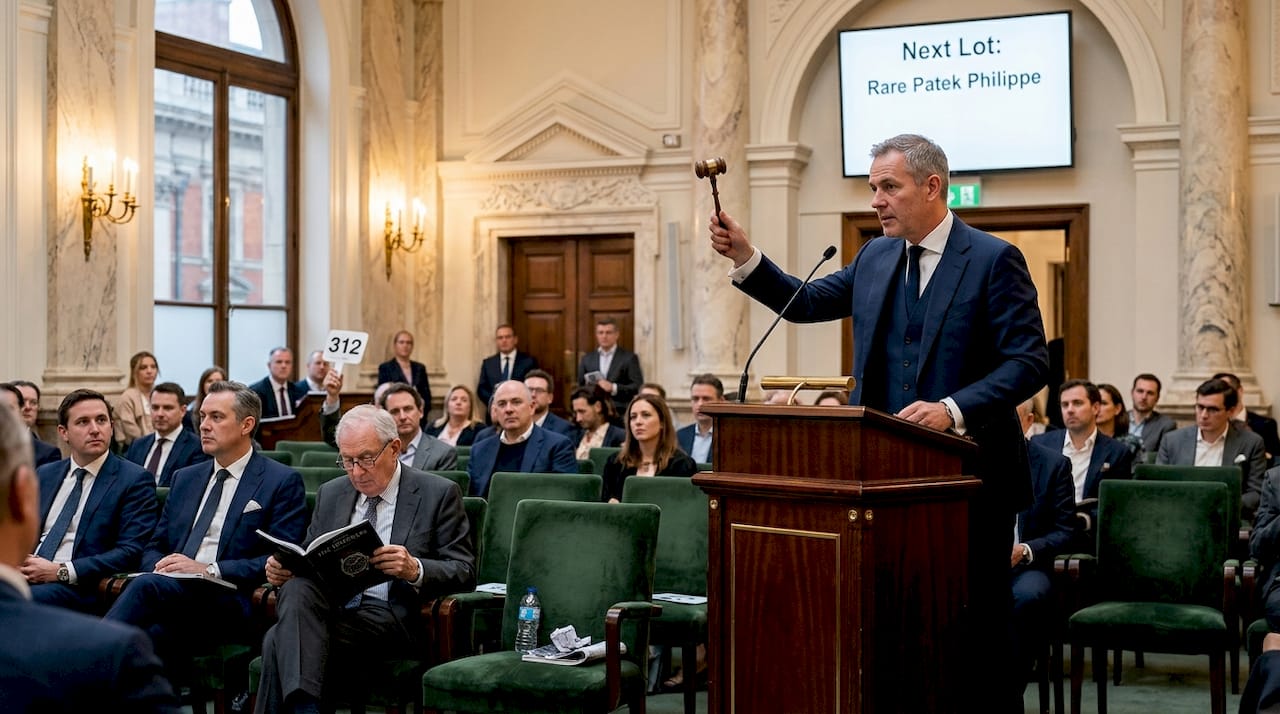
Contrary to popular belief, private sales and grey market channels do not dominate the luxury watch market. Auctions have emerged as the primary channel for acquiring rare timepieces, particularly for Rolex and Patek Philippe collectors. The world’s leading auction houses now command significant market share, with Phillips achieving over $290 million in watch sales during 2025 alone. This guide explores how auctions shape pricing, ensure authenticity, and provide strategic opportunities for discerning collectors and investors seeking high-end timepieces.
Table of Contents
Key takeaways
Point | Details |
Auctions define market value | Public bidding establishes transparent pricing for rare luxury watches |
Provenance drives premiums | Documented history and fresh-to-market status command higher auction prices |
Patek and Rolex dominate | These brands account for 50-60% of auction value share globally |
Global exposure matters | Major auction houses attract serious collectors and institutional buyers |
Due diligence is essential | Verifying condition and authenticity protects against grey market risks |
Why auctions dominate high-end watch sales
Auctions have fundamentally reshaped how collectors acquire rare luxury watches. Unlike private sales, which often lack transparent pricing mechanisms, auctions provide verifiable market data through public bidding records. This transparency allows collectors to make informed decisions based on real-time demand signals rather than subjective valuations.
The concentration of market power amongst leading auction houses demonstrates this dominance. Phillips achieved over $290 million in watch sales during 2025, representing approximately 45% market share. This scale attracts global collectors, institutional investors, and museums competing for the same exceptional pieces. The resulting competitive environment drives fair market pricing that private channels simply cannot replicate.
Authenticity concerns further strengthen auctions’ position. Grey market dealers often operate with limited transparency, creating risks of counterfeit watches or questionable provenance. Reputable auction houses employ specialist teams to authenticate pieces, document service histories, and verify originality. This rigorous vetting process protects buyers whilst building confidence in the secondary market.
Pro Tip: Before bidding, request detailed condition reports and high-resolution photographs from auction houses. These documents often reveal subtle details about originality and restoration that significantly impact value.
Consider these advantages of auction purchases:
Public bidding creates verifiable price discovery
Global marketing reaches serious collectors worldwide
Expert authentication reduces counterfeit risks
Documented provenance enhances future resale value
Transparent buyer premiums eliminate hidden costs
For collectors seeking professional watch valuation, understanding auction dynamics provides essential context for assessing secondary market pricing. The data generated through auction sales establishes benchmarks that influence private transactions, dealer pricing, and insurance valuations across the entire luxury watch ecosystem.
Key auction results that set benchmarks in 2025-2026
Recent auction results have established new valuation benchmarks that guide collector strategies and market expectations. The Phillips 2025 total exceeded $290 million across 1,802 lots, demonstrating sustained demand for authenticated luxury timepieces. These results provide concrete data points that collectors use to assess fair market value and investment potential.
Patek Philippe continues to dominate record-breaking sales. A rare reference 1518 in stainless steel achieved approximately $17.6 million, setting a new benchmark for complicated vintage timepieces. This result reflects the premium collectors place on exceptional provenance, original condition, and historical significance. Steel sports models from this era command particular attention due to their scarcity and desirability amongst serious collectors.
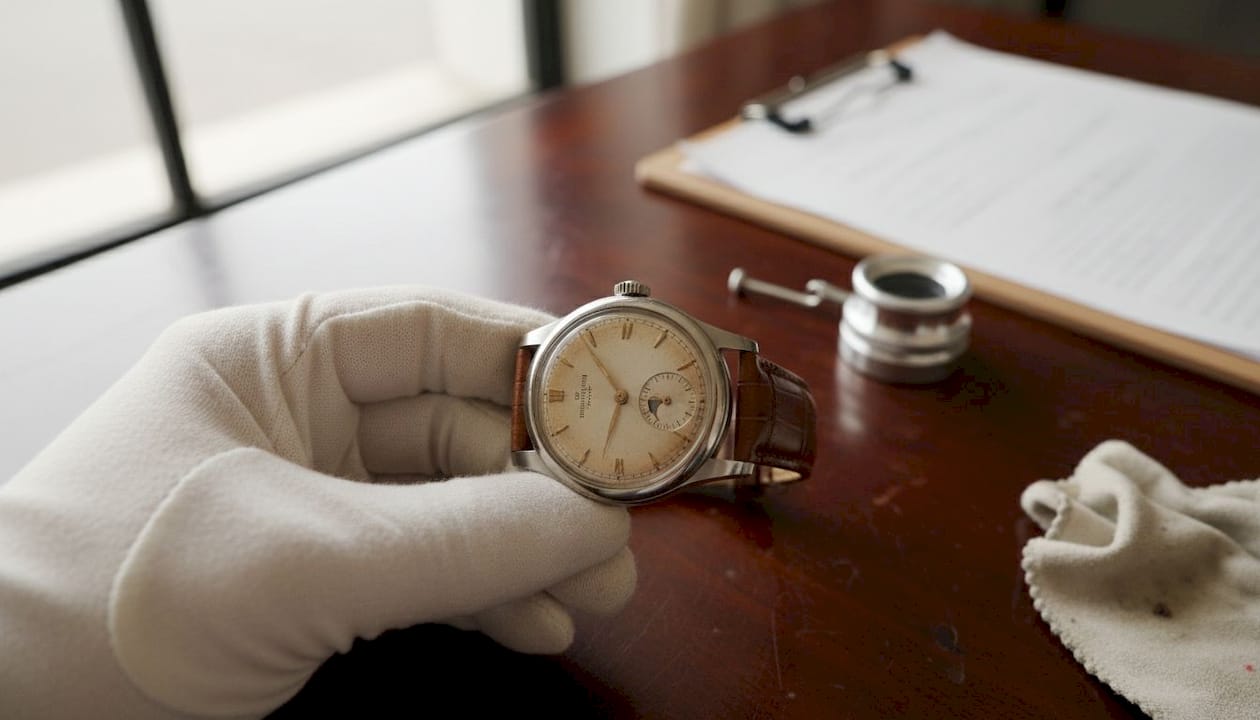
Rolex Daytona references associated with Paul Newman regularly exceed £1 million at auction. These iconic chronographs benefit from documented celebrity provenance, original condition, and the mystique surrounding Newman’s personal connection to the model. Fresh-to-market examples consistently outperform previously circulated pieces, sometimes by 20-30%, demonstrating the value of unseen condition and exclusivity.
Auction House | 2025 Total Sales | Market Share | Notable Records |
Phillips | $290M+ | ~45% | Patek 1518 steel $17.6M |
Christie’s | $180M+ | ~28% | Rolex Daytona Paul Newman $1.2M |
Sotheby’s | $140M+ | ~22% | Patek 2499 perpetual $3.8M |
Bonhams | $32M+ | ~5% | Rolex Submariner 6538 $485K |
These benchmark results influence secondary market pricing across all channels. Dealers reference auction records when setting retail prices, whilst collectors use them to negotiate private transactions. Understanding these benchmarks helps buyers identify fair value and avoid overpaying in less transparent markets.
The premium commanded by fresh-to-market pieces deserves particular attention. Watches appearing at auction for the first time often achieve 15-25% above estimate, driven by competitive bidding from collectors seeking unseen examples. This phenomenon creates opportunities for sellers with long-held pieces and challenges for buyers competing against institutional collectors.
For investors tracking rare Swiss watches value gains, auction results provide the most reliable data for assessing appreciation trends. The public nature of these transactions eliminates the opacity that characterises private sales and grey market channels.
Nuances of auction buying: provenance, condition and market impact
Successful auction buying requires understanding the critical factors that influence final hammer prices. Provenance stands as perhaps the most significant variable, establishing authenticity whilst adding historical narrative that resonates with collectors. Watches with documented ownership histories, original purchase receipts, or celebrity connections consistently outperform similar examples lacking such documentation.
Condition assessment requires expertise that goes beyond superficial inspection. Professional auction houses provide detailed condition reports noting case thickness, dial originality, bracelet stretch, and service history. These technical details significantly impact valuations, with original, unpolished examples commanding substantial premiums over restored pieces. Collectors should scrutinise these reports carefully, as subtle condition differences can represent tens of thousands of pounds in value.
Auction experts emphasise that fresh-to-market pieces consistently outperform previously circulated examples. This premium reflects collector preference for unseen condition and the competitive dynamics created when rare pieces appear publicly for the first time. The phenomenon creates opportunities for long-term owners considering sale whilst challenging buyers to set realistic budgets.
Pro Tip: Request service history documentation before bidding. Recent servicing by authorised service centres adds value, whilst lack of maintenance history may indicate deferred costs that reduce net investment returns.
Consider this due diligence checklist:
Verify serial numbers match documented production periods
Confirm dial, hands, and markers are factory original
Check case condition for evidence of excessive polishing
Review service history and documentation completeness
Research comparable sales to establish fair market range
Factor buyer’s premium and applicable taxes into total cost
“The difference between a £50,000 watch and a £150,000 watch often comes down to provenance and originality. Collectors increasingly demand documentation that proves authenticity and establishes historical significance.” — Leading auction specialist
Grey market risks compound when buyers skip proper due diligence. Counterfeit watches have become increasingly sophisticated, making authentication essential even for experienced collectors. Reputable auction houses invest in specialist expertise and reference databases that private buyers cannot easily replicate. This professional vetting justifies buyer premiums whilst protecting against costly mistakes.
Understanding these nuances helps collectors make informed decisions about when to bid aggressively and when to exercise patience. The auction market rewards preparation, with successful buyers combining technical knowledge, market research, and disciplined bidding strategies. Those seeking expert negotiation guidance can apply similar principles to private transactions.
Comparing auctions with private and grey market sales
The luxury watch market operates across three primary channels, each offering distinct advantages and risks. Auctions dominate value share for rare timepieces, particularly Patek and Rolex commanding 50-60% of total auction values. This concentration reflects collector preference for transparent pricing and authenticated pieces when acquiring significant investments.
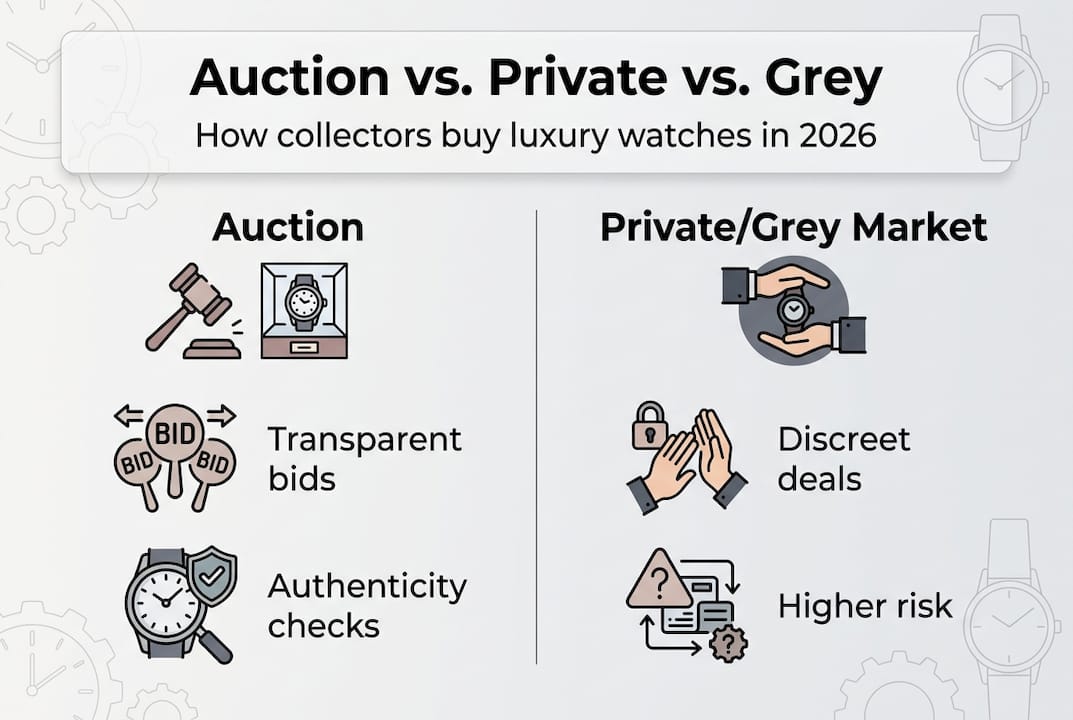
Private sales offer discretion and potentially lower transaction costs, yet lack the price discovery mechanisms that auctions provide. Without public bidding records, buyers and sellers must negotiate based on subjective valuations rather than verified market data. This opacity creates information asymmetry that can disadvantage less experienced collectors. Private transactions work best for standard production models with established secondary market pricing.
Grey market channels present the highest authentication risks. Dealers operating outside authorised networks may offer attractive pricing, but buyers sacrifice warranty coverage, service history verification, and provenance documentation. The savings rarely justify the risks, particularly for six-figure timepieces where authenticity concerns can eliminate resale value entirely.
Channel | Transparency | Authentication | Pricing | Best For |
Auctions | Public records | Expert vetting | Market-driven | Rare, high-value pieces |
Private Sales | Limited visibility | Buyer responsibility | Negotiated | Standard production models |
Authorised Dealers | Full transparency | Factory certified | Premium retail | New purchases |
Grey Market | Minimal disclosure | Questionable | Discounted | High-risk tolerance only |
Auctions excel for rare complications, vintage pieces, and fresh-to-market examples where competitive bidding establishes fair value. The public nature of transactions creates verifiable pricing data that influences the broader market. Collectors benefit from global exposure, attracting serious buyers willing to pay premium prices for exceptional pieces.
Consider these channel-specific advantages:
Auctions provide transparent price discovery and authentication
Private sales offer discretion and flexible terms
Authorised dealers ensure factory warranties and service
Grey markets present unacceptable authenticity risks
Choosing the appropriate channel depends on watch rarity, buyer expertise, and risk tolerance. Collectors acquiring investment-grade timepieces should prioritise auctions or authorised dealers, accepting higher transaction costs in exchange for authenticity assurance and transparent pricing. Those seeking secure online sales can leverage similar transparency principles through reputable platforms.
The market continues evolving, with online auctions expanding access whilst maintaining authentication standards. This democratisation benefits collectors globally, though competition for exceptional pieces has intensified. Understanding these channel dynamics helps buyers develop acquisition strategies aligned with their collecting goals and risk parameters.
How collectors can use auctions to source and invest in luxury watches
Strategic auction participation requires preparation, discipline, and market knowledge. Successful collectors approach auctions as research opportunities, studying catalogues to understand current market trends, pricing dynamics, and emerging collecting categories. This intelligence gathering provides valuable context even when not actively bidding.
Attending major auctions offers direct market insights that online catalogues cannot replicate. Viewing sessions allow hands-on inspection, revealing condition details that photographs may obscure. Speaking with specialists provides expert perspectives on authenticity, restoration, and market positioning. These interactions build knowledge that improves decision-making across all acquisition channels.
Auction experts recommend thorough research on provenance and condition before committing to bid. This due diligence protects against overpaying whilst identifying opportunities where market pricing may not fully reflect a piece’s significance. Fresh-to-market watches deserve particular attention, as their premium potential can justify aggressive bidding strategies.
Pro Tip: Set maximum bid limits before auctions begin and resist emotional escalation during competitive bidding. The most successful collectors maintain discipline, accepting that losing individual lots preserves capital for better opportunities.
Implement this strategic approach:
Study auction catalogues three to four weeks before sale dates
Request detailed condition reports for serious prospects
Research comparable sales to establish fair market ranges
Set firm budget limits including buyer premiums and taxes
Attend preview sessions for hands-on condition assessment
Register early to ensure bidding access and avoid technical issues
Fresh-to-market pieces consistently deliver superior investment returns, making them priority targets for strategic collectors. These watches generate competitive bidding that can push prices beyond conservative estimates, yet their long-term appreciation often justifies initial premiums. Collectors should balance acquisition cost against potential value growth, factoring in holding periods and market cycles.
Consigning watches through reputable auction houses maximises selling prices by accessing global collector networks. Houses charge seller commissions typically ranging from 10-15%, yet the premium prices achieved often exceed private sale proceeds. Timing consignments to coincide with thematic sales or strong market conditions optimises results.
Building relationships with auction house specialists provides advantages including advance notice of significant pieces, guidance on bidding strategies, and insights into buyer preferences. These connections prove valuable whether acquiring or selling, as specialists understand market dynamics that casual participants may miss.
For collectors requiring specific models, professional sourcing services complement auction strategies by monitoring multiple channels simultaneously. This comprehensive approach ensures access to exceptional pieces regardless of sales venue, whilst maintaining authentication standards and transparent pricing.
Discover authentic luxury watches with Horology Kings
Navigating the luxury watch market requires expertise, market access, and unwavering commitment to authenticity. Horology Kings combines these elements, offering collectors a trusted platform for acquiring, maintaining, and selling exceptional timepieces. Our specialisation in Rolex, Patek Philippe, and other prestigious Swiss brands ensures clients access genuine pieces backed by thorough authentication and transparent pricing.
Our professional sourcing service leverages extensive industry networks to locate specific models matching your collecting criteria. Whether seeking a rare vintage Patek complication or a modern Rolex sports model, our team monitors auctions, dealer networks, and private collections to identify exceptional opportunities. This comprehensive approach saves time whilst ensuring authenticity and fair pricing.
Maintaining your collection’s value requires expert care and servicing. Our watch repair and servicing capabilities preserve originality whilst ensuring reliable performance. We work exclusively with experienced watchmakers who understand the nuances of luxury timepiece maintenance, protecting your investment through proper care and documentation.
Discover how Horology Kings can support your collecting journey with personalised service, market expertise, and unwavering commitment to authenticity.
Frequently asked questions
What is the primary role of auctions in luxury watch sales?
Auctions establish transparent market value for rare watches through public bidding that reflects genuine collector demand. They provide global exposure to serious buyers and institutional collectors who compete for exceptional pieces. This competitive environment creates verifiable pricing data that influences the broader secondary market.
How do provenance and condition affect auction prices for watches?
Strong provenance boosts buyer confidence by documenting authenticity and historical significance, often adding 20-30% premiums. Better condition, particularly original unrestored examples, commands substantially higher final bids than polished or refinished pieces. These factors combined can double or triple values compared to similar watches lacking documentation or originality.
Why do fresh-to-market watches often sell for higher prices at auction?
Fresh-to-market pieces generate excitement because collectors prefer unseen examples with unknown condition and complete originality. The exclusivity of watches appearing publicly for the first time creates competitive bidding dynamics. These pieces typically achieve 15-25% above conservative estimates as multiple bidders compete for the opportunity.
Are auctions safer than private sales for authentic luxury watches?
Auctions offer significant safety advantages through expert authentication, detailed condition reports, and public transaction records that verify pricing. Reputable houses employ specialists who examine pieces thoroughly before sale. Private and grey markets carry substantially higher risks of counterfeits, questionable provenance, and pricing opacity that can result in costly mistakes for buyers.
Recommended
Comments