.png)

Watch collector insurance: a complete guide for collectors
- lewisvrichards3
- Jun 10
- 9 min read
TL;DR:
Watch collector insurance offers comprehensive coverage for high-value watches, including theft, accidental damage, and market appreciation, surpassing standard home policies. Proper valuation, secure storage, and regular appraisals are essential for accurate protection and preventing underinsurance. This specialized insurance ensures claims are handled correctly without affecting home coverage, safeguarding your valuable collection.
Watch collector insurance is a specialised policy designed to protect high-value luxury timepieces against theft, accidental damage, loss, and mysterious disappearance, offering coverage that standard home insurance policies cannot match. Known formally in the industry as specialist watch insurance or collector watch coverage, these policies are built around the specific risks that Rolex, Patek Philippe, Audemars Piguet, and Omega owners face. Providers such as Hodinkee Insurance, Chubb, and Jewelers Mutual have developed dedicated products for this market precisely because a single watch can be worth more than a family car, and a standard home policy treats it accordingly poorly. If you own one or more luxury timepieces worth thousands of pounds, understanding what is watch collector insurance is the first step towards genuine financial protection.
What does watch collector insurance typically cover?
Specialist watch insurance operates on an all-risk basis, which means the policy covers any cause of loss unless it is specifically excluded. That is the opposite of standard home insurance, which covers only the perils it names. The practical difference for collectors is enormous.
Core coverage under a quality collector watch policy includes:
Theft, including from your home, a hotel room, or a vehicle
Accidental damage, such as a cracked crystal or a dropped movement
Mysterious disappearance, meaning a watch that simply cannot be accounted for
Loss during travel, covering you worldwide rather than only at your home address
Shipping damage when sending a watch to an authorised service centre such as Rolex’s own facilities or an independent watchmaker
Partial damage, including broken bracelets, damaged bezels, or scratched cases
Standard exclusions across most watch insurance policies include wear and tear, gradual deterioration, depreciation, unauthorised modifications, and losses arising from war or government seizure. These exclusions are reasonable and largely unavoidable across the insurance market.
The settlement method matters as much as the coverage itself. Agreed-value policies provide a fixed payout agreed at the time the policy is set up, eliminating disputes caused by fluctuating market values. This is the preferred structure for serious collectors because a Patek Philippe Nautilus or a Rolex Daytona can appreciate significantly between purchase and claim. Actual cash value policies, by contrast, deduct depreciation from the payout, which is rarely appropriate for watches that tend to hold or increase their value.
Pro Tip: Always confirm whether your policy settles on an agreed-value or actual cash value basis before signing. The difference in a claim payout can be tens of thousands of pounds.
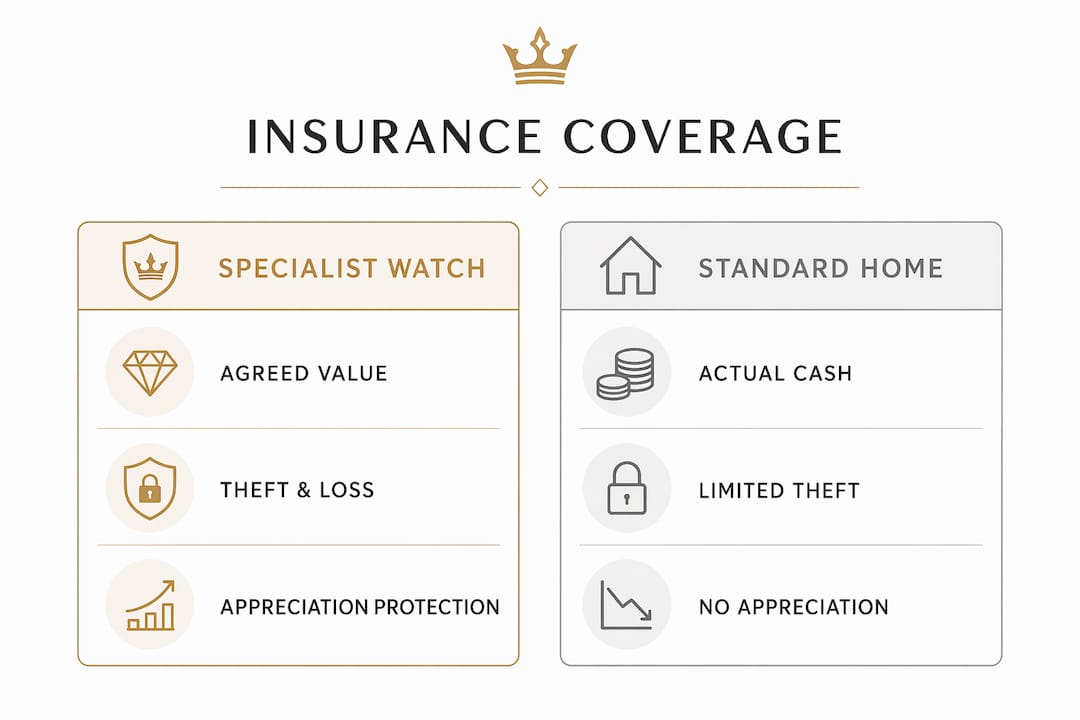
Coverage type | Specialist watch policy | Standard home insurance |
Mysterious disappearance | Included | Excluded |
Worldwide travel cover | Included | Rarely included |
Agreed-value settlement | Standard | Uncommon |
Accidental damage | Included | Often excluded |
Per-item value cap | No cap (subject to declared value) | Typically £1,500 to £5,000 |
Why are valuations and appraisals critical for your coverage?
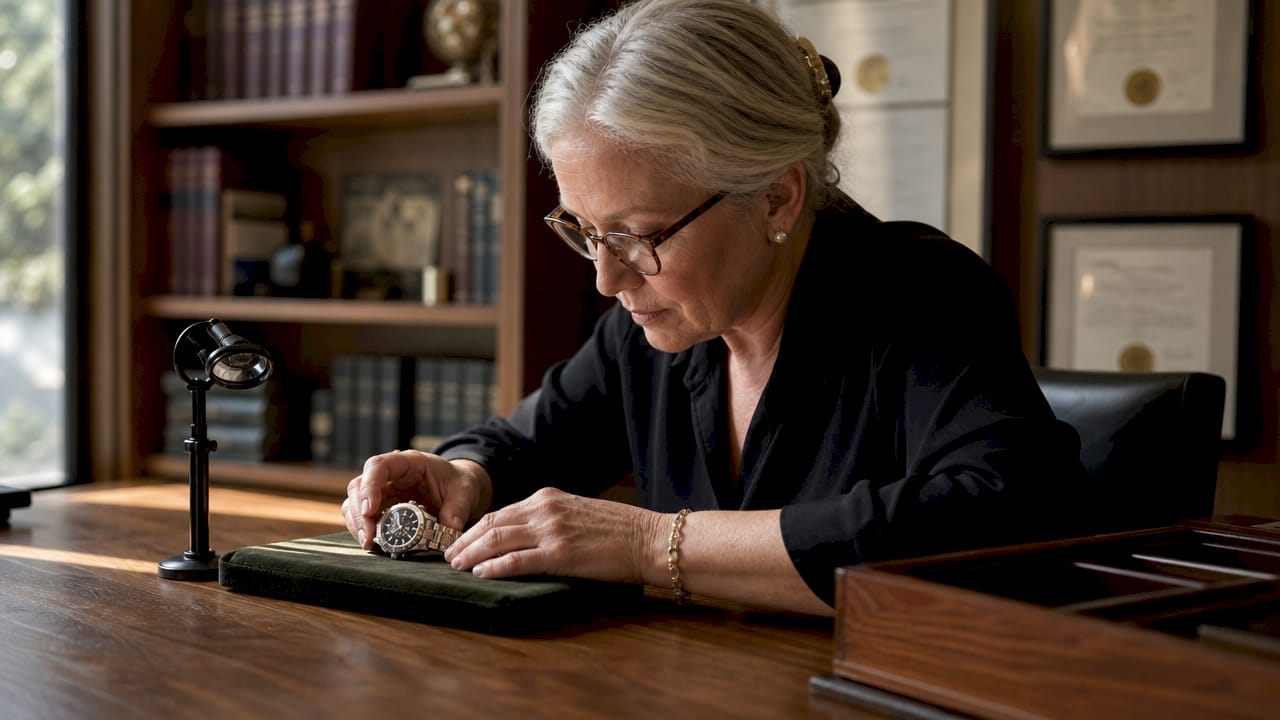
The accuracy of your insurance coverage depends entirely on the accuracy of your declared watch values. An underinsured watch is a partially uninsured watch, and the gap between what you paid and what a watch is worth today can be substantial.
Three valuation concepts govern how watch insurance policies work:
Retail replacement value is the cost to replace the watch with an equivalent new or pre-owned example at current market prices. This is the figure most specialist insurers use to set your sum insured.
Fair market value is what a willing buyer would pay a willing seller in an open market transaction. This figure is typically lower than retail replacement value and is more common in general insurance contexts.
Agreed value is the fixed figure you and your insurer agree upon at inception, which becomes the guaranteed payout in the event of a total loss.
Independent professional appraisals every one to three years are the standard recommendation across the specialist insurance market. Watch values move quickly. A Rolex Submariner that was worth £8,000 three years ago may now command £12,000 on the secondary market. If your policy still reflects the older figure, you face a shortfall at claim time.
Relying on original receipts is inadequate for insurance purposes precisely because watches frequently appreciate rather than depreciate. An independent appraiser who specialises in horology will produce a written report that documents the watch’s condition, reference number, serial number, and current replacement value. That document is what your insurer needs.
Some 2026 policies from providers such as Hodinkee Insurance include appreciation protection covering up to 150% of the originally appraised value. This clause protects you if the market rises sharply between appraisals, which has happened repeatedly with references from Patek Philippe and Audemars Piguet over the past decade.
Documentation beyond the appraisal report strengthens any future claim considerably. Photographs of each watch from multiple angles, records of serial numbers, copies of service records, and original box and papers all contribute to a faster and less disputed claims process. The watch valuation checklist published by Horology-kings provides a practical framework for maintaining this documentation consistently.
Pro Tip: Commission a new appraisal whenever you acquire a significant piece, not just on a fixed schedule. A new Rolex or Patek Philippe purchase changes your collection’s total insured value immediately.
What do watch insurance policies cost and what security is required?
Specialist watch insurance premiums typically range from 1% to 2% of the total insured value annually, though some providers offer rates as low as 0.05% for very large, well-secured collections. A collection valued at £50,000 would therefore cost between £500 and £1,000 per year to insure under a standard specialist policy. That figure is modest relative to the financial exposure it eliminates.
Several factors determine where within that range your premium falls:
Location and postcode, since urban areas with higher theft rates attract higher premiums
Storage quality, with UL-rated safes reducing both premiums and the risk of a declined claim
Travel habits, because a collector who frequently wears watches internationally presents a higher risk profile
Collection composition, since a single ultra-rare reference carries different risk characteristics than a diversified collection
Collections valued above £100,000 often face mandatory requirements for UL-rated safes with a TL-15 or TL-30 burglar rating. A TL-15 safe is rated to resist a skilled attack for 15 minutes using common tools. A TL-30 safe doubles that resistance. Insurers at this level are not suggesting these safes as good practice. They are requiring them as a condition of coverage. Storing a £150,000 collection in a standard domestic safe or, worse, a bedside drawer will result in a declined claim regardless of what your policy document says.
Premiums depend on storage quality, travel habits, and location, which means collectors who invest in proper security infrastructure directly reduce their annual insurance costs. A TL-15 safe installation that costs £2,000 can pay for itself within two or three years through premium reductions alone.
One detail that surprises many collectors: bank safe deposit boxes are often excluded from coverage by specialist insurers because the insurer cannot verify the contents or monitor access. Home storage in a rated safe is generally the preferred arrangement.
Pro Tip: Request a security survey from your insurer before purchasing a safe. Some providers will specify exact models or ratings they accept, and buying the wrong safe means you may not be covered even if you have one.
How does specialist watch insurance differ from standard home insurance?
Standard home insurance is not designed for luxury watch collections, and the gap between what collectors assume they are covered for and what they are actually covered for is one of the most expensive misunderstandings in the hobby.
Standard home insurance jewellery and watch coverage is typically capped between £1,500 and £5,000 per item. A single Rolex Daytona in stainless steel currently trades at multiples of that figure on the secondary market. A Patek Philippe Calatrava or an Audemars Piguet Royal Oak is worth far more. The home policy cap makes these watches effectively uninsured for the majority of their value.
The structural differences go beyond the monetary cap:
Standard policies exclude mysterious disappearance, which is one of the most common types of watch loss
Accidental damage is frequently excluded or subject to a separate, lower sub-limit
Worldwide coverage is rarely included without a specific travel endorsement
Agreed-value settlement is almost never available under a standard home policy
Submitting a claim on a standard home insurance policy can trigger a premium increase at renewal or, in serious cases, a cancellation of the policy altogether. This creates a situation where a collector is effectively penalised for using the insurance they have paid for. Standalone watch insurance claims do not affect your home insurance premiums or coverage status, which is a significant practical advantage.
Specialist insurers such as Chubb, through its Masterpiece policy, and Jewelers Mutual have built their products around the specific claims profile of serious collectors. Their claims handlers understand watch market values, can work directly with authorised service centres, and do not require collectors to justify why a watch is worth what it is worth.
Key takeaways
Specialist watch insurance is the only reliable way to protect a luxury watch collection against the full range of risks collectors actually face, from theft and accidental damage to mysterious disappearance and market appreciation.
Point | Details |
Agreed-value settlement | Insist on agreed-value policies to avoid depreciation disputes and market volatility at claim time. |
Regular appraisals | Commission independent appraisals every one to three years to keep declared values current and avoid underinsurance. |
Security requirements | Collections above £100,000 typically require UL-rated TL-15 or TL-30 safes as a condition of coverage. |
Home policy limitations | Standard home insurance caps watch coverage at £1,500 to £5,000 per item, leaving most luxury watches underinsured. |
Claims isolation | Specialist watch policies protect your home insurance record by keeping watch claims entirely separate. |
The detail most collectors overlook
I have spoken with a significant number of collectors over the years who believed they were properly insured because they had added their watches to a home contents policy. Almost none of them had read the sub-limits section. The moment they did, the conversation changed.
The part of watch collector insurance that receives the least attention is the underwriting disclosure process. Insurers ask detailed questions about storage, travel, and usage for a reason. A collector who wears a £30,000 Patek Philippe daily, travels internationally four times a year, and stores the rest of the collection in a standard domestic safe is a materially different risk from one who wears watches occasionally and stores them in a rated safe. Misrepresenting those facts, even unintentionally, gives an insurer grounds to reduce or void a claim.
My strong view is that insurance should be treated as part of collection risk management rather than as a standalone afterthought. The collectors I have seen handle claims well are those who maintained current appraisals, kept detailed records, and worked with FCA-registered brokers who understood the watch market. The collectors who struggled were those who had patched together coverage without understanding what they had actually bought.
The watch market has produced extraordinary appreciation in certain references over the past decade. That appreciation is only financially meaningful if your insurance coverage reflects it. An outdated appraisal on a Rolex that has doubled in value is not a minor administrative oversight. It is a significant financial exposure that a claim will expose at the worst possible moment.
— Lewis
Protect your collection with Horology-kings

Horology-kings is a Hertfordshire-based luxury watch specialist with deep expertise in buying, selling, and sourcing high-value timepieces from Rolex, Patek Philippe, Audemars Piguet, Omega, and Cartier. Every acquisition or sale through Horology-kings comes with the kind of documentation, authentication, and valuation support that makes insuring your collection straightforward rather than stressful. Whether you are sourcing a specific reference or building a broader collection strategy, the team at Horology-kings can connect you with the right resources to protect what you own. Visit Horology-kings to explore the current catalogue and speak with specialists who understand exactly what your watches are worth.
FAQ
What is watch collector insurance?
Watch collector insurance is a specialist policy that covers high-value luxury watches against theft, accidental damage, loss, and mysterious disappearance. It provides agreed-value settlements and worldwide coverage that standard home insurance policies do not offer.
How much does watch insurance cost per year?
Specialist watch insurance premiums typically range from 1% to 2% of the insured value annually, meaning a £20,000 collection would cost between £200 and £400 per year to insure. Rates can be lower for well-secured, low-risk collections.
Does home insurance cover luxury watches?
Standard home insurance caps jewellery and watch coverage at £1,500 to £5,000 per item, which is insufficient for most luxury watches. It also excludes mysterious disappearance and accidental damage in most cases.
How often should I get my watches appraised for insurance?
Independent professional appraisals every one to three years are the standard recommendation to keep declared values current and avoid underinsurance at claim time.
What safe do I need for watch collector insurance?
Collections valued above £100,000 typically require a UL-rated safe with a TL-15 or TL-30 burglar rating as a mandatory condition of coverage. Standard domestic safes do not meet this requirement.
Recommended
Comments