.png)
Discreet watch selling: protect value, privacy & security

TL;DR:
Discreet watch selling involves private transactions to protect seller identity, watch provenance, and financial details.
Privacy helps prevent theft, fraud, and market devaluation, attracting serious buyers and maintaining asset value.
Expert dealers use secure appraisal, verified payments, and confidential processes to ensure safe, high-value sales.
Selling a luxury watch does not have to mean placing it on a public listing, sitting through a crowded auction room, or broadcasting your assets to strangers online. Many serious collectors and investors assume the only route to a fair price is maximum exposure. In practice, the opposite is often true. Discreet watch selling — the practice of conducting private, confidential transactions away from public view — is increasingly the preferred method among those who understand the risks and rewards of the high-value watch market. This guide explains what it means, why it matters, and how to do it properly.
Table of Contents
Key Takeaways
Point | Details |
Discreet selling defined | Discreet watch selling is a secure, private approach that protects sellers’ privacy and maximises value. |
Collector motivations | High-value watch owners choose discretion to avoid risk, maintain privacy, and effortlessly preserve resale value. |
Trusted processes matter | Work with experienced professionals who can provide confidential valuations, secure negotiations, and insured transactions. |
Documentation is essential | Maintain all papers and histories to ensure smooth, legitimate, and profitable discreet sales. |
What does discreet watch selling mean?
At its core, discreet watch selling refers to any transaction structured to protect the seller’s identity, the watch’s provenance, and the financial details involved. Unlike a public marketplace listing or a major auction house sale with catalogue photography and open bidding, a discreet sale takes place through carefully managed, private channels with a limited, vetted audience.
The contrast with conventional methods is significant. Public platforms such as online classifieds or high-visibility auction events expose the seller to an uncontrolled audience. Anyone can view the listing, learn what you own, assess its value, and potentially track the transaction. For a Rolex Daytona or a Patek Philippe Nautilus worth tens of thousands of pounds, that level of exposure carries very real risks.
Discreet selling takes several forms:
Private dealer transactions: Selling directly to a specialist who purchases the watch outright or acts as a trusted intermediary.
Off-market introductions: Where a dealer connects the seller with a pre-vetted private buyer without public advertising.
Invite-only auctions: Closed events where participation is by referral or qualification only.
Confidential consignments: Arrangements where the watch is marketed privately, with the seller’s identity fully protected.
The reasons collectors choose these routes are consistent. Privacy sits at the top of the list. Revealing ownership of a significant timepiece can attract unwanted attention, including theft and fraud. There is also the matter of asset protection. A public failed listing can suppress a watch’s perceived value, whereas a discreet sale preserves its mystique and market position.
“Discreet transactions are favoured for protecting sellers’ privacy and mitigating security risks.”
This is not simply a preference of the cautious. It is a well-established approach among sophisticated watch owners who treat their pieces as both collectibles and financial assets. Understanding discreet auction processes is the first step towards making a sale that is both rewarding and safe.
Why collectors and investors choose discretion
The motivations behind choosing a discreet sale go well beyond simple privacy preferences. For watch investors and serious collectors, the decision is often driven by a combination of financial logic, personal security, and hard-won experience.
Here are the most compelling reasons to pursue discretion:
Personal security: Advertising ownership of a watch worth £30,000 or more makes you a target. Theft from private sellers who arranged viewings through public listings has increased noticeably in recent years.
Value preservation: A watch that sits unsold on a public platform for weeks signals to the market that something is wrong. Private sales avoid this perception entirely.
Buyer quality: Discreet channels attract serious, financially qualified buyers rather than casual browsers or low-ball negotiators.
Financial confidentiality: Not every seller wishes to disclose what they are liquidating, particularly if the watch forms part of an investment portfolio or estate.
Reduced fraud risk: Public listings attract fraudulent enquiries, fake escrow services, and elaborate payment scams. Specialist dealers screen all parties before any dialogue begins.
The link between privacy and resale value is particularly telling. Discreet selling methods help protect sellers from unwanted attention and can maintain the value of high-end watches. A rare piece sold quietly to the right buyer, without bidding wars or public price anchoring, frequently achieves a stronger outcome than one exposed to an unfiltered market.
Concerns around theft and fraud are not theoretical. Sellers who arrange viewings at their home with unknown buyers, or who accept unverified bank transfers from strangers, expose themselves to serious risks. Experienced intermediaries carry out identity checks, hold funds securely, and manage the handover process with protocols that private individuals simply cannot replicate.

For those exploring selling watches online securely, the message is clear: the platform and process matter as much as the price.
Pro Tip: Always verify the credentials of any dealer or intermediary before sharing details about your watch. Ask for references, check their trading history, and confirm they operate with formal confidentiality agreements.
How discreet selling works: processes and practices
Understanding the theory of discreet selling is useful. Knowing exactly how it works in practice is essential. The process varies depending on the channel chosen, but all credible discreet sales share a set of core steps.
The most common methods are:
Specialist private dealer: The seller engages a trusted dealer who appraises the watch, agrees terms, and either purchases outright or introduces vetted buyers.
Boutique and collector networks: Some high-end boutiques maintain private client lists and facilitate off-market introductions for exceptional pieces.
Invite-only auctions: These events are not publicised and participation requires vetting. They offer competitive pricing without public exposure.
Personal network sales: For sellers with established collector contacts, a direct introduction can work, though professional oversight is still advisable.
Here is how these channels compare:
Channel | Privacy level | Typical speed | Commission range | Buyer vetting |
Specialist dealer | Very high | Fast (days) | 0 to 10% | Comprehensive |
Boutique network | High | Moderate | 10 to 15% | Moderate |
Invite-only auction | High | Moderate | 12 to 20% | Comprehensive |
Personal network | Variable | Variable | None | Seller-managed |
Safe luxury watch selling involves several non-negotiable steps regardless of the channel. First, a secure appraisal by a qualified specialist establishes the watch’s current market value without any public disclosure. Next, identity verification, authentication of the timepiece, and negotiation all take place within a controlled environment. Finally, the handover itself must be managed carefully, with insured logistics and documented transfer of ownership.
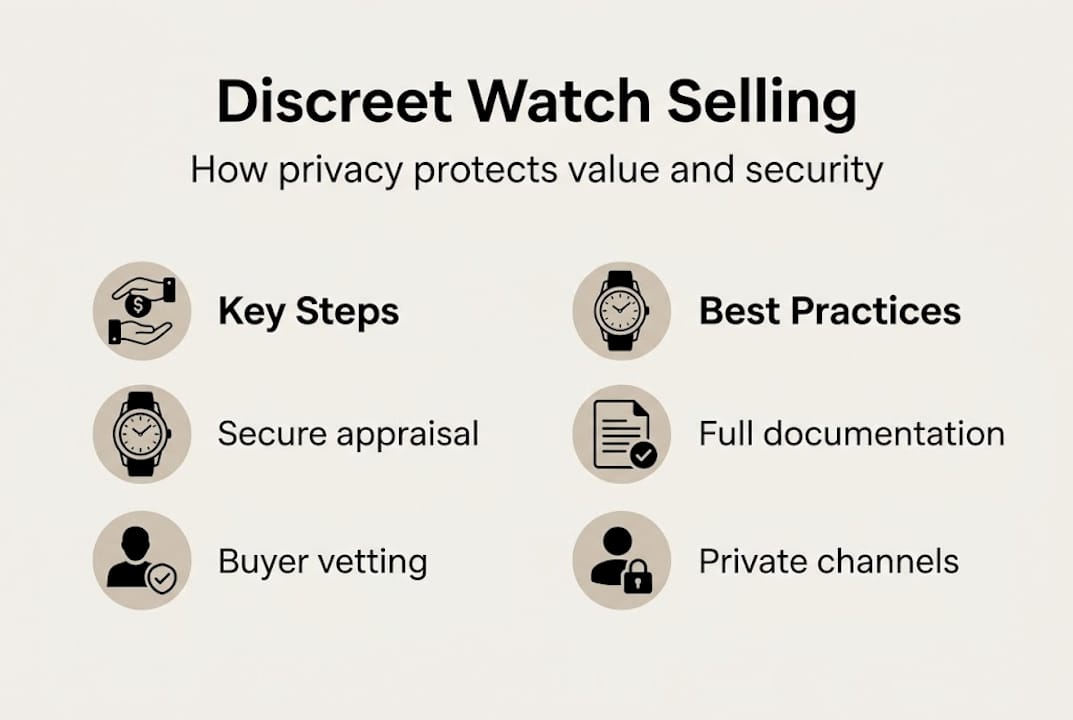
The importance of documentation cannot be overstated. Even in a fully private sale, both parties benefit from a paper trail that confirms the transaction and satisfies any regulatory requirements. A specialist dealer will handle this as standard practice.
Valuing your timepiece and maximising security
Knowing what your watch is worth before you sell is not optional — it is the foundation of any successful transaction. The challenge in discreet selling is obtaining an accurate valuation without exposing the watch or your intentions to the wider market.
Secure appraisals are conducted privately, often at the dealer’s secure premises or via an insured delivery arrangement. Reputable appraisers sign confidentiality agreements as a matter of course. You should never submit photographs or details to public valuation forums, where your watch and its condition become visible to anyone browsing.
The key factors that determine a watch’s value are:
Valuation factor | Impact on value | Notes |
Brand and model | Very high | Rolex, Patek Philippe, Audemars Piguet command premiums |
Provenance and history | High | Notable previous ownership adds significant value |
Condition | High | Original, unpolished cases retain more collector appeal |
Box and papers | Significant | Full set can add 20 to 40% in some cases |
Service history | Moderate | Documented servicing by authorised centres is preferred |
Rarity and edition | Very high | Limited runs and discontinued references are most sought-after |
Pro Tip: Before any appraisal, gather all documentation you have, including the original purchase receipt, service records, and any correspondence with the manufacturer. A well-documented watch is a stronger watch at negotiation.
Professional dealers employ secure valuation and sales processes to prevent data leakage or theft. This includes encrypted communications, secure physical storage of the watch during the sales process, and verified bank transfers rather than cash or informal payment methods.
For best practice for watch selling, the chain of custody matters from the moment you hand the watch over. Insist on receipts, photograph the watch in its current condition before transfer, and confirm the insurance arrangements covering it during any transit or holding period.
The hidden value of discretion in today’s luxury watch market
There is a tendency among newer collectors to equate maximum exposure with maximum results. List it everywhere, photograph it extensively, and wait for the best offer to emerge. In reality, this approach works against you in the luxury segment.
The watch market has grown significantly more sophisticated. Fraudsters are more organised, and the risks of public listings are well-documented. Experienced investors have moved away from consumer platforms and towards private frameworks precisely because the outcomes are more reliable. Well-executed private sales are linked to stronger outcomes for buyers and sellers alike.
What the smart money recognises is this: discretion is not secrecy born of suspicion. It is professionalism applied to an asset class that demands it. The red flags are easy to spot once you know them. Unsolicited offers via social media, buyers who pressure you to bypass standard checks, and platforms that offer no identity verification are all indicators that the transaction is not structured in your favour.
The collectors and investors who consistently achieve strong results treat their private watch trading decisions the same way they treat any other serious financial transaction: with structure, due diligence, and the support of experienced professionals. That mindset is what separates one-off sellers from those who build lasting, profitable relationships in the watch market.
Take the next step in discreet watch selling
If you have reached this point, you already understand that a well-managed, private sale is the most intelligent route for a serious watch owner. The next step is finding the right partner to make it happen.
At Horology Kings, we specialise in exactly this. Based in Hertfordshire, we work with collectors and investors across the UK to facilitate secure, confidential watch sales with complete professionalism. Every transaction is handled with formal documentation, verified payments, and absolute discretion. Whether you want to sell, or you are looking to source a watch discreetly, our expert team is ready to assist. We also provide luxury watch servicing to ensure your timepiece is presented at its finest before any sale.
Frequently asked questions
Is discreet watch selling legal in the UK?
Yes, discreet watch selling is fully legal in the UK, provided all parties comply with anti-money laundering regulations. Luxury watch transactions must meet regulatory standards and retain appropriate documentation, even when conducted privately.
How do I ensure my personal details remain private?
Work with reputable specialist dealers who use confidentiality agreements and encrypted communications throughout every stage. Confidentiality is a core part of how trusted specialist dealers structure their processes.
Will selling discreetly affect my watch’s value?
In most cases, it improves the outcome. Private transactions can help maintain or enhance market value for rare and high-end watches by targeting genuinely motivated buyers.
Do I need to prepare any documents for a discreet sale?
Yes. Prepare proof of purchase, service records, and authentication papers before any appraisal or sale begins. Documentation is crucial for high-value watch sales, even when the sale is conducted confidentially.
What types of watches benefit most from discreet selling?
Limited edition pieces, high-value references, and provenance-rich timepieces benefit the most. Collectors prefer discretion for rare and investment-grade watches to protect both value and personal security.
Recommended
Comments